Why do professional telescopes benefit from being situated on mountaintop observatories regarding viewing conditions?
Answer
To gain a cleaner, less extincted view above dense, turbulent air layers
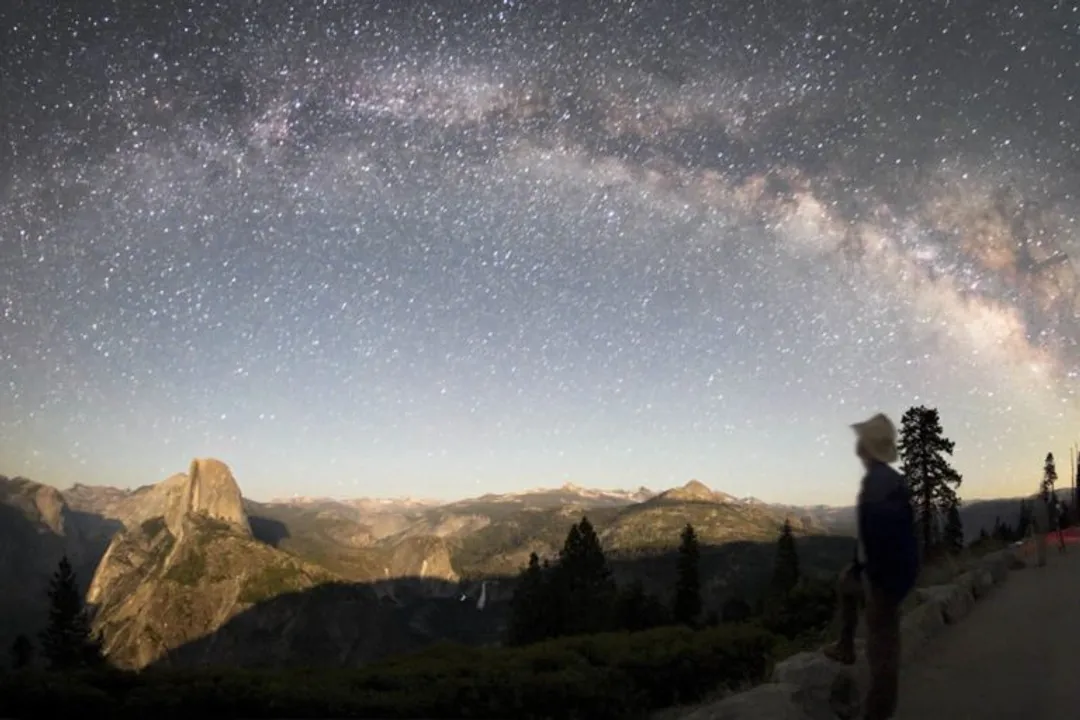
Mountaintop observatories are strategically placed high above the ground primarily to place the telescope above a substantial portion of the Earth's dense, turbulent atmosphere. By achieving this altitude, the telescope minimizes exposure to the thickest air layers where extinction and atmospheric turbulence (seeing) are most pronounced. This positioning grants a cleaner optical path, allowing astronomers to gather light with less dimming and distortion, which is crucial for resolving the true density of the star field.
#Videos
Why You Can't See Stars in Space - YouTube
Related Questions
What fundamentally defines the boundary and existence of our Solar System?Which structure, theoretically encompassing icy bodies, extends the Sun's gravitational influence up to perhaps a light-year away?Which specific star system is identified as the nearest known stellar neighbor to the Sun?Which specific star holds the distinction of being the single closest known star to our Sun?How many miles equate to one light-year based on the distance light travels in one Earth year?What is the composition of the Alpha Centauri star system according to stellar designations?What is the name for the phenomenon where atmospheric path length dims stars near the horizon due to scattering?What factors primarily cause the scattering leading to Atmospheric Extinction when viewing stars near the horizon?Why do professional telescopes benefit from being situated on mountaintop observatories regarding viewing conditions?Traveling the distance from the Sun to Neptune, measured in light-years, equates to what fraction of the distance to the nearest star?