Why do all major planets orbit the Sun in nearly the same direction as the original nebula spun?
Answer
Because the disk was flattened by increasing rotational speed during collapse.
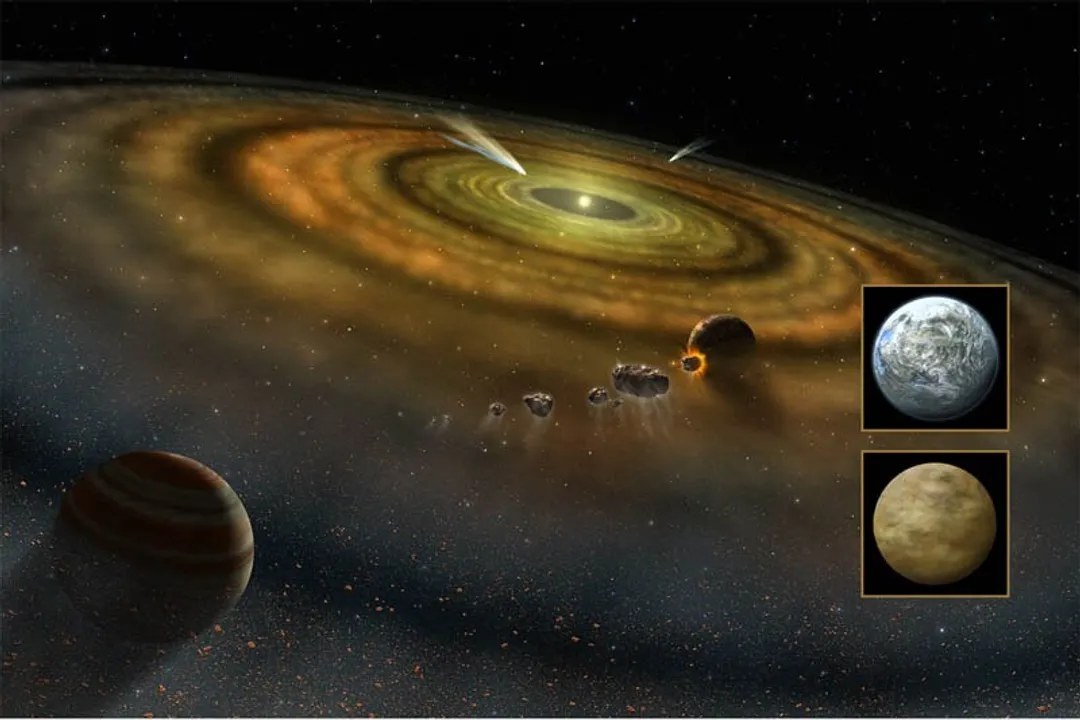
One of the key regularities explained by the nebular hypothesis is the uniformity of planetary motion. As the initial diffuse, rotating nebula contracted under gravity, the conservation of angular momentum dictated that its spin rate increased. This rapid spinning forced the cloud to flatten into a rotating accretion disk. Since the planets formed from the material within this flattened disk, their resulting orbital planes naturally align nearly coplanar with each other, and they all orbit in the direction of the original nebula's spin (counterclockwise when viewed from above the Sun's north pole).
Related Questions
Which individual formalized the nebular hypothesis around 1796 with a mathematically grounded mechanism?What event is suggested as a likely trigger for the initial contraction of the solar nebula?What major distribution puzzle challenged early nebular models regarding the Sun and planets?Which high melting point materials were primarily responsible for forming the inner terrestrial planets?Where did temperatures drop low enough for volatile compounds to condense into solid ice grains, enabling giant planet cores to grow rapidly?Why do all major planets orbit the Sun in nearly the same direction as the original nebula spun?What modern observation directly validates the existence of the protoplanetary structures predicted by the hypothesis?What was the core prediction of catastrophic models regarding the commonality of solar systems?What modern accretion disk scenario describes Jupiter migrating inward and then outward?What physical law dictates that the contracting solar nebula spins faster as its volume decreases?