Which high melting point materials were primarily responsible for forming the inner terrestrial planets?
Answer
Silicates and metals.
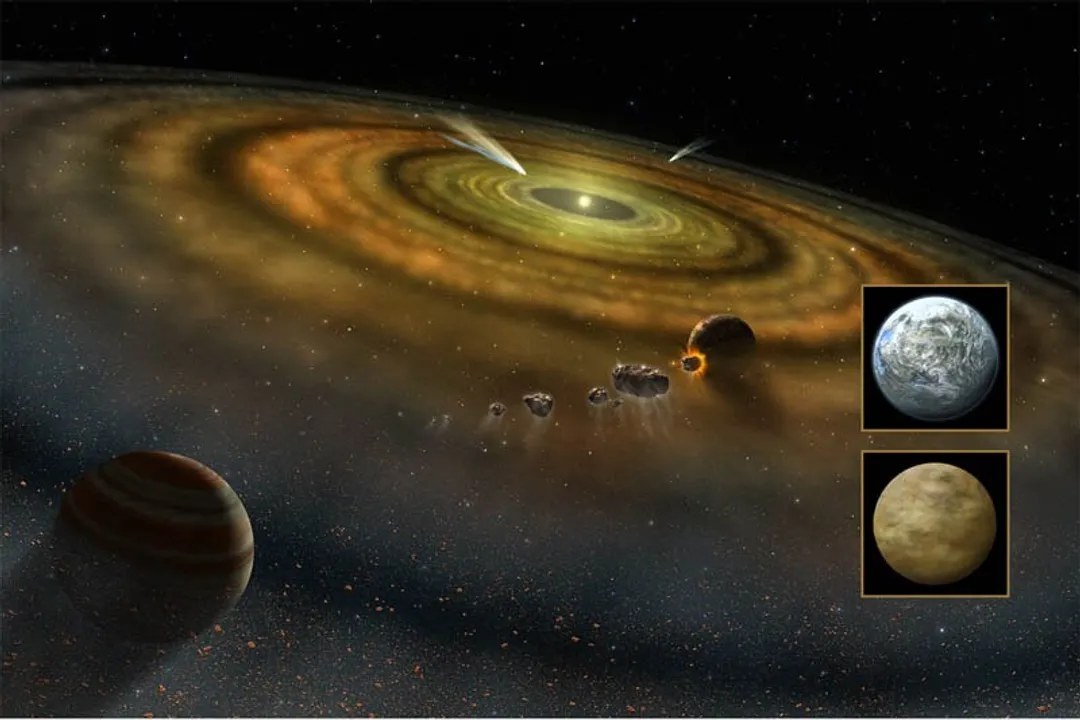
The formation pathway for the inner, rocky terrestrial planets was dictated by the intense heat near the newborn Sun. In this region of the protoplanetary disk, only materials capable of remaining solid at high temperatures could condense. Therefore, substances like silicates (minerals) and metals were the only components available to accrete, first forming small solid grains, then larger planetesimals, and eventually building up the dense, smaller worlds like Mercury, Venus, Earth, and Mars.
Related Questions
Which individual formalized the nebular hypothesis around 1796 with a mathematically grounded mechanism?What event is suggested as a likely trigger for the initial contraction of the solar nebula?What major distribution puzzle challenged early nebular models regarding the Sun and planets?Which high melting point materials were primarily responsible for forming the inner terrestrial planets?Where did temperatures drop low enough for volatile compounds to condense into solid ice grains, enabling giant planet cores to grow rapidly?Why do all major planets orbit the Sun in nearly the same direction as the original nebula spun?What modern observation directly validates the existence of the protoplanetary structures predicted by the hypothesis?What was the core prediction of catastrophic models regarding the commonality of solar systems?What modern accretion disk scenario describes Jupiter migrating inward and then outward?What physical law dictates that the contracting solar nebula spins faster as its volume decreases?