Which term describes very energetic supernovae, sometimes exceeding $10^{45}$ joules in kinetic energy release?
Answer
Hypernova.
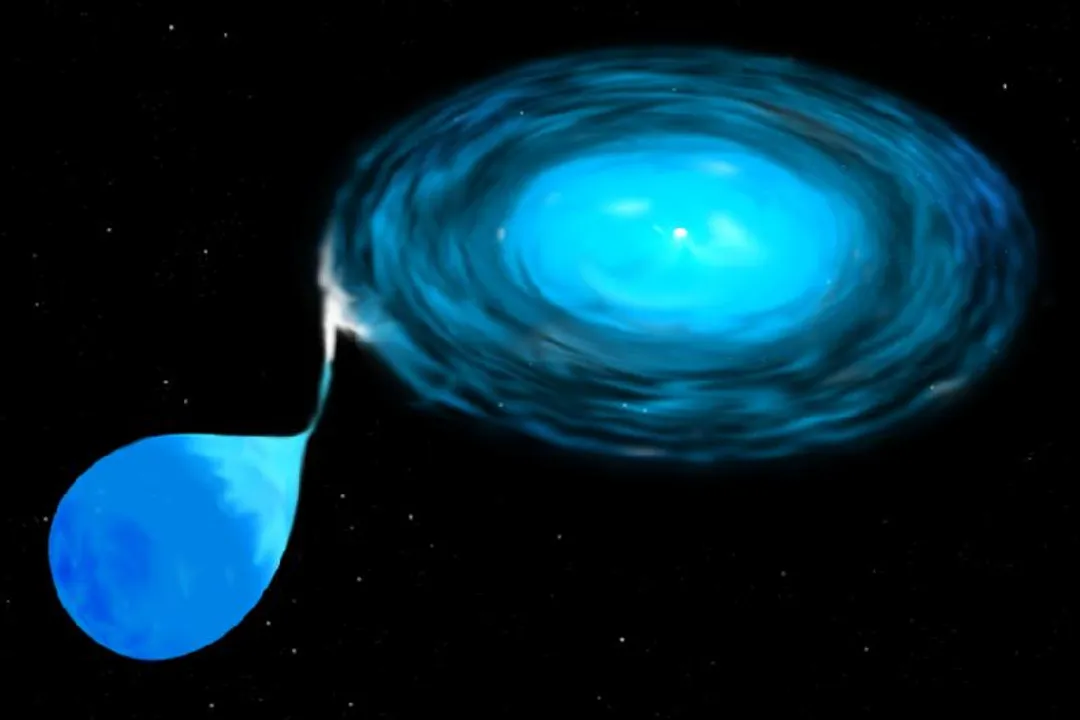
A hypernova is a descriptive term applied to certain extreme stellar explosions, usually associated with the core-collapse mechanism, that vastly exceed the energy output of typical supernovae like standard Type Ia or Type II events. While a typical supernova releases around $10^{44}$ joules, a hypernova is characterized by kinetic energy releases that can be ten to one hundred times greater, sometimes exceeding $10^{45}$ joules. These exceptionally powerful outbursts represent the most energetic explosions known to occur during the death of a single star and are often linked to the creation of long-duration gamma-ray bursts.
Related Questions
What crucial role do supernovae play in cosmic evolution?What spectral feature differentiates Type I from Type II supernovae?What mass threshold causes a white dwarf in a binary system to create a Type Ia supernova?Why are Type Ia supernovae valuable tools in cosmology?What mechanism characterizes a Type II supernova, often called a core-collapse supernova?What compact objects can result from the core collapse in a Type II supernova?What distinguishes a recurring nova from a terminal Type Ia supernova?Which term describes very energetic supernovae, sometimes exceeding $10^{45}$ joules in kinetic energy release?How is a kilonova distinct from a supernova event regarding its origin?What expanding structure is formed immediately after a supernova explosion?