What would a body found on the Moon after a century likely resemble?
Answer
A desiccated, freeze-dried mummy chemically altered by radiation.
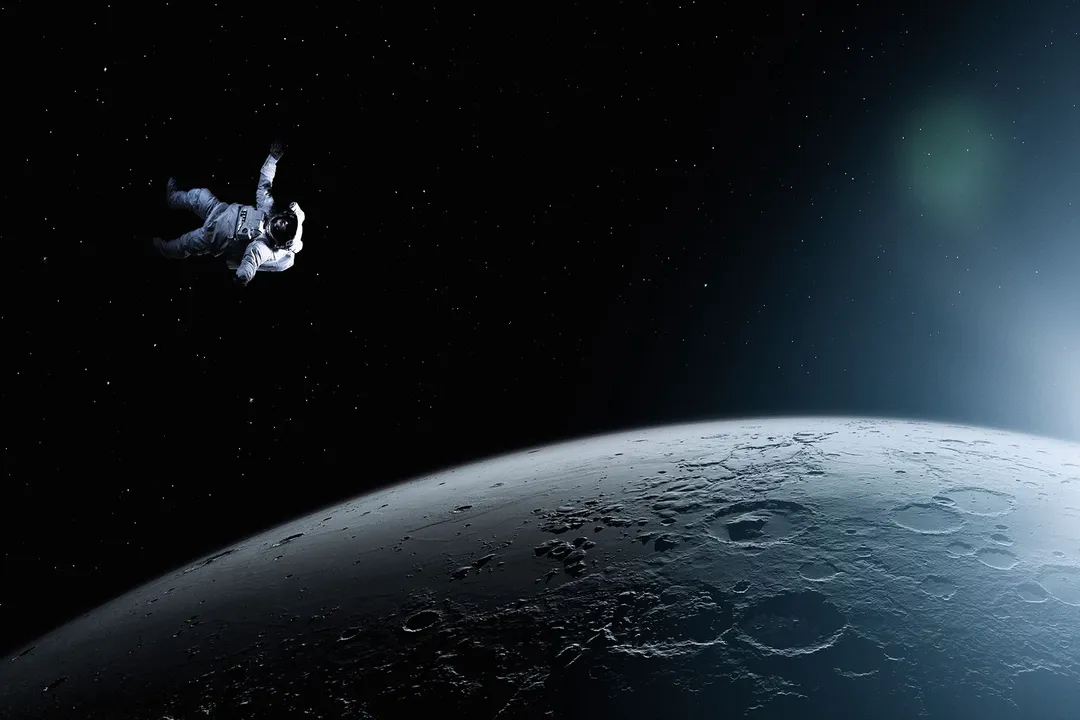
A body exposed on the airless surface of the Moon would undergo initial rapid freeze-drying due to vacuum exposure, halting bacterial decay. Over a century, the primary ongoing process would be chemical degradation caused by unfiltered solar UV radiation and cosmic rays attacking the organic structure. Therefore, the resulting remains would not resemble something that rotted; instead, they would be physically intact in overall form but drastically dehydrated and chemically altered, analogous to an ancient mummy preserved in extremely dry and cold terrestrial conditions.
Related Questions
What causes body fluids to boil due to ebullism in space vacuum?Why does typical putrefaction not occur on an unprotected body in space?What temporarily restrains the swelling caused by expanding gases and vaporizing fluids?What is the primary long-term destructive force acting on complex organic molecules in space?What would a body found on the Moon after a century likely resemble?What happens to an unprotected body exposed to direct sunlight in orbit?What dynamic defines the environment on the Moon concerning temperature for an exposed body?How does the very thin atmosphere of Mars marginally differ in its effect compared to the Moon's vacuum?What consequence arises from the significant loss of water mass due to vacuum exposure?What is the fundamental distinction between conventional rotting and breakdown in space?