What theory explains the formation of stars and planetary systems from nebulae?
Answer
Nebular Hypothesis
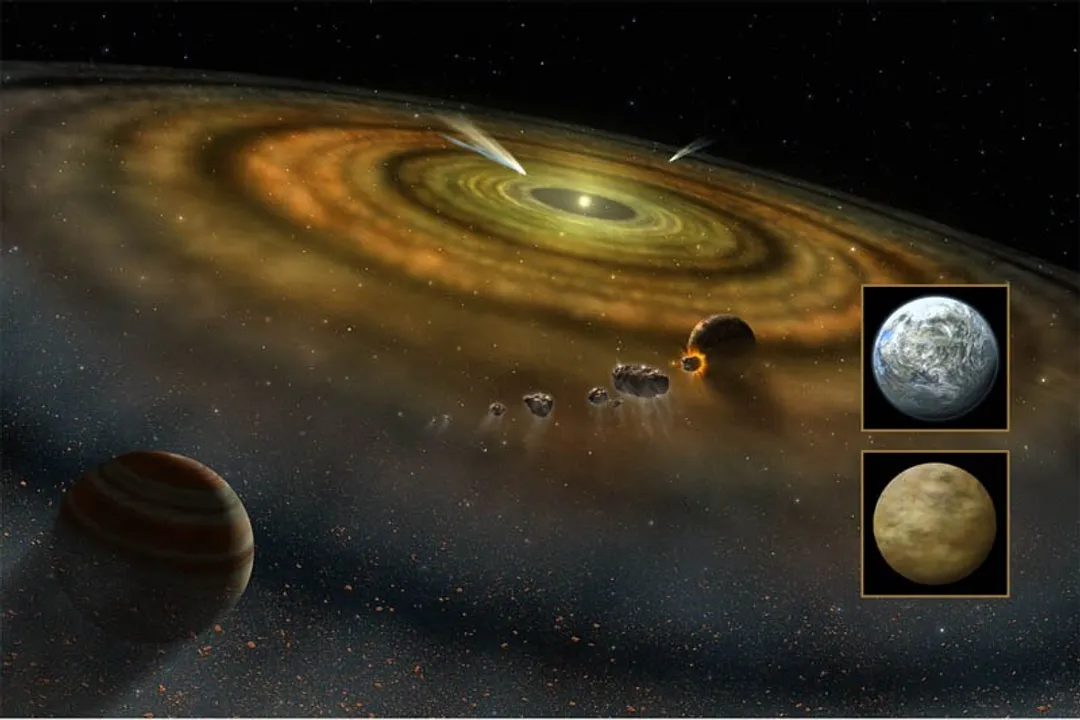
The comprehensive theory describing how a central star surrounded by a flattened disk of leftover material evolves into a full solar system is termed the Nebular Hypothesis. This concept posits that the entire process—starting from the collapse of a large, rotating cloud of gas and dust—is the universal mechanism for birthing stars and their attendant planetary bodies. The necessary angular momentum that prevents all material from falling onto the central star and ensures material orbits in a planar structure is provided by the initial spin of the nebula.
#Videos
What Causes A Nebula To Collapse? - Physics Frontier - YouTube
Related Questions
What gases primarily constitute a diffuse nebula prior to stellar birth?What external trigger can initiate the collapse of a stable nebula?What physical law dictates the increasing spin rate during cloud shrinkage?Which force acts outward, perpendicular to the rotational axis, causing cloud flattening?What is the fundamental name for the flattened structure orbiting the protostar?What theory explains the formation of stars and planetary systems from nebulae?How does the protostar core generate intense heat before achieving stellar status?What defines the boundary where volatiles condense into solid ice grains in the disk?What kind of planets typically form close to the hot protostar core?What happens if an initial nebula fragment is part of a large cluster?