What subsequent process must the protoplanet model invoke for Hot Jupiters?
Substantial orbital migration to move planets inward.
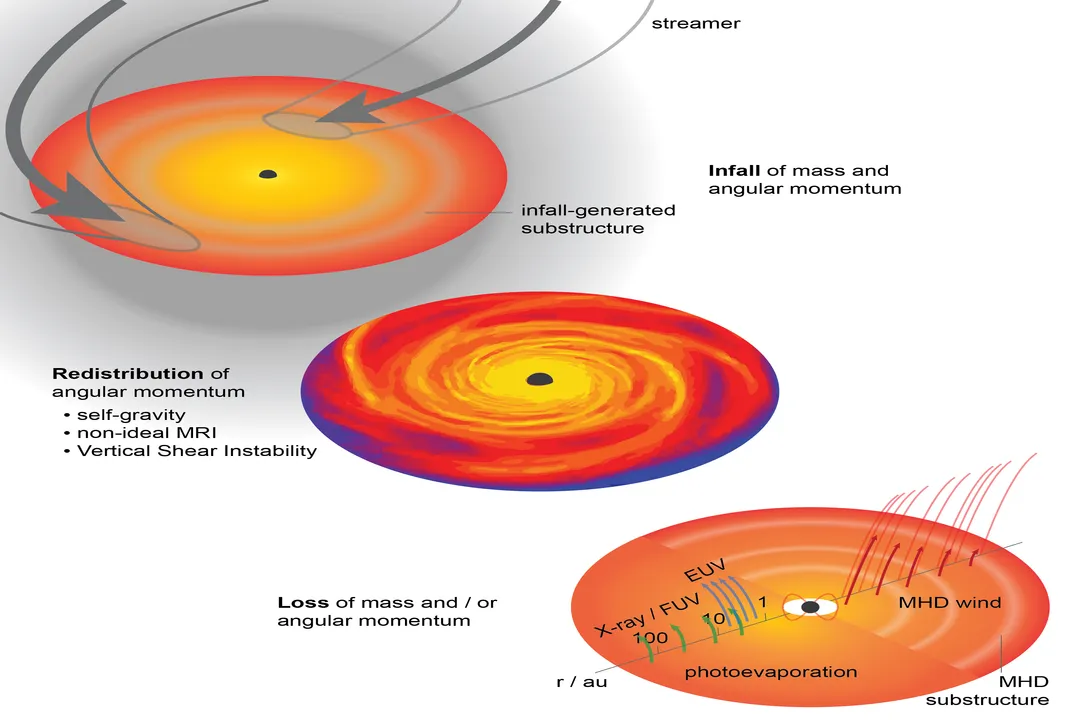
The existence of Hot Jupiters—massive, Jupiter-sized planets orbiting extremely close to their stars—poses a significant architectural challenge to the protoplanet theory, assuming standard *in situ* formation within an orderly disk structure. The core accretion model struggles to explain how such large masses accumulate so near the star from the initial disk composition. Therefore, to reconcile this observation with the theory, scientists must rely heavily on post-formation orbital evolution processes. Specifically, the theory necessitates invoking substantial planet migration, driven by interactions with the surrounding gas disk (Type I or Type II migration), to transport the planets from their presumed formation zones further out to their observed tight, inner orbits. This reliance on migration complicates the narrative significantly.