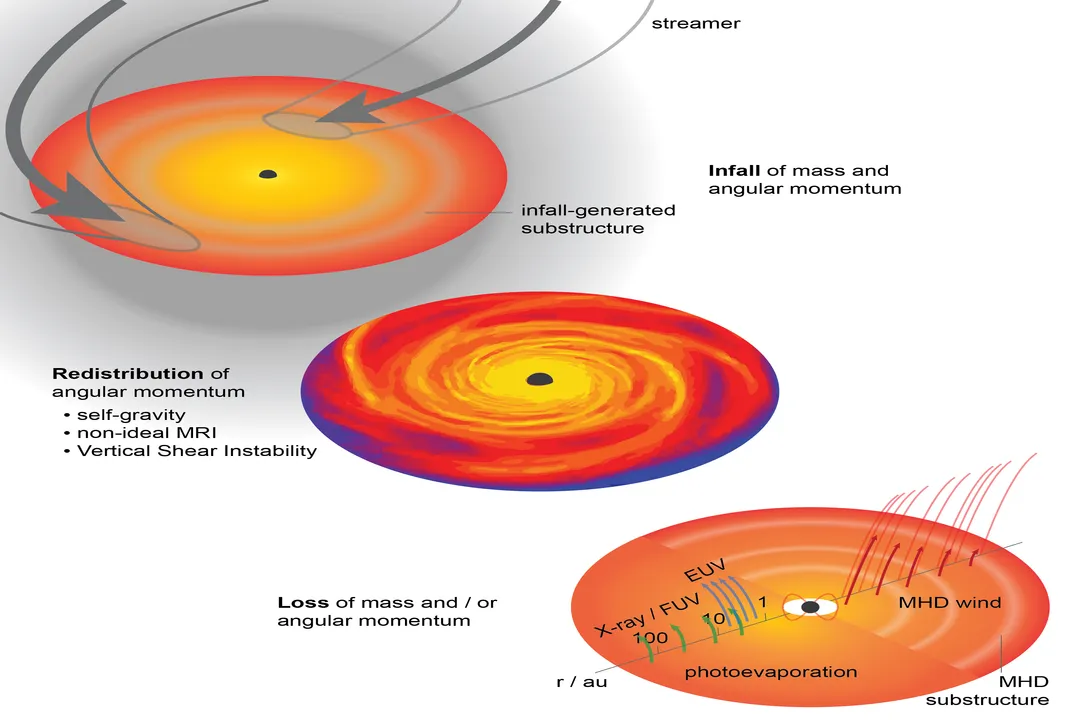
How might dominant streaming instability slow terrestrial planet formation timescales?
Larger initial planetesimals cause higher velocity dispersion and less efficient accretion.
While the streaming instability solves the pebble barrier by creating large planetesimals quickly, this rapid success can have a paradoxical negative consequence for the subsequent stage of building terrestrial planets. If planetesimals are born very large (hundreds of kilometers), they experience less aerodynamic drag from the disk material compared to smaller ones. Furthermore, this large initial size leads to higher relative velocities between these massive bodies due to scattering dynamics. This increased velocity dispersion, rather than speeding up the final accretion phase onto protoplanets, can actually reduce the efficiency of the collision and sticking process, potentially increasing the overall time required for Earth-sized worlds to fully assemble.