What are the disadvantages of the Protoplanet theory?
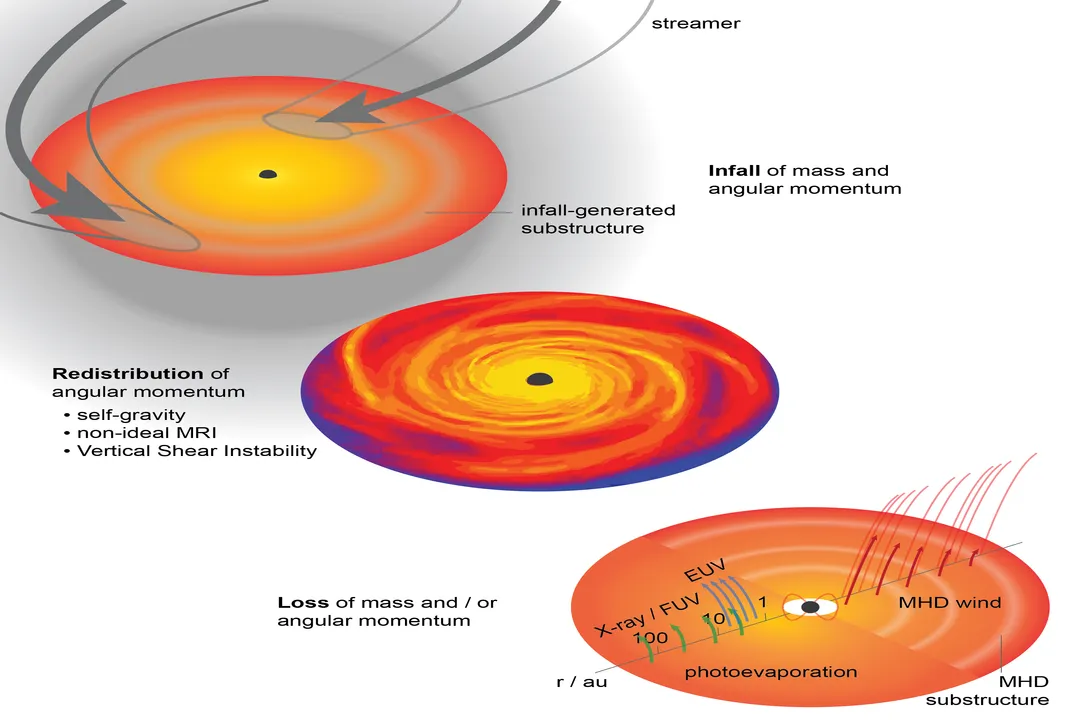
The reigning view of how planetary systems arise, often termed the protoplanet or core accretion theory, is a bottom-up process, tracing the origins of rocky and gaseous worlds back to the collision of microscopic dust grains within gas-rich protoplanetary disks. While this framework has successfully outlined the main stages—grain growth, planetesimal formation, core growth, and atmosphere accretion—it is far from a complete story. Modern observational astronomy, particularly with instruments like ALMA, reveals complexities that the foundational models struggle to resolve, pointing toward significant disadvantages or, at the very least, profound areas of incompleteness in the current understanding. A crucial initial hurdle is the historical reliance on our own Solar System as the sole template; for a long time, all theory was derived from a single data point, which naturally restricts the scope of what is considered "normal" or "possible".
# System Bias
The very origin of the hypothesis is rooted in a limited dataset. Early models were built entirely around the structure and composition of the Sun’s planetary neighbors. While the discovery of thousands of exoplanets has since demonstrated a far wider range of architectures, the fundamental framework was established before this diversity was known. This initial constraint means that features common in our Solar System—like the general separation between small, rocky worlds and large, icy/gaseous worlds—were perhaps overemphasized as universal rules, making it difficult to account for systems that deviate significantly.
# Giant Planet Timing
One of the most significant conceptual challenges arises when applying the core accretion part of the protoplanet theory to the formation of giant planets, like Jupiter or Saturn. The process posits that a solid core must first form, massive enough to then gravitationally capture a substantial gas envelope before the protoplanetary disk dissipates. The major disadvantage here is the timescale. Theory suggests that the time required for core accretion to build a body as massive as Jupiter, solely through the accumulation of planetesimals, is simply too long—it would take much longer than the typical observed lifetime of the gas disk, which is often cited as around 3 million years. This failure to form gas giants quickly enough in situ provides strong motivation for alternative scenarios, such as disk fragmentation, which can form massive clumps much faster.
# Hot Jupiter Puzzle
Related to the timing issue is the challenge of explaining the architecture of systems beyond our own, specifically the existence of Hot Jupiters—massive, Jupiter-like worlds orbiting extremely close to their host stars. If planets formed in situ from an initial, orderly protoplanetary disk, one would not expect to find such large masses in tight, inner orbits. The protoplanet model, therefore, must rely heavily on subsequent orbital evolution to explain these observations. The need to invoke substantial planet migration to move planets inward drastically complicates the narrative, suggesting the initial, local formation process is not the final arbiter of system structure, but rather the first step in a longer, more chaotic rearrangement phase. If in-situ formation were universally efficient and orderly, the invocation of large-scale migration would be less necessary.
# Initial Growth Limits
The bottom-up approach, where kilometer-sized planetesimals aggregate into protoplanets, is fraught with physical hurdles related to the intermediate-sized solids, often called "pebbles".
The traditional idea of simply letting these pebbles collide and stick until they reach planetesimal sizes faces at least two major roadblocks:
- Fragmentation Barrier: Laboratory experiments show that silicate aggregates can only withstand low collision velocities, typically less than , before they shatter. In a turbulent disk, collision speeds quickly exceed this threshold, preventing large, solid bodies from forming through simple coagulation.
- Radial Drift/The Meter Barrier: Even if particles could somehow grow past the fragmentation limit, they are aerodynamically coupled to the surrounding gas, meaning they drift inward toward the star over surprisingly short timescales. Particles that are meter-sized, or even millimeter-sized (which are expected to form easily), can drift across significant portions of the disk within a few thousand years if their stopping time is comparable to the orbital frequency (i.e., Stokes number ). This rapid inward movement leads to an effective "meter-sized barrier," as particles are either destroyed, fall into the star, or concentrate in ways that might not immediately favor the growth of large planetesimals through simple accretion.
The leading theoretical escape route from this barrier is the streaming instability, which causes localized clumping of dust that can gravitationally collapse into planetesimals faster than they drift away. However, this reliance on a specific instability introduces its own theoretical dependency. The efficiency of this instability is sensitive to the dust-to-gas ratio and the particle size distribution (). Furthermore, simulations suggest that even if the streaming instability is successful, it produces a top-heavy initial mass function, meaning most of the mass ends up in very large planetesimals (hundreds of kilometers) very quickly.
A critical, often under-discussed consequence of this streaming instability dominance is a potential slowdown in the subsequent, mass-building phase for terrestrial planets. If planetesimals are born large, they experience less drag and higher relative velocities due to scattering. This increased velocity dispersion, instead of speeding up the final assembly, might actually reduce the efficiency of planetesimal accretion onto protoplanets, counter-intuitively leading to longer overall formation timescales for Earth-sized worlds than if the initial planetesimals had been smaller. This suggests that the "solution" to the pebble barrier might create a bottleneck in the next accretion stage.
# Angular Momentum Problem
While the protoplanet hypothesis is an evolution of the older Nebular Hypothesis, it inherits one of the older theory’s most fundamental unsolved issues: the distribution of angular momentum. In the Solar System, the Sun contains about $99%$ of the total mass, yet the planets hold about $99%$ of the total angular momentum. The theory attempts to correct this imbalance by invoking magnetic braking, where the solar wind interacts with the star's magnetic field, slowing the Sun's rotation and transferring angular momentum outward to the disk (and subsequently the planets). However, this mechanism remains the "only remaining problem" in this context, suggesting that the physics governing this transfer and its magnitude are not yet modeled with complete confidence, leaving a fundamental observational constraint only tenuously explained.
# Migration Dependency
The theory struggles to remain entirely in situ. The observation of diverse exoplanet systems, particularly those with close-in planets or non-coplanar orbits, forces the model to rely on processes that occur after the initial cores are assembled, such as Type I or Type II migration due to planet-disk interaction. In many models, the migration timescale is comparable to or shorter than the gas disk's lifetime.
The very necessity of post-formation migration to explain observed architectures like Hot Jupiters fundamentally weakens the predictive power of the simple, local formation aspect of the protoplanet theory. A theory where most of the planet mass forms in one location and then must be violently redistributed to match observations is less parsimonious than one predicting the final configuration directly. This forces the overall model to become a sequence of two distinct, interacting regimes—core growth followed by disk-driven migration—where the efficiency and outcome of the second stage are highly dependent on uncertain disk viscosity () parameters and gravitational torques.
# Structure Uncertainty
Finally, the standard model often assumes planets—even as they grow—maintain a near-spherical shape, consistent with the end state of terrestrial planet formation via accretion. However, recent high-fidelity simulations of planets forming via the competing disk instability mechanism have shown that these young, massive protoplanets are not spheres, but rather oblate spheroids—flattened, like "Smarties" candies. The authors of this work suggest that the 3D structure of forming planets affects their observed properties and how they accrete material (faster from the poles). While this observation pertains directly to the instability pathway, it highlights that even the resulting shape of the initial object is a complex, non-spherical outcome dictated by the disk environment, which may not be fully captured by simpler core-accretion models that treat the growing body as a perfect sphere from the outset.
# Unresolved Theoretical Nuances
Beyond these large-scale explanatory hurdles, the contemporary standard model itself is characterized by significant internal uncertainties, which are themselves disadvantages for its application as a definitive theory. Scientists still wrestle with:
- The Pebble/Planetesimal Balance: Determining the tipping point—what fraction of solids goes into forming planetesimals versus what fraction is immediately available for pebble accretion by existing cores—remains an open question. Pebbles are a consumable resource; their fate dictates whether the core accretion pathway can proceed efficiently enough.
- Migration Quantification: The rates for gas disk migration, while theoretically calculable, carry a large degree of uncertainty that varies with planet mass and disk structure. Removing this uncertainty is a major goal, as the migration rate dictates whether planets stay near their birth location or move significantly.
- Dominant Disk Physics: It is not definitively settled whether disk evolution and angular momentum transport are dominated by turbulent processes (like the Magnetorotational Instability) or by disk winds. Since planet migration torques depend heavily on the disk's internal structure and viscosity (), the correct physical driver of disk evolution directly impacts migration predictions.
In summary, while the protoplanet hypothesis provides a plausible sequence of events, its disadvantages lie in its reliance on unconfirmed mechanisms (like magnetic braking for angular momentum), its difficulty in explaining observed non-Solar System planets (like Hot Jupiters without resorting to migration), and fundamental physical barriers (fragmentation and drift) that require invoking highly specific, complex instability mechanisms (like the streaming instability) to bridge the gap between microscopic dust and macroscopic planetesimals.
Related Questions
#Citations
What are the flaws of the protoplanet hypothesis? - Reddit
Some Young Planets Are Flattened Smarties, not Spheres.
Planet formation theory: an overview - arXiv
Origin of the Solar System - University of Oregon