What structure do matter distributions form on scales smaller than about 300 million light-years?
Answer
Cosmic webs composed of filaments, walls, and enormous voids.
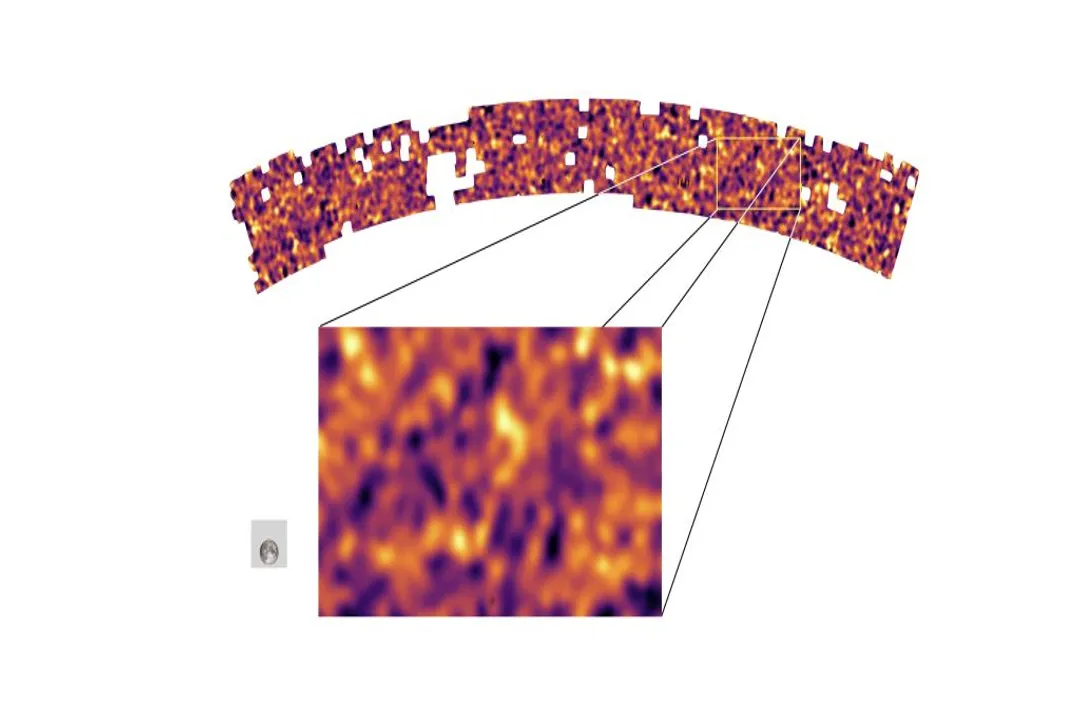
While radiation (CMB) is nearly perfectly uniform on large scales, the distribution of matter on smaller scales exhibits significant lumpiness. On scales under approximately 300 million light-years, matter organizes itself into complex structures known as cosmic webs. These webs are characterized by filaments, which are long, thin alignments of galaxy clusters, and voids, which are expansive regions largely empty of galaxies. This non-uniform clumping is precisely why the universe is only considered homogeneous (the same everywhere) when averaging over volumes large enough to smooth out these specific features.
#Videos
why does the universe look the same in all directions? - YouTube
Related Questions
What characteristic describes the universe appearing remarkably the same in every direction on the largest scales?What is the measured temperature of the Cosmic Microwave Background (CMB) radiation across the observable sky?What causes the observed dipole anisotropy in the CMB temperature measurements?What structure do matter distributions form on scales smaller than about 300 million light-years?How old was the universe when the radiation that forms the Cosmic Microwave Background (CMB) was emitted?What foundational assumption does the standard cosmological model rely upon regarding the largest scales?What is the role of the minuscule temperature variations, known as anisotropies, in the CMB?What observation method can scientists use to test for directional preferences in the expansion rate across different lines of sight?What scale defines the threshold above which the universe settles into its smooth, uniform appearance?What concept describes the physical requirement that the laws governing cosmic evolution remain consistent over vast periods of time?