What role is liquid water believed to have played during Mars's ancient epoch regarding iron oxidation?
Answer
Crucial ingredient interacting with iron-rich rocks
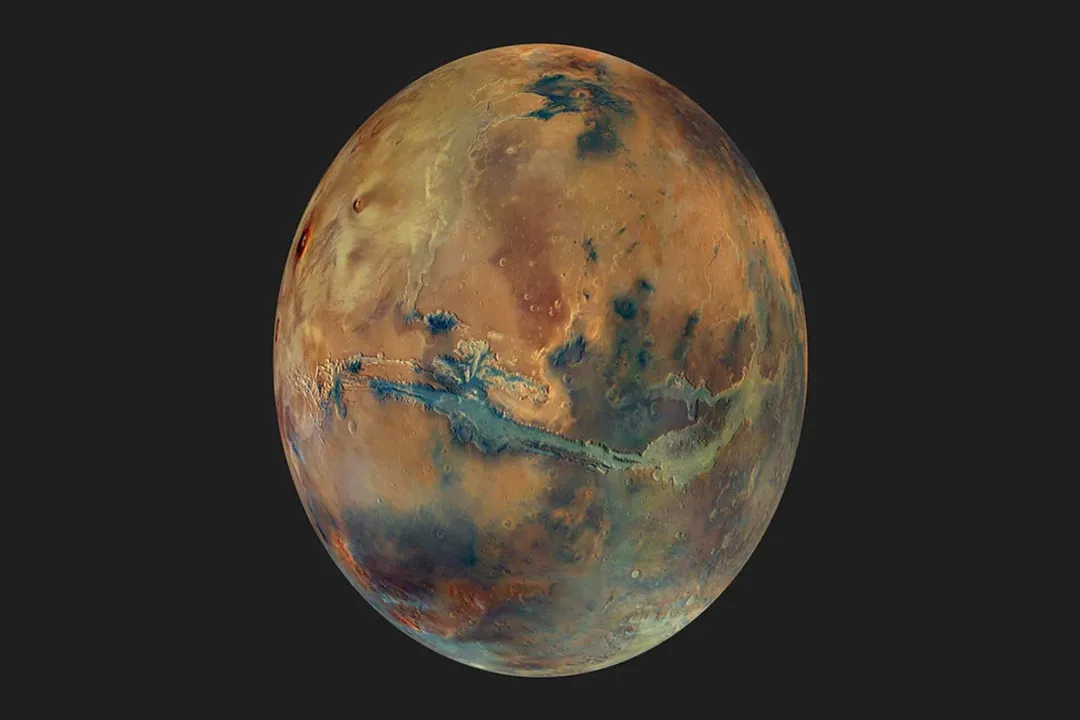
The most straightforward explanation for the massive scale of iron oxidation observed on Mars invokes the presence of liquid water billions of years ago when the planet was hypothesized to be warmer and wetter with a thicker atmosphere. Liquid water is essential for the standard terrestrial oxidation process where iron corrodes. During this early epoch, as liquid water interacted directly with the abundant iron-rich rocks, the iron would have leached out and oxidized rapidly. This large-scale, early rusting event likely established the bulk of the iron oxide minerals that form the current Martian regolith.
#Videos
New study explains why Mars is RED - YouTube
Related Questions
What chemical signature dominates the Martian surface, causing the ruddy glow?Which specific iron oxide provides the deep, characteristic red tint to Mars?What magnetic property characterizes stable, fully oxidized hematite ($ ext{Fe}_2 ext{O}_3$) on the Martian surface?What role is liquid water believed to have played during Mars's ancient epoch regarding iron oxidation?How do modern atmospheric processes continue surface rusting without significant standing liquid water?Why is atmospheric oxidation slower on Earth compared to Mars regarding surface iron exposure?Which mineral is noted spectrally as a less weathered or intermediate product compared to hematite?What does the surface coverage of non-magnetic hematite signify about the crustal iron inventory?How do Martian dust storms mechanically contribute to maintaining the oxidized state of the surface material?Which state of iron, associated with meteorites or the core, is described as being strongly ferromagnetic?What contrast exists between the Martian crustal inventory and the potential iron state in the core?