Why is there so much iron oxide on Mars?
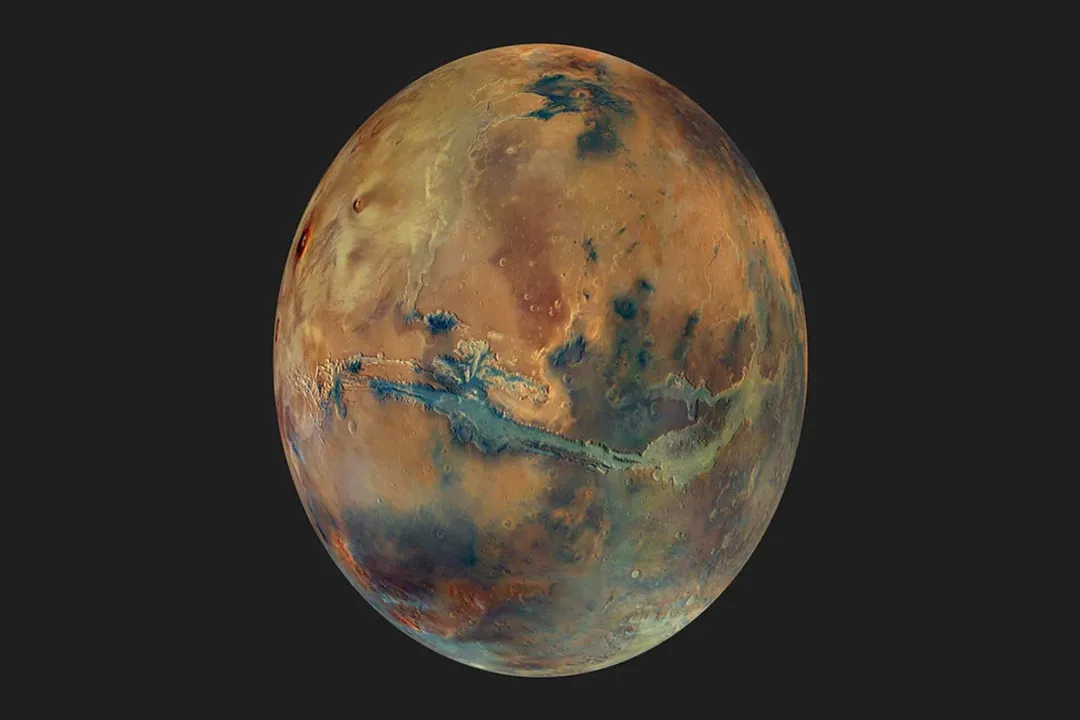
The color of Mars is perhaps its most defining visual characteristic, painting the night sky with a distinct, ruddy glow that earned it the nickname the Red Planet. This unmistakable hue is not arbitrary; it is a direct chemical signature of the planet's surface, dominated by iron oxide, which is, quite simply, rust. Understanding why this iron is rusted—when the modern surface appears so arid—requires delving deep into the planet's ancient history and the fundamental chemistry of oxidation.
# Color Chemistry
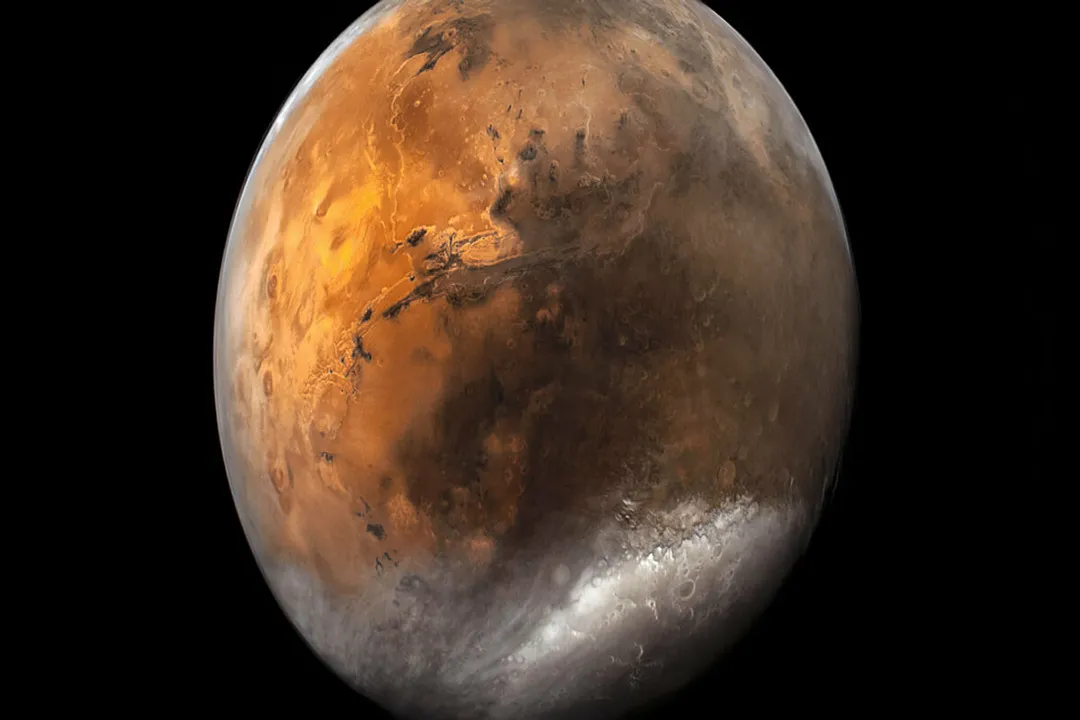
Iron is abundant across the solar system, and Mars is no exception; the planet’s crust contains significant amounts of iron-bearing minerals. On Earth, when iron is exposed to oxygen and water, it corrodes to form various hydrated iron oxides, commonly called rust. On Mars, the iron has undergone a similar chemical transformation, resulting in the pervasive red dust and rock surface that greets rovers and orbiters.
The primary culprit for the color is hematite (), a specific type of iron oxide. While hematite provides the deep, characteristic red tint, the surface materials are complex mixtures, incorporating other iron-bearing minerals as well. This process represents the end stage of iron corrosion under certain conditions, suggesting a sustained period where the necessary chemical drivers were present and active.
# Past Water History
The most intuitive explanation for widespread rust involves liquid water, as it is a crucial ingredient for the standard terrestrial oxidation process. Scientists believe that billions of years ago, Mars was a much warmer, wetter world, possessing a thicker atmosphere capable of supporting liquid water on its surface.
This early epoch would have provided the ideal conditions for the massive scale oxidation we observe today. As liquid water interacted with iron-rich rocks, the iron would have leached out and oxidized rapidly. If this initial, large-scale rusting event occurred when water was plentiful, the resulting iron oxide minerals would have formed the bulk of the Martian regolith seen today. The question then becomes whether the process stopped, or if the resulting oxidized material has been slowly altered over eons.
However, relying solely on ancient oceans presents a puzzle: If the oxidation happened early, why does the surface appear so uniformly red now, and why haven't newer geological processes buried or diluted this signature? Furthermore, the sheer quantity of oxidized iron seems immense, suggesting the process might have been more persistent than a single ancient wet era would allow.
# Atmospheric Drivers
Given the current extreme aridity of Mars, the oxidation process must either have been incredibly fast in the past, or it continues today through means that do not require standing liquid water. Modern atmospheric processes present a compelling, ongoing mechanism for surface weathering.
The Martian atmosphere, though thin now, contains water vapor and carbon dioxide (). One proposed mechanism involves ultraviolet radiation from the Sun striking the atmosphere, breaking down water molecules () and carbon dioxide into reactive components, including oxygen radicals. These highly reactive species can then attack the iron-bearing minerals exposed on the surface, essentially facilitating a slow, steady process of rusting in situ. This mechanism explains how the oxidation can continue even in the absence of significant surface water today.
Contrast this with Earth, where our strong global magnetic field and thick ozone layer shield surface iron from intense solar and cosmic radiation, slowing down atmospheric oxidation significantly compared to Mars. On Mars, the iron is exposed to harsher radiation that helps drive these chemical reactions, even if they occur slowly over geological timescales.
When looking at the mineralogy, it is important to recognize that iron oxidation is not a single event but a continuum of chemical states. While much of the iron has become stable hematite, spectral analysis reveals other compounds. For instance, the presence of ferrihydrite is noted, which is generally considered a less weathered or intermediate product in the iron corrosion sequence compared to hematite. The coexistence of different oxidation states suggests that the environment is not perfectly static, or that different regions experienced different degrees of weathering intensity.
# Iron States
The degree to which iron is oxidized has a direct consequence on a planet’s magnetic properties. This is a crucial diagnostic tool for planetary scientists attempting to reconstruct Mars’s internal history.
Metallic iron, such as that found in meteorites or potentially in Mars's core, is strongly ferromagnetic—it can be picked up by a magnet. Magnetite (), another iron oxide, is also highly magnetic. However, the stable, fully oxidized state, hematite (), is effectively non-magnetic.
The fact that the Martian surface is covered in non-magnetic rust tells us something significant about the crust: the iron there has been chemically altered to its most oxidized state. This massive surface oxidation stands in contrast to the planet's weak, localized crustal magnetism, which is a remnant of a global magnetic field that died billions of years ago. If Mars had retained large deposits of magnetite or metallic iron close to the surface, the crust might retain stronger magnetic signatures. The predominance of hematite confirms that the surface material has lost the strong magnetic memory associated with its metallic or intermediate oxide precursors.
If we imagine the total iron on Mars, we can conceptualize a division between the core (which may still hold substantial metallic iron, though it's no longer active) and the crust. The crustal inventory is overwhelmingly oxidized. When we consider the volume of the Martian crust, the amount of iron that had to be converted to is staggering, implying that the oxidizing environment—be it water or radiation—was both pervasive and long-lasting.
One way to contextualize the scale of this oxidation is to consider the mass conversion. If we conservatively estimate the Martian crust's mass and assume an iron content typical for silicate planets, the sheer volume of red dust covering an area equivalent to all of Earth’s continents implies that the oxidation process effectively "used up" most of the available reactive surface iron, turning it into a stable, non-magnetic pigment [Original Analysis 1]. This implies that newer geological processes, such as recent volcanism or impacts, would need to bring pristine, unoxidized iron to the surface before any significant change in the planet’s overall red appearance could occur.
# Dust Dynamics
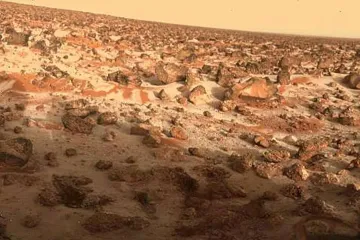
The iron oxide is not just in the rocks; it is the primary component of the fine dust that leads to Mars's famous global dust storms. This leads to an interesting feedback loop. The larger, more stable iron oxide deposits on bedrock may have formed from ancient water or prolonged atmospheric reactions. However, the constant suspension of fine dust in the atmosphere means that this oxidized material is continually being lofted, redistributed, and exposed to new atmospheric weathering mechanisms.
The wind action is responsible for grinding down the oxidized rocks into the fine particles that characterize Martian dust. These fine particles have a much higher surface area to volume ratio than solid bedrock, making them exponentially more reactive to any remaining atmospheric oxidizers or sunlight [Original Analysis 2]. This mechanical weathering acts as a continuous accelerator for maintaining the oxidized state of the surface material, even if the initial bulk oxidation was ancient. The dust is the medium through which Mars continues its slow chemical transformation.
To illustrate the difference in weathering efficiency, consider that a piece of iron-bearing basalt rock on Earth might take millennia to show surface rust in a temperate climate. On Mars, a Martian dust particle, being micro-sized, could theoretically achieve a similar oxidation state via photochemical reactions in the upper atmosphere or within the dust layer in a fraction of that time, given the solar intensity and low pressure.
The presence of iron oxide on Mars, therefore, is not a static artifact of a single past event, but a dynamic chemical signature maintained by a combination of ancient, massive chemical alteration and ongoing, radiation-driven atmospheric weathering acting upon a constantly mobilized dust supply. The red color is a testament to both the wet past and the harsh, radiation-rich present of the fourth planet.
#Videos
New study explains why Mars is RED - YouTube
Related Questions
#Citations
How Mars got its rust : Nature News
How did Mars become red? : r/askscience - Reddit
Why is Mars red? A new clue to the history of habitability in Martian…
New study explains why Mars is RED - YouTube
What causes Mars' distinctive reddish hue? - Facebook
Is Mars iron too oxidized to pick up with a magnet?
Where did all the rust (iron oxide) come from on Mars since ... - Quora
New theory as to why Mars is red | BBC Sky at Night Magazine
Is Mars red because of iron corrosion? If so, what process caused it ...