What process supports the core of a Sun-like star during the Horizontal Branch phase after the helium flash?
Answer
Electron degeneracy pressure
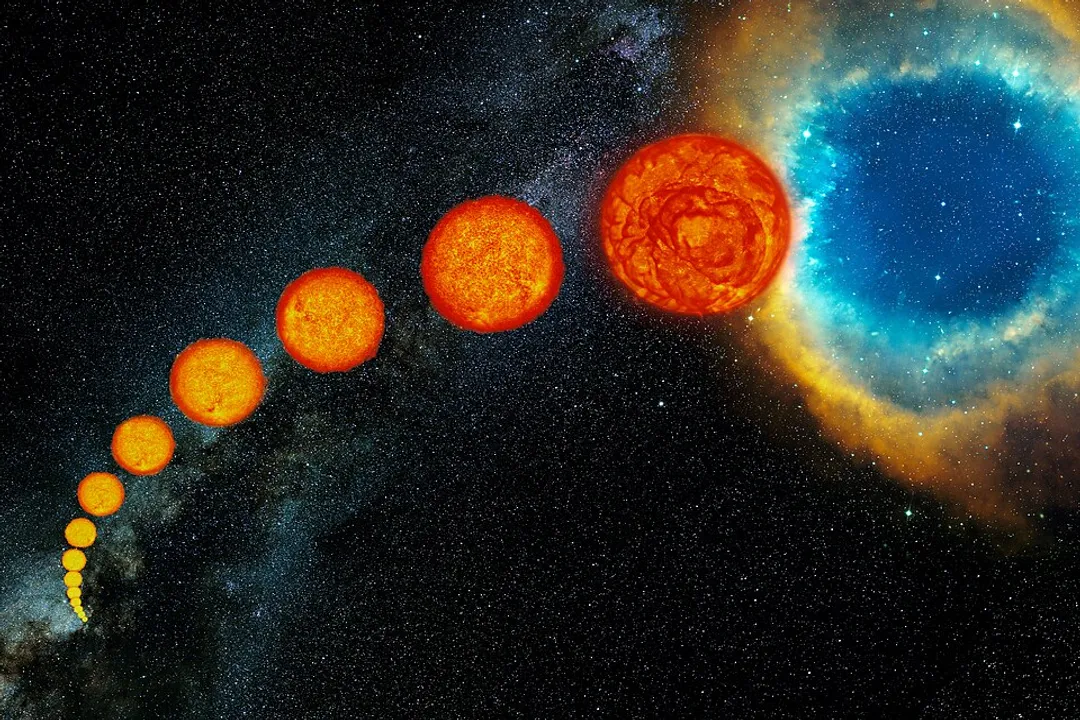
For stars similar to the Sun, the contracting helium core becomes supported by electron degeneracy pressure while it actively fuses helium into carbon and oxygen during the Horizontal Branch phase.
Related Questions
How do astronomers primarily understand stellar transformation over time?What are the raw materials found in stellar nurseries called?What condition leads to the formation of a brown dwarf instead of a true star?Due to their location embedded in dust and gas, how are protostars most easily detected?What dynamic phenomenon is characteristic of the T-Tauri Phase in lower-mass objects?What core temperature must be reached for nuclear fusion to begin, marking stellar ignition?What crucial state is established immediately following stellar ignition and hydrogen fusion?How does the main sequence lifespan of a massive star compare to that of a low-mass star like a red dwarf?What process supports the core of a Sun-like star during the Horizontal Branch phase after the helium flash?What is the ultimate fate of the stellar core remaining after a Sun-like star (up to $8 M_ ext{Sun}$) gently puffs away its outer layers?What critical element forms in the core of a massive star just before its final gravitational collapse triggers a supernova?If the remnant core following a supernova explosion exceeds the neutron degeneracy pressure limit, what object is formed?