What is the process of a star called?
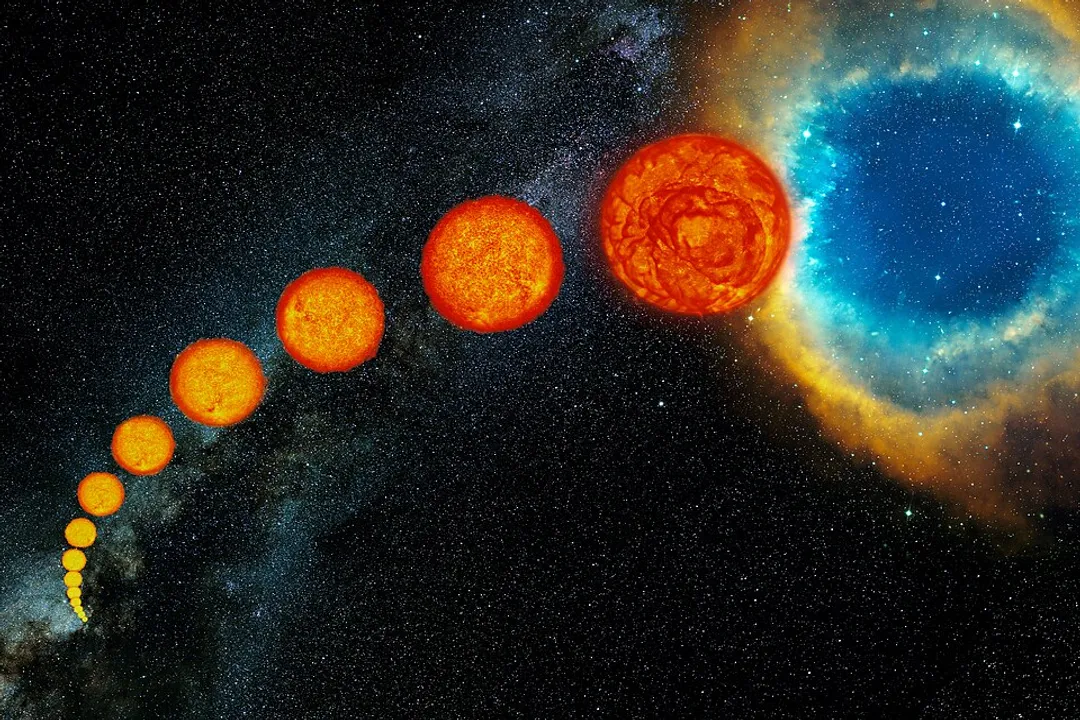
The process by which a star changes over its existence is called stellar evolution. Every star, from the smallest red dwarf to the most massive giant, undergoes a natural cycle involving birth, a long lifespan characterized by internal reactions, and an eventual death, though the timescale for these events can range from a few million years for the most massive stars to potentially trillions of years for the least massive, a duration longer than the universe has existed. Astronomers understand this transformation not by watching a single star age—since the changes happen too slowly—but by observing countless stars at different points in their lives and by running sophisticated computer simulations of stellar structure. All stars fundamentally begin their lives the same way: as products of gravitational collapse within the cold, dusty expanse of interstellar space.
# Cloud Birth
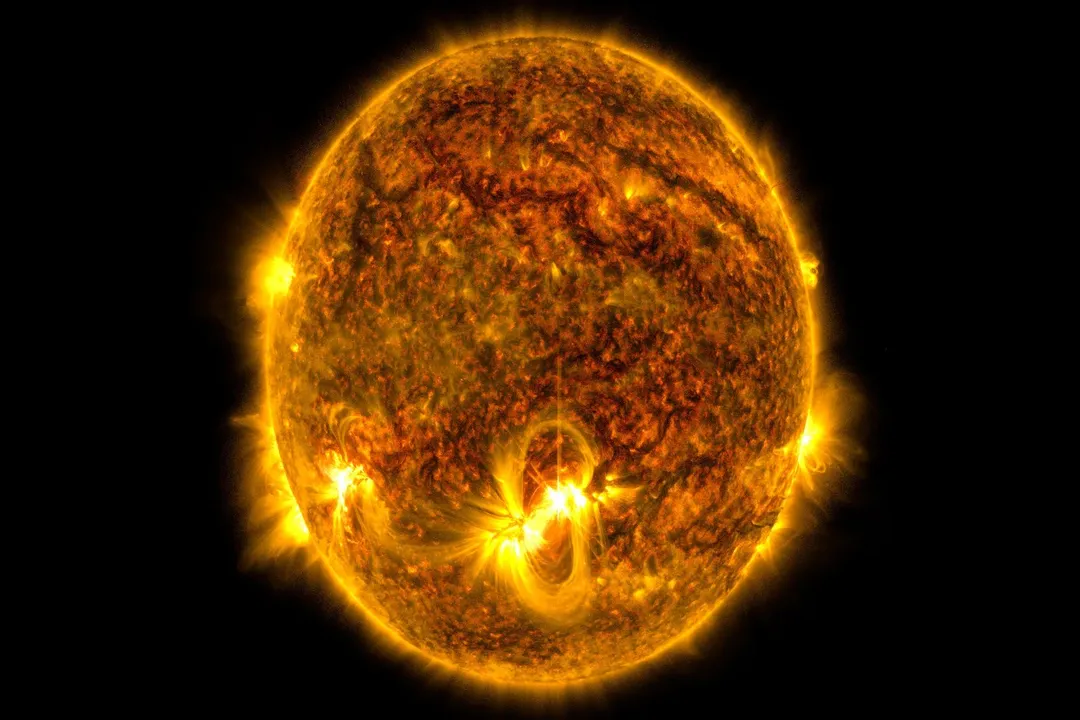
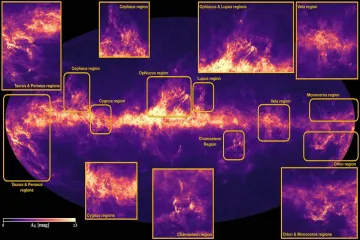
The raw materials for a star are found in molecular clouds or nebulae, immense, cold clouds of gas and dust that act as stellar nurseries. These clouds are cold enough for molecules to form, and the nearest regions where massive stars are actively forming, like the Orion Nebula, illustrate these chaotic birth sites. A typical giant molecular cloud can span hundreds of light-years and contain millions of times the mass of our Sun.
Within these vast regions, local fluctuations in density occur, sometimes aided by external events like colliding clouds or the shockwaves from a distant supernova. As a region becomes denser, gravity begins to dominate the internal gas pressure. The cloud begins to contract inward, often fragmenting into smaller, gravitationally bound clumps called cores. As gas falls into these cores, gravitational potential energy is converted into heat, causing the center to become extremely hot and dense. The cloud also starts to spin, leading to the formation of a flat disk of material surrounding the increasingly compact center. If a cloud fragment is not massive enough, the pressure may balance gravity before fusion begins, resulting in a brown dwarf instead of a true star. Brown dwarfs are sub-stellar objects that glow dimly from residual heat, but their cores never reach the necessary temperature for sustained hydrogen fusion.
# Protostar Ignition
The intensely hot, dense core that forms before a star fully ignites is termed a protostar. Because these initial objects are deeply embedded within the surrounding dust and gas envelope, they are most easily detected using infrared wavelengths, which can penetrate the cosmic cocoon. The early stages of collapse involve the release of gravitational energy as heat. As the core continues to contract, it may go through several transient phases, such as the first hydrostatic core when the material initially becomes opaque to its own radiation.
The next phase, often called the T-Tauri Phase for lower-mass objects, sees the young object radiating energy, but the core temperature is still insufficient to start the primary power source of a star. This youthful stage is dynamic; young stars often exhibit bipolar outflows—jets of charged particles ejected from the poles—which scientists observe as Herbig-Haro objects. These outflows and the associated accretion process are thought to be critical for shedding excess angular momentum gathered during the collapse.
The true birth of a star, known as stellar ignition, occurs when the core temperature and pressure finally become high enough—around 27 million degrees—for nuclear fusion to begin. At this point, hydrogen nuclei are squeezed together to form helium, releasing vast amounts of energy. This energy creates an outward radiation pressure that precisely balances the inward crush of gravity, establishing hydrostatic equilibrium. Once this balance is achieved, the object settles onto the main sequence, beginning the longest and most stable phase of its life.
It is worth noting that the classic depiction of a star forming in isolation is becoming outdated. Modern simulations and observations suggest that stars, including ones like our Sun, are more likely to form within dense groups or clusters, leading to chaotic interactions early on. For instance, the 7-degree tilt between our Sun's rotation axis and the plane of the planetary orbits could be a residual effect from the gravitational tug of a close companion star in the Sun's stellar nursery, indicating the star may have "sisters" scattered throughout the galaxy. This early dynamic environment, where stars interact gravitationally, is fundamental to understanding everything from binary star orbits to the very structure of the planetary systems that eventually form from leftover disk material.

# Main Sequence Life
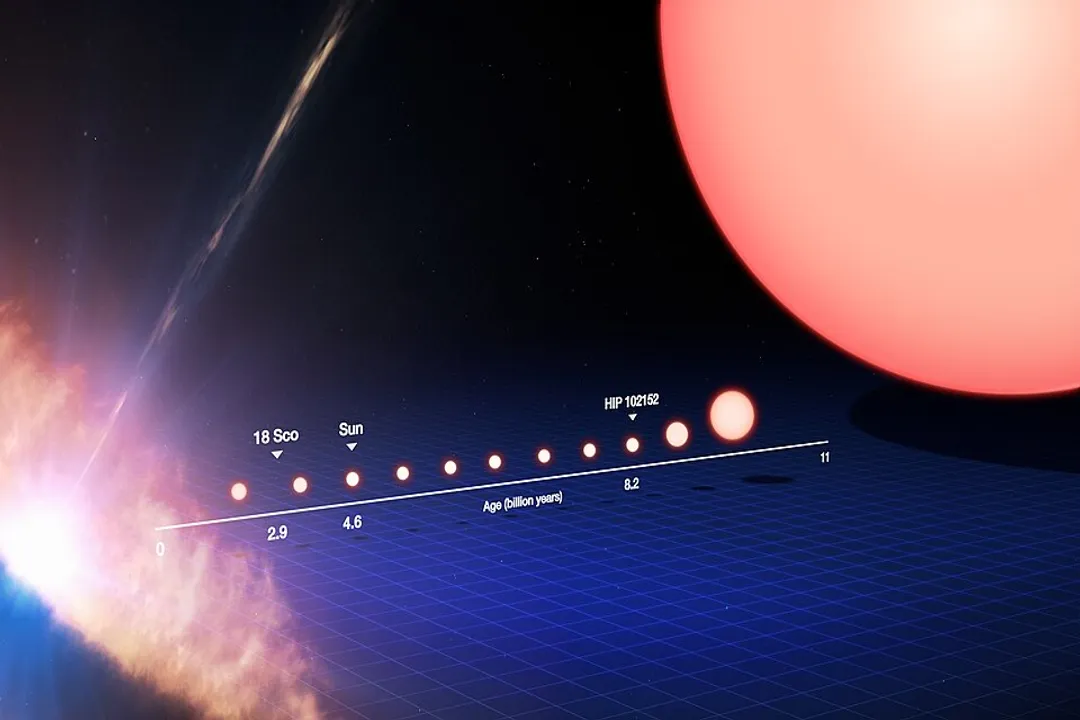
The main sequence is the period where a star happily fuses hydrogen into helium in its core, marking the majority of its existence. A star's position on the Hertzsprung-Russell (H-R) diagram during this phase is determined almost entirely by its initial mass, which dictates its temperature and luminosity.
The lifespan on the main sequence is heavily dependent on how quickly the fuel is consumed.
- Low-mass stars, like small red dwarfs (less than ), burn their hydrogen very slowly and efficiently. Models suggest they could remain on the main sequence for trillions of years, far exceeding the current age of the universe. They are predicted to slowly become hotter and brighter before collapsing into white dwarfs.
- Sun-like stars (mid-sized, yellow dwarfs) have a more familiar timeline, expected to remain stable for about 10 billion years, with our own Sun currently estimated to be halfway through this phase.
- Massive stars—hot, blue-white objects—must burn their fuel at an incredible rate to counteract their immense gravitational weight. Consequently, they exhaust their core hydrogen in just a few million years.
# Core Exhaustion
Eventually, the hydrogen fuel supply in the core is depleted, and the outward fusion pressure drops. Gravity seizes control, causing the core to contract and heat up significantly. This contraction raises the temperature in the shell of hydrogen immediately surrounding the core, triggering hydrogen fusion there. This shell burning generates more energy than the core fusion did, causing the star's outer layers to expand and cool, transforming it into a giant star.
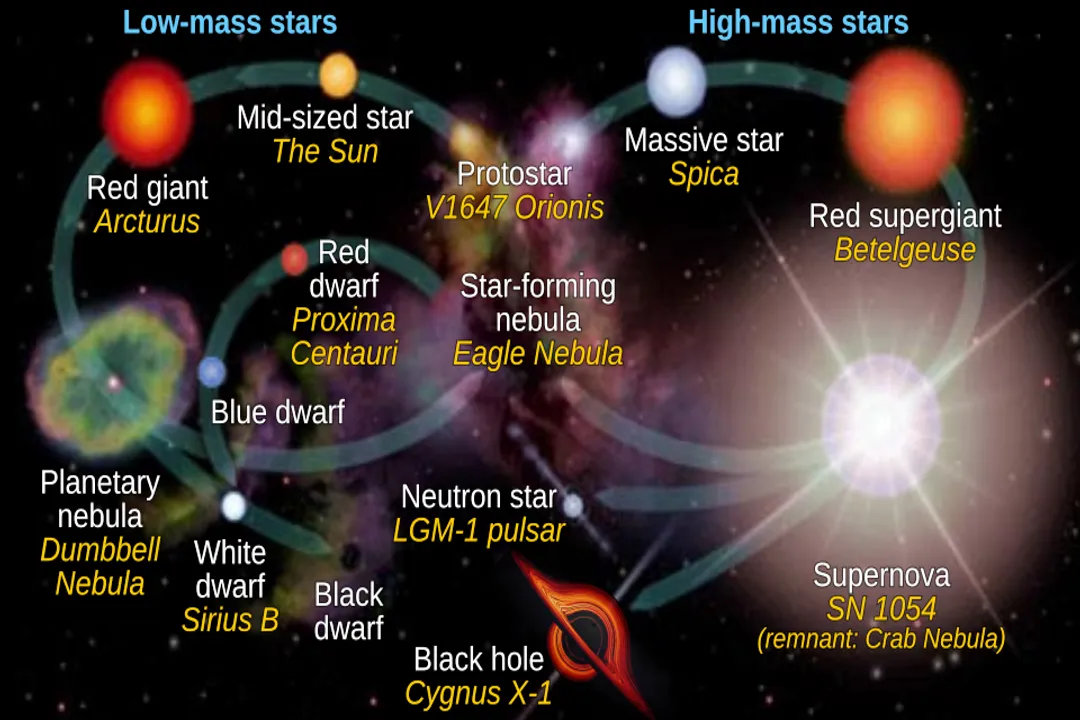
What happens next marks a sharp divergence based on mass, creating two primary evolutionary tracks:
# Low-Mass Divergence
For stars similar in mass to the Sun (roughly $0.6$ to ), the initial expansion leads to the Red Giant phase. In these stars, the contracting helium core eventually becomes hot and dense enough to ignite helium fusion, burning it into carbon and oxygen.
This evolution proceeds through sub-stages:
- Subgiant Phase: The star expands as hydrogen shell burning increases.
- Red-Giant-Branch (RGB) Phase: The star swells significantly. For stars around the Sun's mass, the helium core ignites in a rapid event called the helium flash.
- Horizontal Branch: After the flash, the core actively fuses helium. If the star is like the Sun, the core is supported by electron degeneracy pressure during this period.
- Asymptotic-Giant-Branch (AGB) Phase: Once the core exhausts its helium and is left with an inert core of carbon and oxygen, fusion continues in two surrounding shells (helium and hydrogen). This is an unstable phase marked by increasing luminosity and thermal pulses.
# Gentle Fading
Stars in the Sun-like category (up to about ) do not possess the mass required to generate the extreme temperatures needed to fuse carbon in their cores. As the star exhausts the fuel in its AGB shells, it contracts one last time, entering a post-AGB phase. During this final instability, the star's outer layers are gently puffed away over millions of years, forming a beautiful, expanding shell of gas and dust known as a planetary nebula.
What remains is the incredibly dense, hot stellar core—a white dwarf. A white dwarf, roughly the size of the Earth but containing about half a solar mass, radiates away its residual heat over vast stretches of time. Because no fusion occurs, these stellar cinders cool indefinitely, eventually becoming a cold, dark mass called a black dwarf. Current cosmological timescales, however, are too short for any white dwarf to have cooled completely into a black dwarf yet.
# Massive Endings
The fate of the most massive stars—those with initial masses greater than about $8$ to $10$ times that of the Sun—is far more dramatic. Their immense gravity drives fusion past the helium stage, fusing carbon into neon, oxygen, silicon, and so on, creating an "onion-like" structure of shells around a growing core. This chain reaction culminates when the core becomes primarily composed of iron. Fusing iron requires an input of energy rather than releasing it, meaning the core suddenly loses its primary energy source.
Without the sustaining outward pressure, the iron core collapses under gravity in a fraction of a second. The collapse halts when the density becomes so extreme that the nuclei are jammed together, forcing electrons and protons to merge into neutrons in a process called electron capture. This violent stopping of the infall creates a powerful outward shock wave that blows the star apart in a spectacular explosion known as a supernova. The elements heavier than iron, forged in the extreme conditions of the explosion itself, are scattered across the galaxy.
# Extreme Remnants
The stellar core surviving the supernova explosion forms one of two ultra-dense objects, depending on the remaining mass:
Neutron Star: If the surviving core's mass is below a certain threshold (the Tolman–Oppenheimer–Volkoff limit, estimated around $2$ to ), the object is a neutron star. These objects are mind-bogglingly dense, perhaps only the size of a large city or about 10 kilometers in radius, yet packing over $1.4$ times the Sun's mass. Due to the conservation of angular momentum during the collapse, neutron stars spin extremely fast, sometimes completing over 600 revolutions per second. If the magnetic poles of such a star align with Earth, we detect a regular pulse of radiation, classifying it as a pulsar.
Black Hole: If the collapsing remnant core exceeds the neutron degeneracy pressure limit, the collapse continues unimpeded, crushing the matter to a point of infinite density, forming a black hole. A black hole possesses such intense gravity that nothing, not even light, can escape its boundary, known as the Schwarzschild radius. While the exact mechanism for forming a black hole directly from a core collapse versus an unstable neutron star collapse is still being investigated, these objects represent the final, most collapsed state of stellar evolution.
The material ejected by supernovae and planetary nebulae—rich in elements created during fusion or explosion—returns to the interstellar medium, enriching the next generation of molecular clouds. In this cyclical fashion, the death of one star provides the necessary building blocks for the birth of the next.
Related Questions
#Citations
Star Basics - NASA Science
Stellar evolution - Wikipedia
Star Formation - | The Schools' Observatory
Life Cycle of Stars - BYJU'S
Astrobiology Institute at the University of Hawaii
A Star is Born: The Life Cycle of Stars | Wisconsin Space Grant ...
Life Cycle of Stars