What is the name given to the main body or circular shell of the astrolabe that houses the internal components?
Answer
The Mater (Mother)
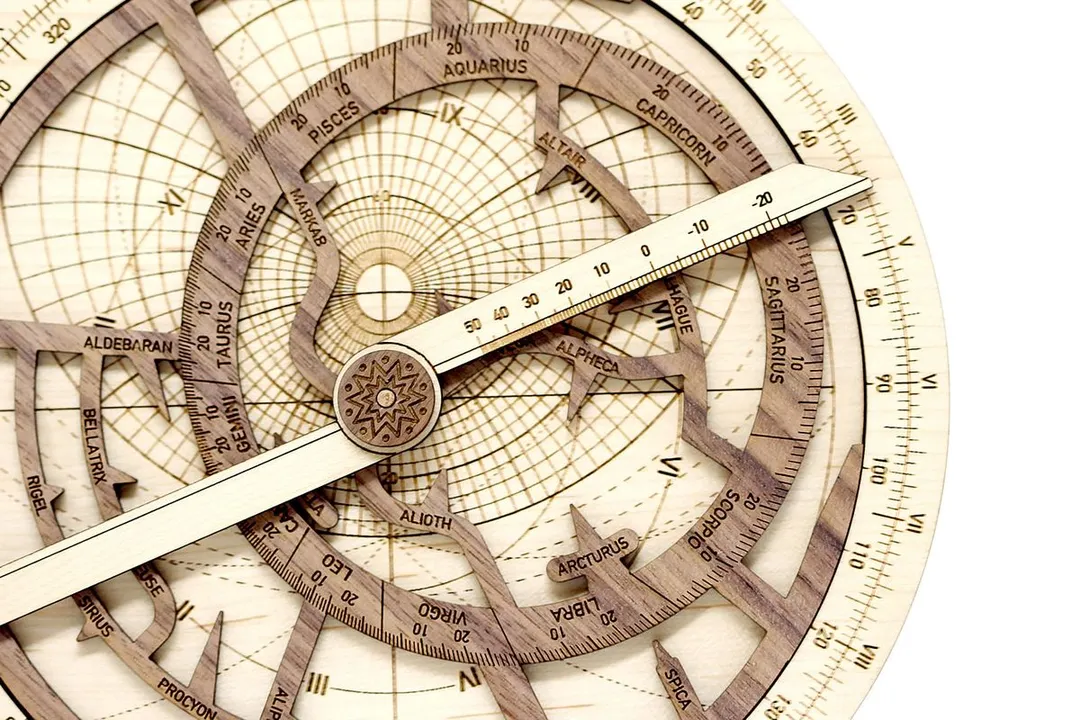
The Mater, which translates literally to 'Mother,' serves as the foundational casing or main body of the astrolabe instrument. It is typically constructed as a circular disc featuring a deep recess designed to hold the various removable parts, such as the latitude plates. Furthermore, the Mater is essential for measurement calibration because its rim is usually engraved with degree markings. These markings provide the necessary scale against which sighting measurements, like altitude taken via the alidade, are read, establishing the physical context for all calculations performed by the assembled instrument.
#Videos
How to use an astrolabe I Curator's Corner S3 Ep1 #CuratorsCorner
Related Questions
What is the literal meaning of the term "astrolabe" derived from the Greek words *astron* and *lambanō*?Which component of the astrolabe is described as the openwork framework placed over the plates that carries pointers indicating star positions?What fundamental measurement did the astrolabe primarily utilize the alidade to determine relative to the observer?What specific item needed to be swapped out when moving an astrolabe from London to Cairo to maintain calculation accuracy?How does the core operation of the astrolabe fundamentally differ from the function of a modern optical telescope?What is the name given to the main body or circular shell of the astrolabe that houses the internal components?In what historical era was the recognizable, perfected form of the astrolabe widely disseminated across the world?What sophisticated field of mathematics provided the foundation for the astrolabe's calculations regarding celestial mechanics and coordinate conversion?Which specific navigational instrument, often a simplified version of the planispheric astrolabe, was crucial for determining latitude during ocean voyages?The astrolabe is described as a physical manifestation of complex mathematical relationships rendered in what portable, heavy metal material?