What elements, revealed by MESSENGER, complicate the simple vaporization model for Mercury's formation?
Answer
potassium and sulfur
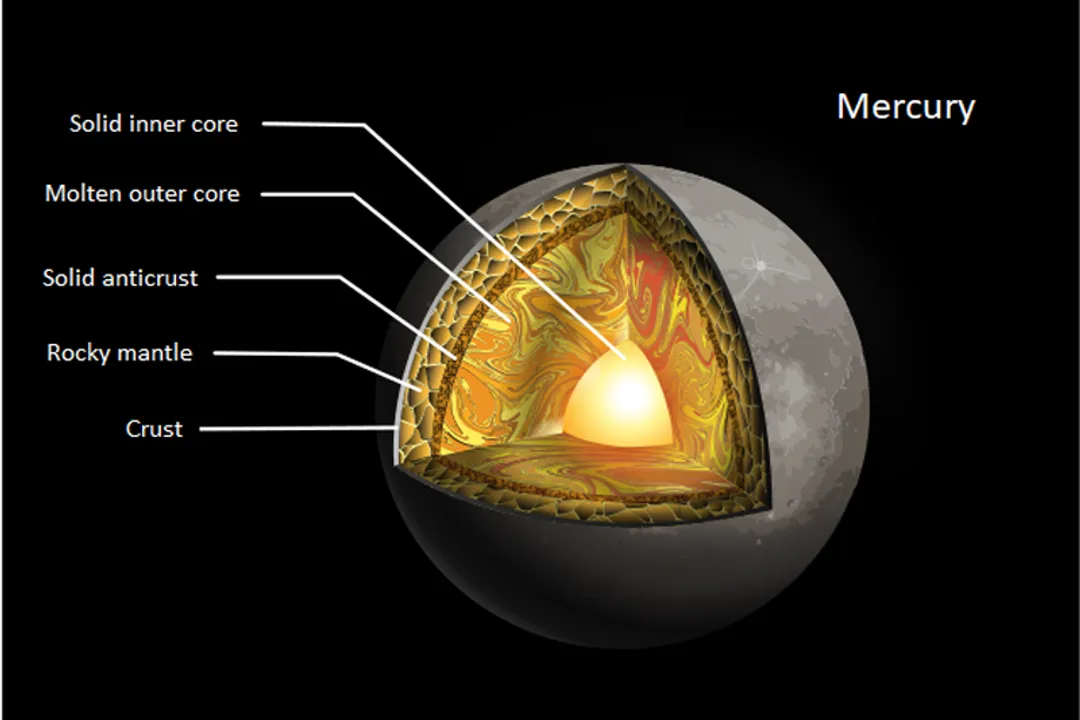
One early hypothesis for Mercury’s structure suggested extremely high temperatures near the young Sun, causing rocky material to vaporize and be blown away by the solar wind, leaving the heavier iron behind. However, data returned from NASA's MESSENGER mission introduced contradictory evidence. Analyses of Mercury’s surface composition detected unexpectedly high quantities of elements such as potassium and sulfur. These elements are classified as volatiles, meaning they should have been easily driven off or vaporized under the extreme heat scenarios postulated by the simple vaporization model, thus requiring scientists to look toward alternative formation scenarios.
Related Questions
What percentage of Mercury's bulk composition is metallic material?What percentage of Mercury's entire volume is estimated to be occupied by its metal core?What is the calculated uncompressed density for Earth's constituent materials?What elements, revealed by MESSENGER, complicate the simple vaporization model for Mercury's formation?What fraction of Mercury’s total diameter is estimated for its core's radius?What geological process tends to recycle surface materials back into Earth's mantle?What is the name of the exoplanet noted to rival Mercury’s metallic leanings?For the giant impact hypothesis, what mass fraction was the impactor relative to the initial Mercury mass?How is the iron on Mars’s surface characterized, leading to its signature color?In terms of mean density in the Solar System, where does Mercury rank relative to Earth?Smelting metals from which bodies could potentially be more energy-efficient than digging out Mercury’s core?