How is the iron on Mars’s surface characterized, leading to its signature color?
Answer
highly oxidized, creating the signature red dust
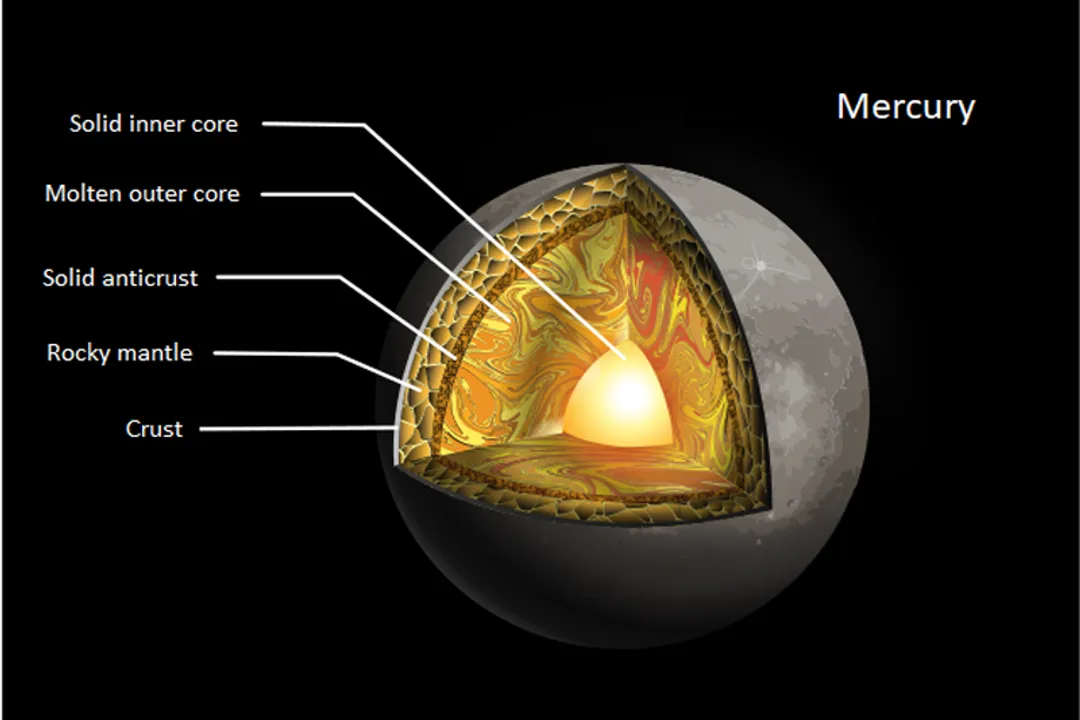
The visible differences between planets are strongly influenced by how their iron content is distributed and chemically treated. Unlike Mercury, where iron is overwhelmingly concentrated in the core, the iron on Mars presents differently on its exterior. The iron present on the Martian surface is highly oxidized, meaning it has reacted chemically with oxygen. This oxidation process results in the formation of iron oxides, which manifest visually as the pervasive, reddish-brown dust that gives Mars its characteristic red color throughout the planet's surface regions.
Related Questions
What percentage of Mercury's bulk composition is metallic material?What percentage of Mercury's entire volume is estimated to be occupied by its metal core?What is the calculated uncompressed density for Earth's constituent materials?What elements, revealed by MESSENGER, complicate the simple vaporization model for Mercury's formation?What fraction of Mercury’s total diameter is estimated for its core's radius?What geological process tends to recycle surface materials back into Earth's mantle?What is the name of the exoplanet noted to rival Mercury’s metallic leanings?For the giant impact hypothesis, what mass fraction was the impactor relative to the initial Mercury mass?How is the iron on Mars’s surface characterized, leading to its signature color?In terms of mean density in the Solar System, where does Mercury rank relative to Earth?Smelting metals from which bodies could potentially be more energy-efficient than digging out Mercury’s core?