For the giant impact hypothesis, what mass fraction was the impactor relative to the initial Mercury mass?
Answer
one-sixth of Mercury’s mass
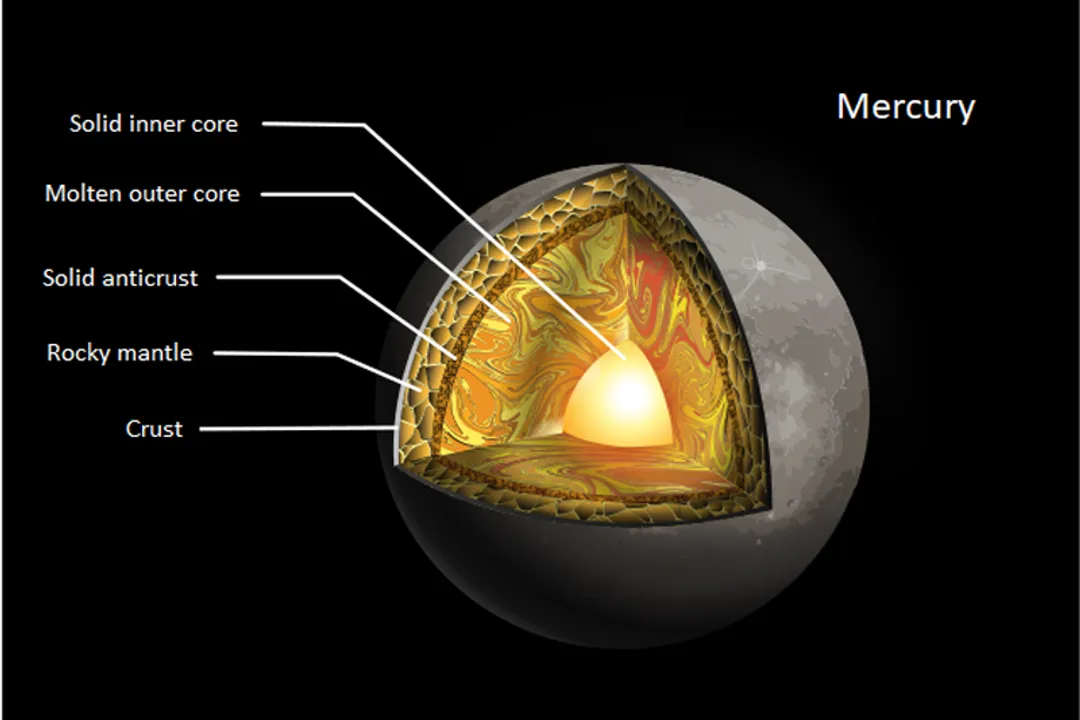
The giant impact hypothesis offers a leading explanation for Mercury's extreme iron content, drawing parallels to theories about Earth's Moon formation. This model posits that the progenitor body, proto-Mercury, was initially much larger—perhaps 2.25 times its current mass, possessing a standard metal-to-silicate ratio common in the early solar nebula. This larger body then suffered a catastrophic collision with a massive impactor. The text specifies that this impactor was roughly one-sixth of Mercury’s mass; this violent strike effectively blasted away the majority of the lighter, rocky crust and mantle, leaving behind the dense, exposed metallic core that constitutes the bulk of the planet observed today.
Related Questions
What percentage of Mercury's bulk composition is metallic material?What percentage of Mercury's entire volume is estimated to be occupied by its metal core?What is the calculated uncompressed density for Earth's constituent materials?What elements, revealed by MESSENGER, complicate the simple vaporization model for Mercury's formation?What fraction of Mercury’s total diameter is estimated for its core's radius?What geological process tends to recycle surface materials back into Earth's mantle?What is the name of the exoplanet noted to rival Mercury’s metallic leanings?For the giant impact hypothesis, what mass fraction was the impactor relative to the initial Mercury mass?How is the iron on Mars’s surface characterized, leading to its signature color?In terms of mean density in the Solar System, where does Mercury rank relative to Earth?Smelting metals from which bodies could potentially be more energy-efficient than digging out Mercury’s core?