In terms of mean density in the Solar System, where does Mercury rank relative to Earth?
Answer
second highest, just slightly less than Earth’s
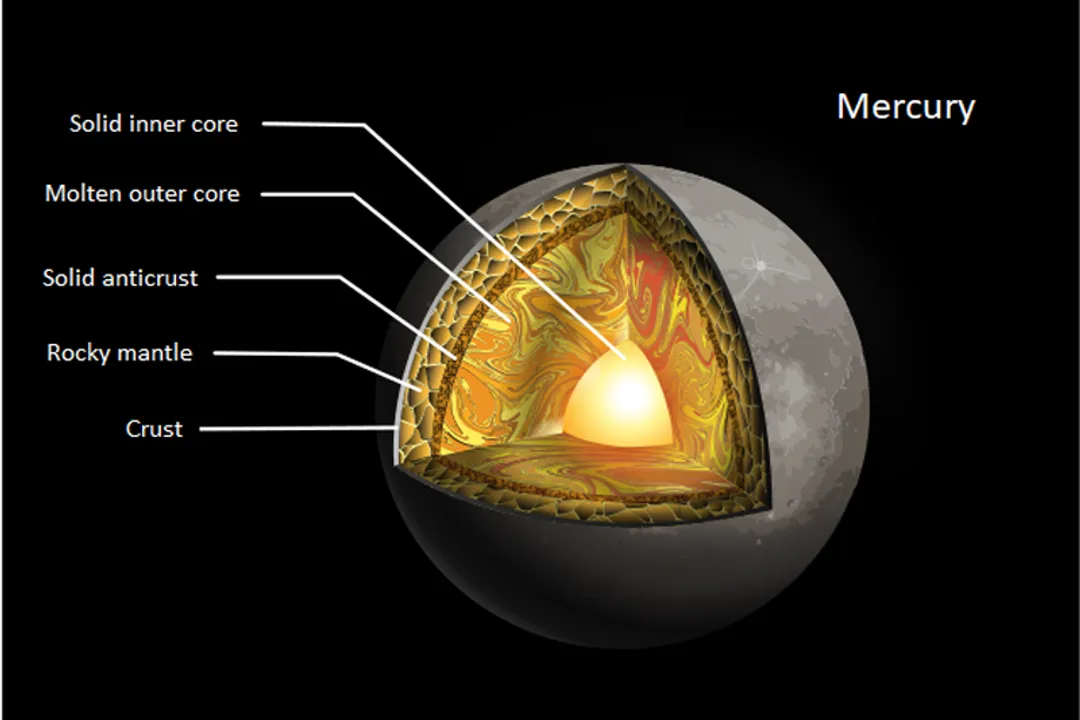
Mercury achieves its remarkable density due to the vast amount of iron packed into its interior. Its calculated mean density is approximately $5.427 ext{ g/cm}^3$. When ranked against all other planets in the Solar System, this places Mercury second highest in terms of density. It trails only Earth, whose mean density is slightly greater at $5.515 ext{ g/cm}^3$. This close ranking, despite Mercury being a much smaller world subject to significantly less gravitational compression, underscores the fundamental difference in the underlying material composition—Mercury’s material being inherently more metallic than Earth’s.
Related Questions
What percentage of Mercury's bulk composition is metallic material?What percentage of Mercury's entire volume is estimated to be occupied by its metal core?What is the calculated uncompressed density for Earth's constituent materials?What elements, revealed by MESSENGER, complicate the simple vaporization model for Mercury's formation?What fraction of Mercury’s total diameter is estimated for its core's radius?What geological process tends to recycle surface materials back into Earth's mantle?What is the name of the exoplanet noted to rival Mercury’s metallic leanings?For the giant impact hypothesis, what mass fraction was the impactor relative to the initial Mercury mass?How is the iron on Mars’s surface characterized, leading to its signature color?In terms of mean density in the Solar System, where does Mercury rank relative to Earth?Smelting metals from which bodies could potentially be more energy-efficient than digging out Mercury’s core?