Which planet has the most iron?
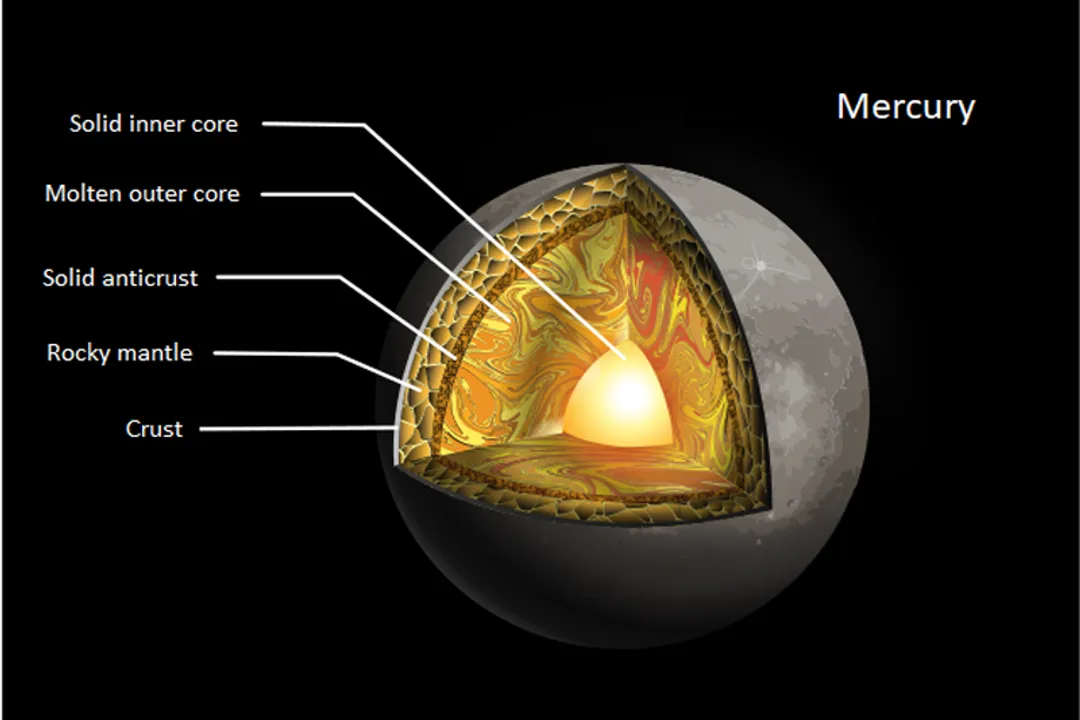
The planet in our Solar System that holds the title for the most iron is unequivocally Mercury. [4][5] While it is true that stars, through fusion, contain vastly larger quantities of heavy elements like iron, when strictly limiting the comparison to planets orbiting our Sun, the innermost world reigns supreme in terms of metallic concentration. Mercury is not just iron-rich; it is often referred to as the iron planet due to an internal structure unlike any other terrestrial world we have closely examined. [4]
# Core Concentration
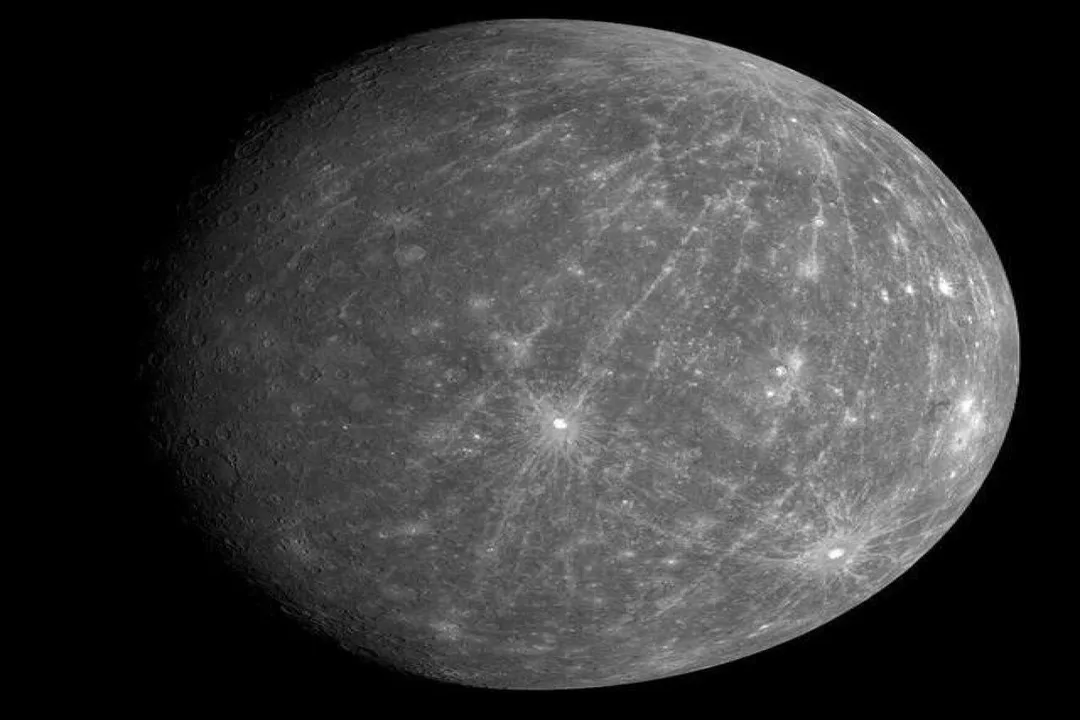
To appreciate Mercury’s iron content, we must first look at its bulk composition. This small world, the closest to the Sun, is composed of approximately 70% metallic material and only 30% silicate material by volume. [3] This ratio is dramatically skewed toward metal compared to its neighbors. For context, Earth, which is far more massive, is less metal-rich overall.
The scale of this metallic concentration becomes evident when examining the size of its core. Scientists estimate that Mercury’s metal core occupies nearly 85 percent of the planet's entire volume. [1] If we consider the core's radius specifically, estimates place it at about 2,020 kilometers, which is roughly three-quarters () of the planet’s total diameter. [3] This core is not just solid iron, but likely a complex structure itself, consisting of a liquid outer layer surrounding a solid inner core. [1][4] Data gathered by NASA's MESSENGER spacecraft indicated that this inner core is very nearly the same size as Earth’s inner core, even though Mercury is a much smaller planet overall. [1]
# Density Comparison
The vast amount of iron packed into Mercury is what makes it so dense. Its mean density of about is the second highest in the Solar System, just slightly less than Earth’s . [3] This is where the critical nuance lies: Mercury is much smaller than Earth, meaning it experienced significantly less gravitational compression.
When researchers model what the planets would be like without the squeezing effect of their own gravity—their "uncompressed density"—Mercury’s true material nature shines through. The uncompressed density of Mercury’s constituent materials is calculated to be around , whereas Earth’s uncompressed density is closer to . [3] This calculation implies that the stuff Mercury is made of is inherently richer in heavy elements, primarily iron, than the stuff Earth is made of. [3]
To clearly see this difference in metal proportion versus total mass, consider a quick comparison:
| Planetary Body | Estimated Iron/Metal Proportion | Core Volume Percentage (Approx.) |
|---|---|---|
| Mercury | Highest overall percentage in Solar System | ~57% to 85% of total volume [1][3] |
| Earth | Significant mass, but less concentrated than Mercury | ~17% of total volume [1] |
| Mars | Less overall iron than Earth; surface iron is oxidized | Iron concentrated primarily near the surface/crust |
This stark contrast in core volume percentage—Mercury's core taking up over half its volume compared to Earth's core making up about one-third of its total core or 17% of the planet's volume—is what solidifies Mercury’s standing as the Solar System’s most iron-laden world relative to its size. [1][3]
# The Formation Enigma
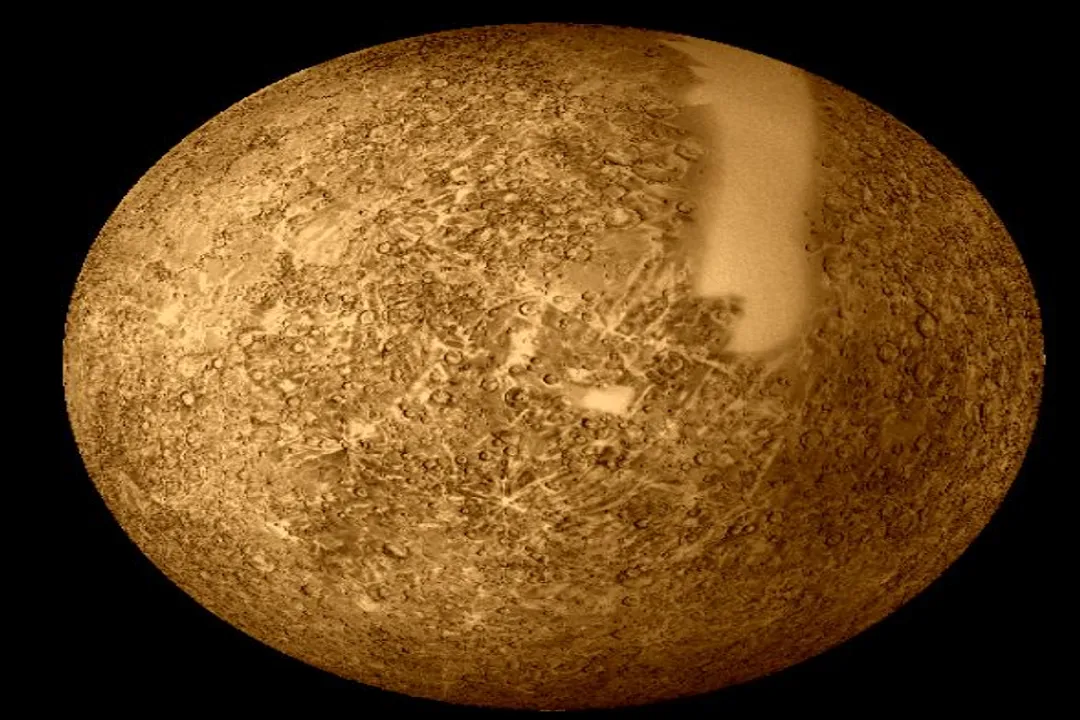
The question of why Mercury possesses such an outsized metallic heart is one of planetary science’s enduring puzzles. [3][5] Several major hypotheses attempt to explain this extreme iron-to-silicate ratio, and they often involve dramatic early Solar System events.
One widely supported scenario is the giant impact hypothesis, similar to the leading theory for Earth’s Moon formation. [3] This model suggests that Mercury began as a much larger body, perhaps $2.25$ times its current mass, with a metal-to-silicate ratio typical of common rocky matter elsewhere in the solar nebula. [3] Early in its history, this proto-Mercury was then struck by a massive impactor—a planetesimal roughly one-sixth of Mercury’s mass—that literally blasted away the majority of its lighter, rocky crust and mantle. [3] What remained was the dense, massive metallic core, now exposed and composing the bulk of the planet we see today. [2][3]
An alternative explanation centers on the intense environment near the young Sun. If Mercury accreted material before the protosun’s energy output stabilized, temperatures could have been extremely high, potentially ranging up to . [3] At such heat, much of the rock vaporized, forming a temporary "rock vapor" atmosphere that was subsequently blown away by the strong solar wind, leaving the heavier iron behind. [3]
However, data collected by the MESSENGER mission has added complexity to these simple models. Analyses of Mercury’s surface composition revealed unexpectedly high levels of elements like potassium and sulfur. [3] In the simple vaporization model, these volatile elements should have been driven off by extreme heat. [3] The giant impact hypothesis also struggles to fully account for the observed crustal composition. [3] The current findings lean slightly toward a third, less dramatic model involving drag in the solar nebula, which selectively prevented lighter particles from accreting into Mercury in the first place, though further study is still needed. [3]
# Iron Distribution: Core vs. Crust
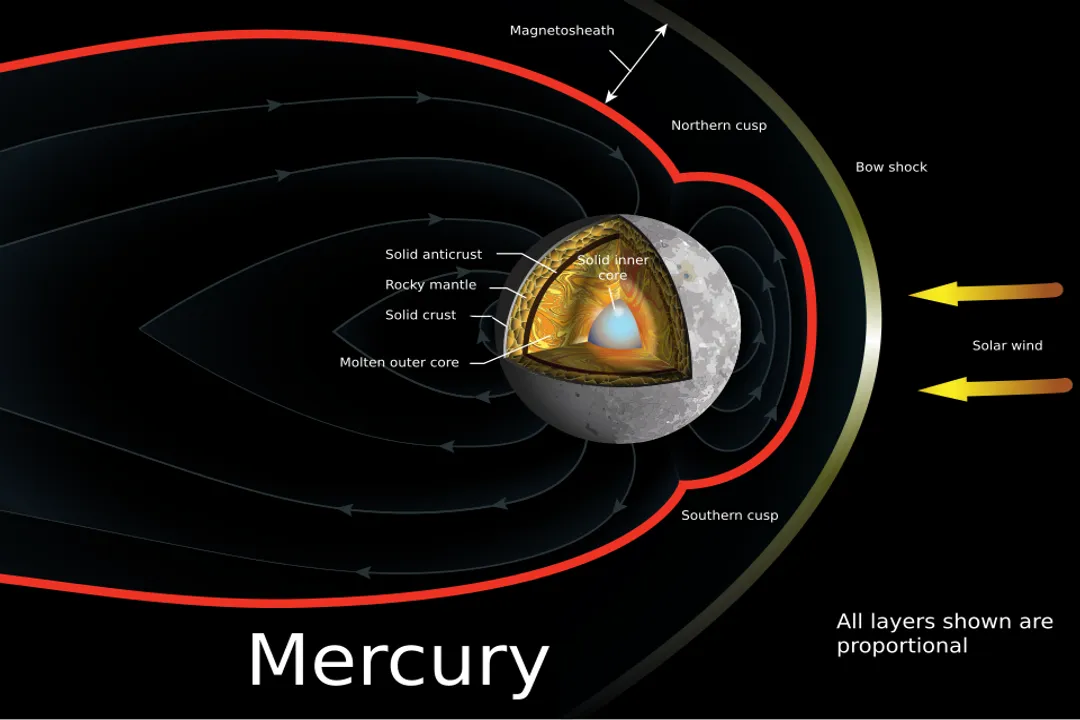
The way iron is distributed within planets drastically affects their visible characteristics and internal activity. While Mercury has the most iron overall because so much is locked in its core, other planets show their iron wealth differently.
Mars, for instance, has significantly less total iron than Earth. [2] However, the iron on its surface is highly oxidized, creating the signature red dust that characterizes the planet. [2] Earth, on the other hand, has a huge iron core, but geological processes like subduction have tended to recycle surface materials back into the mantle, depleting the crust of some of its native iron over eons. [2] This process helps concentrate the densest material, iron, deep within the core, reinforcing the magnetic field. [2]
When considering materials for future large-scale construction, this distribution matters. While Mercury has unparalleled access to pure metal via its relatively thin mantle—making it a prime resource depot for tasks like building a Dyson swarm close to the Sun [2]—mining its deep, dense core presents a colossal engineering challenge due to that very density and high escape velocity relative to smaller bodies. [2] Some analyses suggest that smelting metals from the silicate crusts of other, less differentiated bodies, like certain asteroids or even Venus, could prove more energy-efficient than digging out Mercury’s core. [2]
# Iron Worlds Beyond Our Sun
Mercury is not alone in being an iron-dominated world, though it remains unique among the eight established planets in our neighborhood. Astronomers have discovered exoplanets that rival or even exceed Mercury’s metallic leanings. One notable example is GJ 367 b, a planet orbiting a star about 31 light-years away. [6] This exoplanet is smaller and less massive than Earth but appears to be largely composed of iron, similar to Mercury. [6]
The existence of GJ 367 b, which orbits incredibly close to its star (completing an orbit in just eight Earth hours), suggests that the mechanisms that create iron-rich worlds—whether extreme proximity to the star or giant early impacts—are not isolated events. [6] Discovering these "iron worlds" in other solar systems helps scientists test theories about the formation of terrestrial planets, providing external context for understanding why our own innermost planet ended up as an anomaly of metal and rock.
Ultimately, the search for the planet with the most iron leads directly to Mercury. Its composition stands as a testament to the violent and energetic processes that shaped the inner Solar System, leaving behind a dense, metallic remnant orbiting near the solar inferno. [4]
Related Questions
#Citations
Mercury (planet) - Wikipedia
Is Mercury the only metal-rich body in the solar system? - Reddit
Did you know that Mercury has a higher percentage of iron than any ...
Does Mars contain more iron than the Earth?
Mercury – the iron planet - British Astronomical Association
Astronomers find a new planet that's mostly made of iron | WLRN
A Closer Look at Mercury's Spin and Gravity Reveals the Planet's ...