What common characteristic defines both M78 and IC 4592 in terms of light generation?
Answer
Both rely on illumination from nearby stars rather than generating their own visible light
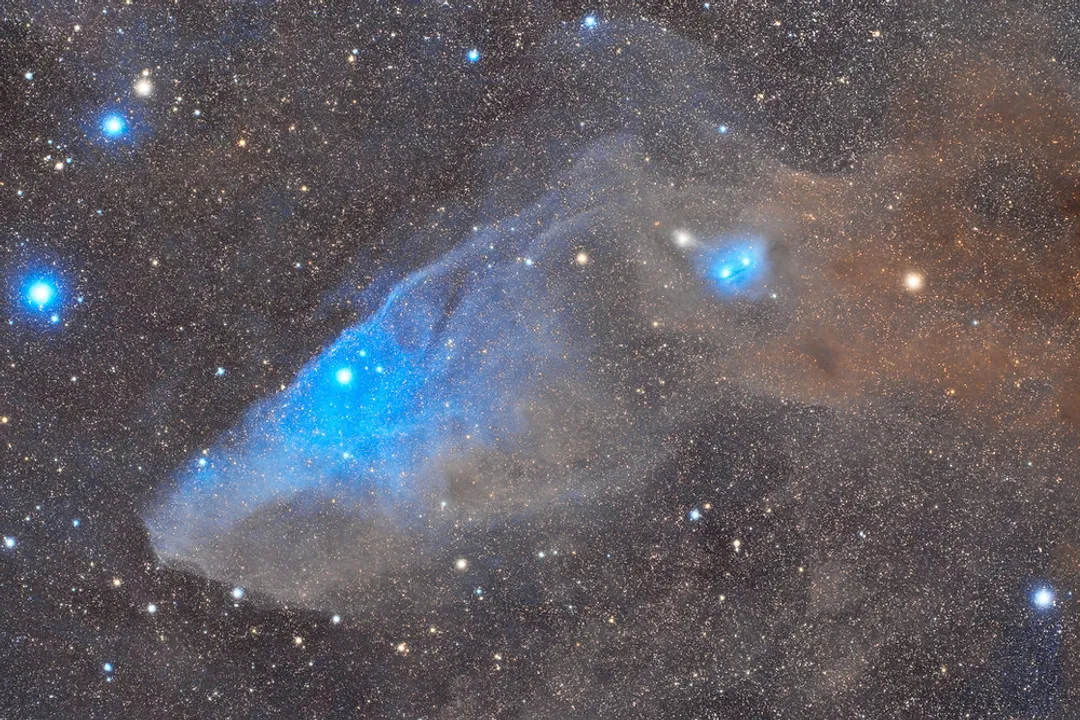
Both M78 and IC 4592 share the classification of being reflection nebulae. This classification dictates their light source: they do not possess the internal energy mechanism, such as gas ionization driven by a central star's ultraviolet output, to produce their own visible light like emission nebulae do. Instead, their luminosity derives entirely from reflecting the visible light originating from adjacent, luminous stars. The observed blue color arises solely from the selective scattering of that external starlight by the intervening dust.
#Videos
How to find the Blue Snowball Nebula (also known as NGC 7662 ...
Related Questions
What physical mechanism causes reflection nebulae to appear blue when illuminated by nearby stars?Which light wavelengths are interstellar dust grains in reflection nebulae most efficient at scattering toward an observer?What is the nickname associated with the reflection nebula IC 4592 located in Scorpius?What appearance results if the dust cloud in a nebula is too thick relative to the illuminating star?To which specific nebula classification does the celestial object M78 belong?In the planetary nebula NGC 7293 (Helix Nebula), what specific atomic emission is often responsible for observed blue-green tones?What difference often exists between the appearance of M78 through an amateur eyepiece versus a long-exposure astrophotograph?What is the essential role of narrowband filters in imaging nebulae that appear blue in processed photographs?In reflection nebulae, what crucial factor, besides the presence of a bright star, determines the visibility of the blue scattered light?What common characteristic defines both M78 and IC 4592 in terms of light generation?What is the official designation for the planetary nebula often referred to as the Eight-Burst Nebula or Southern Ring Nebula?