What celestial process causes a true star to appear to twinkle when viewed from Earth?
Answer
Disturbance of light rays by Earth’s atmosphere from a distant point source
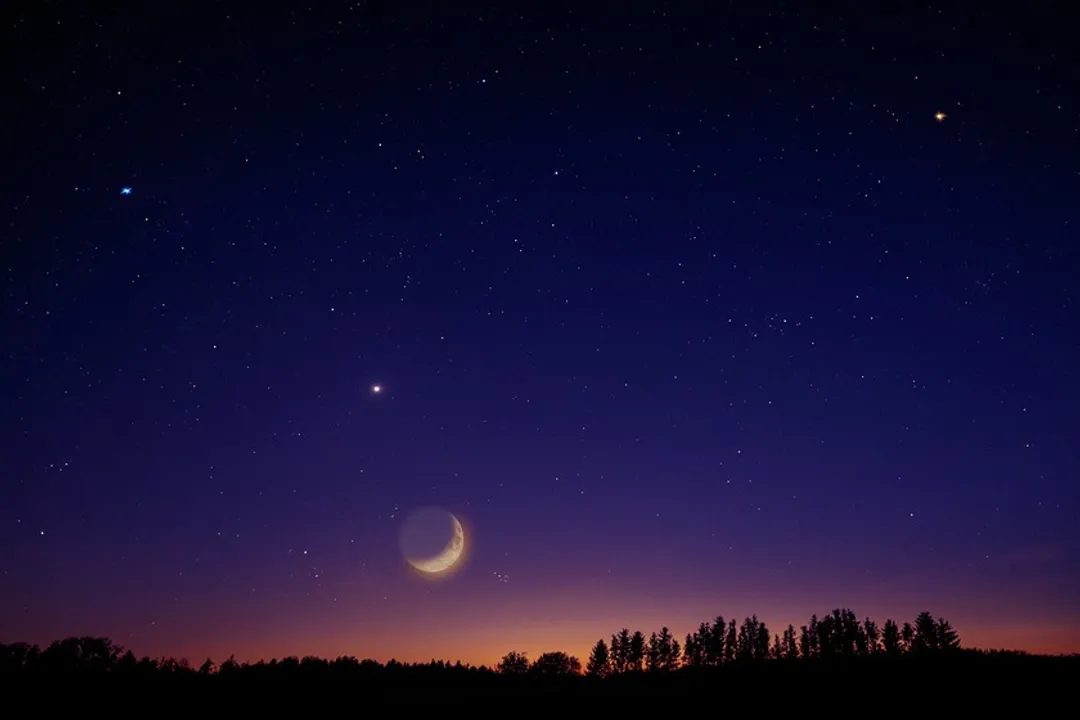
Stars emit their own light traveling across vast distances; this light is slightly disturbed by Earth’s atmosphere, causing the phenomenon known as twinkling, which occurs because the star acts as a single, distant point source.
Related Questions
What is the overwhelmingly likely celestial object seen as a brilliant point of light near the Moon?What gives Venus its incredible luminosity?What term is used when the Moon and a planet appear very close to one another in the sky?What is the fundamental difference in light behavior that makes planets typically not twinkle?If Venus is visible shortly after sunset in the western sky, what is it casually called?What astronomical path do the Moon and the major planets share, causing their conjunctions to be predictable?What is the actual spatial separation between the Moon and a planet during an apparent close conjunction as viewed from Earth?How can an observer typically differentiate Mars from Venus when both are near the Moon?What celestial process causes a true star to appear to twinkle when viewed from Earth?How long does it take Jupiter to complete one orbit around the Sun in Earth years?