How will the Sun's life cycle eventually compare to the evolution of the Cat's Eye Nebula?
Answer
The Sun will eventually undergo a similar transition into a planetary nebula
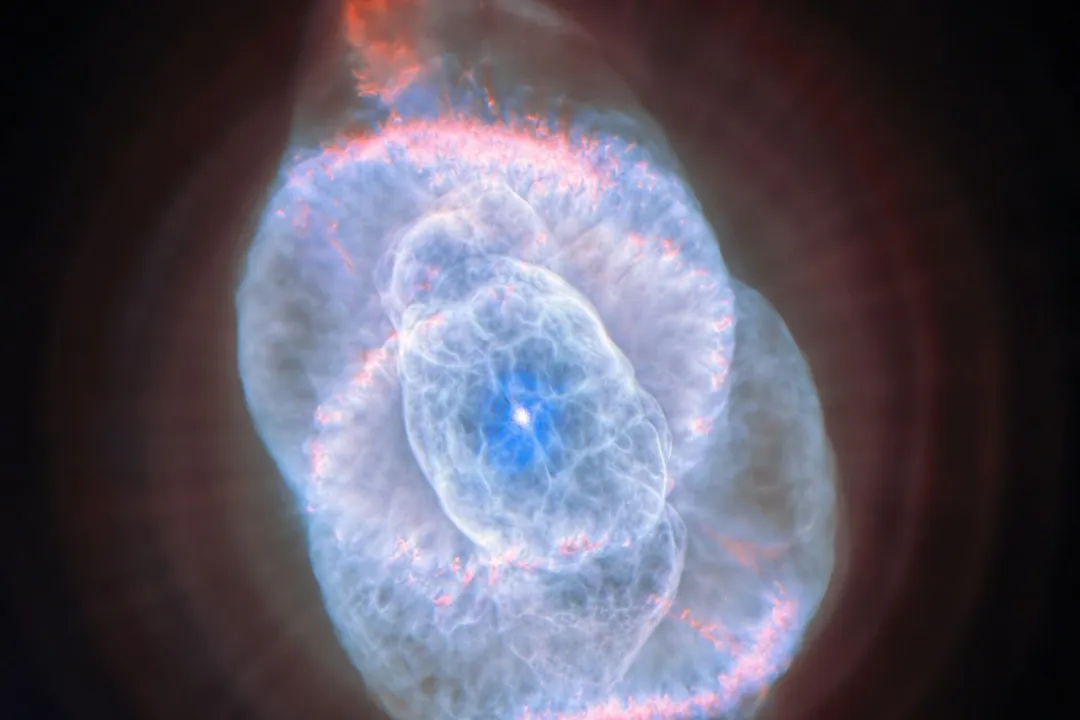
In approximately 5 billion years, the Sun will exhaust its nuclear fuel. It will transition into a red giant and subsequently shed its outer layers, just as the central star of the Cat's Eye Nebula is doing. While the Sun may not produce an object with the exact same level of complexity due to differences in mass and rotation, the fundamental physical processes regarding mass loss and the formation of a planetary nebula are the same.
Related Questions
In which constellation is the Cat's Eye Nebula, also known as NGC 6543, located?What physical process primarily causes the gas within the Cat's Eye Nebula to glow?What will the central star of the Cat's Eye Nebula ultimately become after shedding its layers?What phenomenon creates the sharp-edged, layered appearance observed in the Cat's Eye Nebula?What has the Chandra X-ray Observatory revealed about the interior of the Cat's Eye Nebula?Why is the structure of the Cat's Eye Nebula considered unusually complex for a planetary nebula?What is the ultimate fate of the gas shells defining the Cat's Eye Nebula after thousands of years?How will the Sun's life cycle eventually compare to the evolution of the Cat's Eye Nebula?Which chemical elements are mentioned as being distributed back into the interstellar medium by the Cat's Eye Nebula?What limitation do astronomers face when observing the current structure of the Cat's Eye Nebula?