What happened as the nebula became denser?
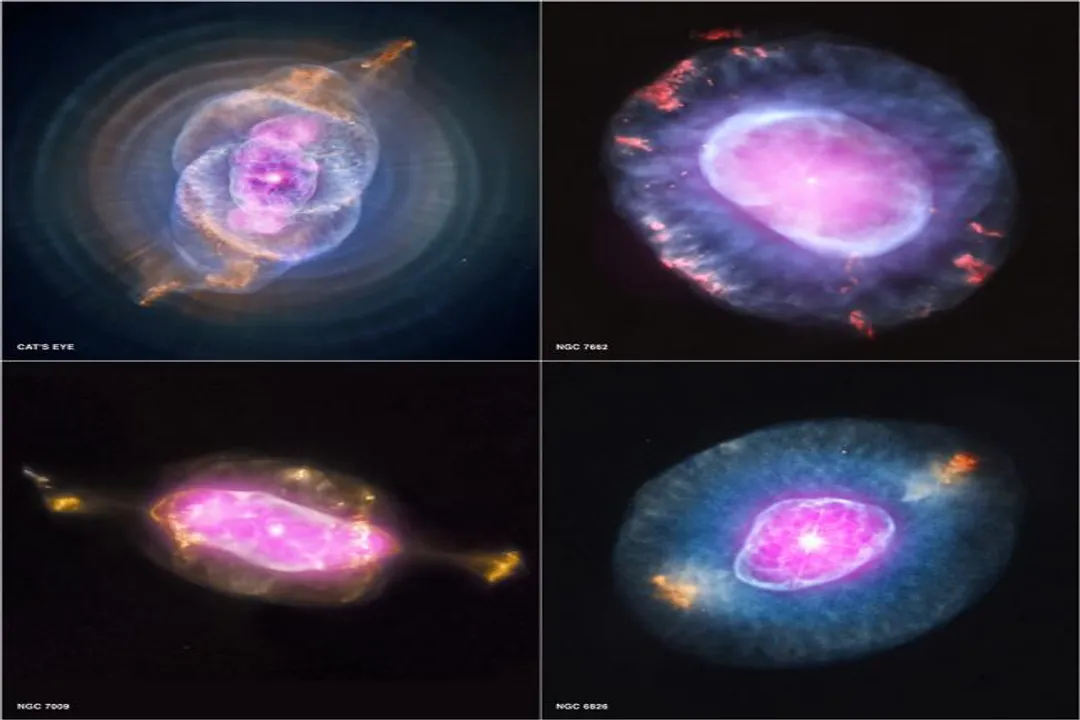
The transformation that occurs as a vast, diffuse cloud of gas and dust—a nebula—begins to compress is the foundational step in creating new stars and solar systems. These expansive stellar nurseries, composed primarily of hydrogen and helium along with trace amounts of heavier elements, represent immense reservoirs of raw material scattered across space. [2][5] What happens when this material stops remaining dispersed and starts to aggregate is a direct result of fundamental cosmic forces taking hold.
# Cloud Genesis
A nebula exists in a state of near-balance, a subtle equilibrium between the outward pressure from its own sparse heat and the relentless inward tug of gravity. [5] These structures can be truly gigantic, often spanning many light-years across the cosmos. [8] For context, even the closest star system, Alpha Centauri, is over four light-years away; a single, large star-forming nebula can encompass volumes of space equivalent to that entire distance or much more. [8] This initial state is one of extremely low density, far less dense than the best vacuum achievable in a laboratory on Earth. [8] Stars, which are incredibly dense objects by comparison, cannot form until this tenuous material is forced to consolidate.
# Gravity's Pull
The critical event initiating the collapse, and thus the process of increasing density, is the action of gravity. [4][5][8] While the cloud is generally spread out, there are always slight, random variations in the density of the gas and dust—small ripples or clumps that already possess a slightly higher concentration of mass in a localized area. [2] When gravity successfully dominates the internal pressure within one of these slightly denser regions, a runaway process begins. The region starts to contract; as it pulls in more surrounding material, its own mass increases, which in turn strengthens its gravitational pull, drawing in matter even faster. [2] This feedback loop is the engine that drives density upward.
It's worth pausing here to consider the magnitude of the initial trigger. Since the starting density is so incredibly low, any slight unevenness that manages to initiate a gravitational collapse becomes the seed for an entire star. The specific structure and initial distribution of this seed material dictate the final mass and type of star that will eventually form, a point of immense interest in astrophysics regarding how stars end up being Sun-like versus massive giants.
# Material Clumping
As this contraction proceeds, the overall density within the collapsing core increases dramatically, and the physical state of the matter begins to change. [6] The kinetic energy of the infalling particles starts to convert into thermal energy; essentially, the matter heats up as it gets squeezed. [6] This contracting, heating clump is no longer just a piece of the larger nebula; it is becoming a distinct object called a protostar. [6] This phase marks the definitive end of the diffuse nebula stage for that particular region. The material is now localized, falling inward rapidly, and undergoing fundamental physical changes driven by compression.
The process isn't uniform. While the central region heats and contracts rapidly, the outer layers might continue to feed material onto this growing core over millions of years, often forming a spinning disk of accreting matter around the nascent star. The crucial change driven by density, however, is happening in that center, where temperatures and pressures are skyrocketing toward the thresholds required for nuclear fusion.
# Stellar Nursery Role
It is important to differentiate this process from other events in a nebula’s life cycle, such as the formation of planetary nebulae, which occur at the end of a star’s life when it gently puffs off its outer layers. [9] The density increase we are discussing is the precursor to stellar birth. Nebulae are the actual stellar nurseries where this birth occurs. [1][2][5] The contrast between the vast, cool, dark expanse of the original cloud and the extremely hot, bright proto-star forming at its heart illustrates the physical transformation that increased density forces upon the matter.
For clarity, consider this basic progression summarizing the change in state:
| State | Primary Force | Density/Temperature | Resulting Structure |
|---|---|---|---|
| Diffuse Nebula | Equilibrium | Very Low | Vast Cloud |
| Early Collapse | Gravity Dominates | Increasing | Dense Core Forms |
| Protostar Stage | Intense Gravitational Infall | High/Rising | Heating, Pre-Fusion Object |
This steady accumulation of mass and subsequent density rise is precisely what separates the nebula from a star. The nebula is simply the potential for stars, while the dense, collapsing core embodies the process of becoming one.
# Protostar Ignition
The culmination of the density increase is the point where the core becomes hot and compressed enough for hydrogen nuclei to begin fusing into helium, releasing massive amounts of energy. This event, known as the start of nuclear fusion, officially marks the birth of a true star, transitioning it away from being merely a protostar. [6] Before this ignition, the object was glowing solely due to the heat generated by gravitational collapse; afterward, it becomes self-sustaining. The extreme conditions required—millions of degrees Celsius and immense pressures—are only achievable through the deep, sustained compression of the initially sparse nebular gas and dust. The initial density fluctuation dictated where this event would happen; the ongoing gravitational collapse determined when it would happen.
Related Questions
#Citations
What happened as the nebula became denser due to increasing ...
Hubble's Nebulae - NASA Science
What happened as the nebula became denser due to ... - Brainly
The Outer Planets: A Star is Born
Life cycle of a star ✍️ Nebula: A vast cloud of gas and dust where ...
Protostars and Nebulae - ASPIRE
chapter 3 section 1 Flashcards - Quizlet
How big are nebulae, what causes them, and what do they form later ...
Planetary Nebulas - Center for Astrophysics | Harvard & Smithsonian