What will happen to the cat's eye nebula in the future?
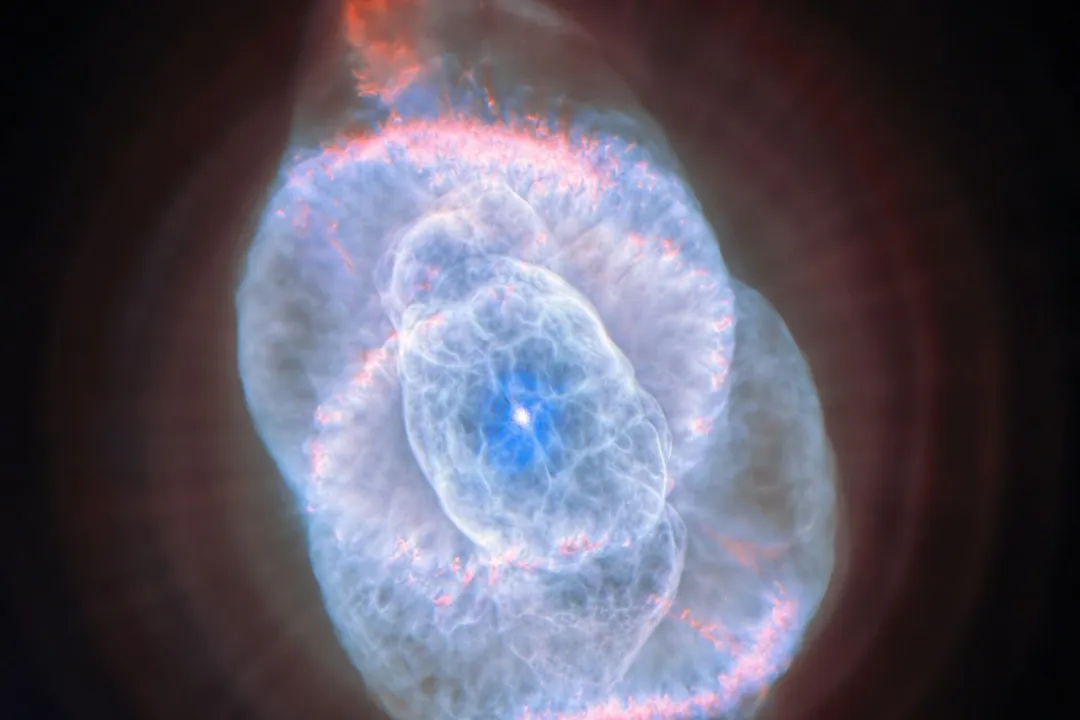
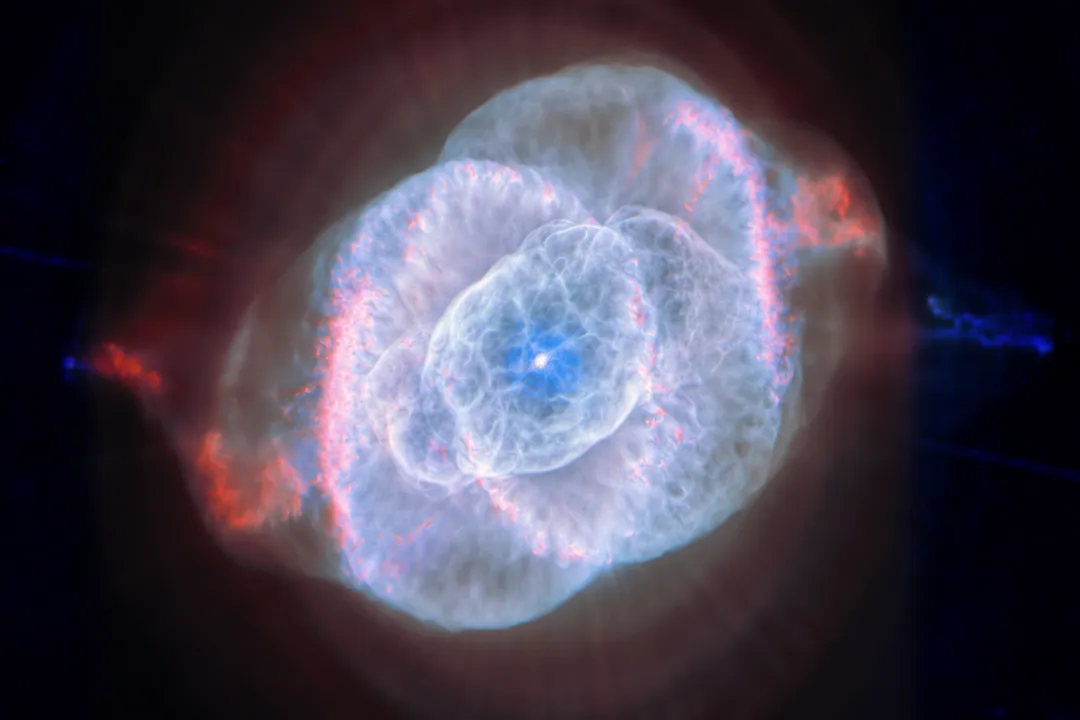
The Cat's Eye Nebula, cataloged as NGC 6543, serves as a prominent example of how stars conclude their active lives. [8] Located in the constellation Draco, this object presents a highly complex structure that astronomers use to study the chaotic processes surrounding stellar death. [8] When observing this nebula, we are essentially looking at a star that has begun shedding its outer layers into space, creating the intricate, shell-like patterns that give the object its distinctive name. [1][5]
The current appearance of the nebula is defined by a series of concentric gas shells, jets of high-speed gas, and unusual knots of material. [1][7] These features are not static; they are the physical results of the central star's volatile behavior. As the star exhausts its nuclear fuel, it becomes unstable, leading to a series of pulsations that eject material in different directions and at varying velocities. [5] The interaction between these older ejections and newer, faster stellar winds creates the sharp-edged, layered look seen in images from telescopes like Hubble and Euclid. [1][5]
# Stellar Evolution
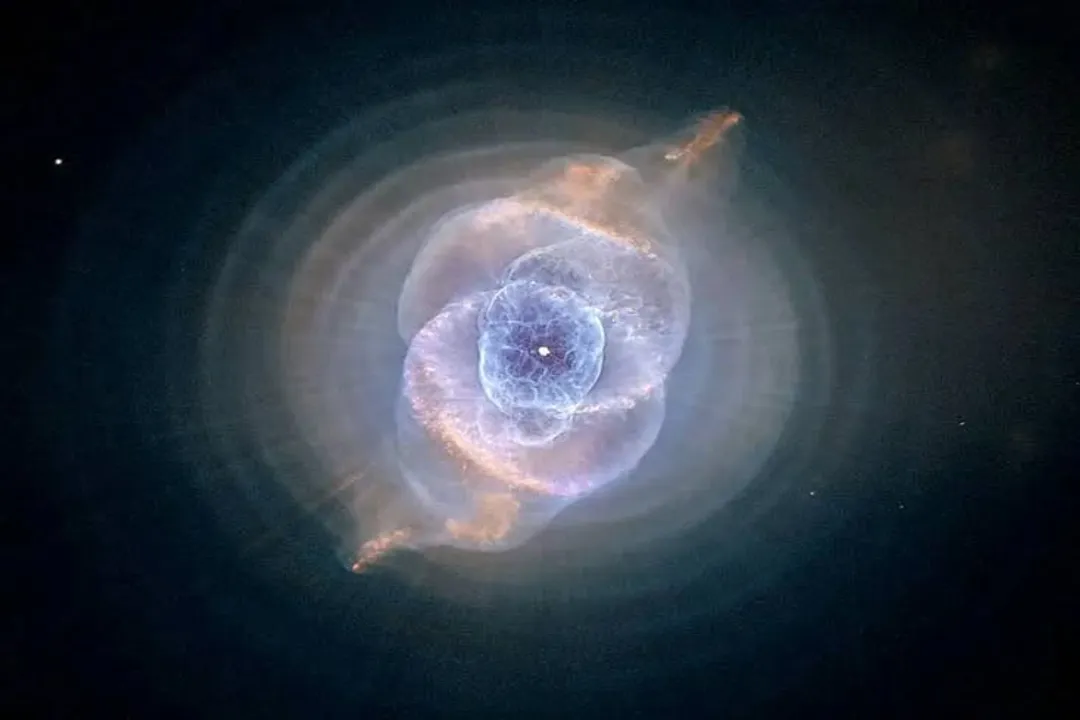
To understand what awaits the Cat's Eye Nebula, one must first look at the state of the central star. It is currently in a transition phase, moving from being a red giant toward the final white dwarf stage. [8] During this period, the star is intensely hot, emitting strong ultraviolet radiation that ionizes the gas it has already expelled, causing it to glow. [8] This ionization is what makes the nebula visible to us across interstellar distances. [5]
The central star is currently shedding mass at a significant rate. This process is not a smooth, singular event but a series of episodic outbursts. [1] Observations utilizing X-ray data from the Chandra X-ray Observatory reveal that the interior of the nebula contains high-energy gas heated to millions of degrees. [3] This suggests that the star is currently producing strong winds that are colliding with the slower-moving gas ejected previously. [3] This collision creates a shock front, which contributes to the diffuse X-ray glow observed in the center. [3]
As the central star continues to lose mass, its core will eventually become exposed. This core, which will essentially be the stripped-down, degenerate remains of the star, will become a white dwarf. [8] This remnant will be incredibly dense—containing roughly the mass of the Sun squeezed into a volume comparable to Earth—but it will lack the nuclear fuel to sustain fusion. [8]
# Future Dissipation
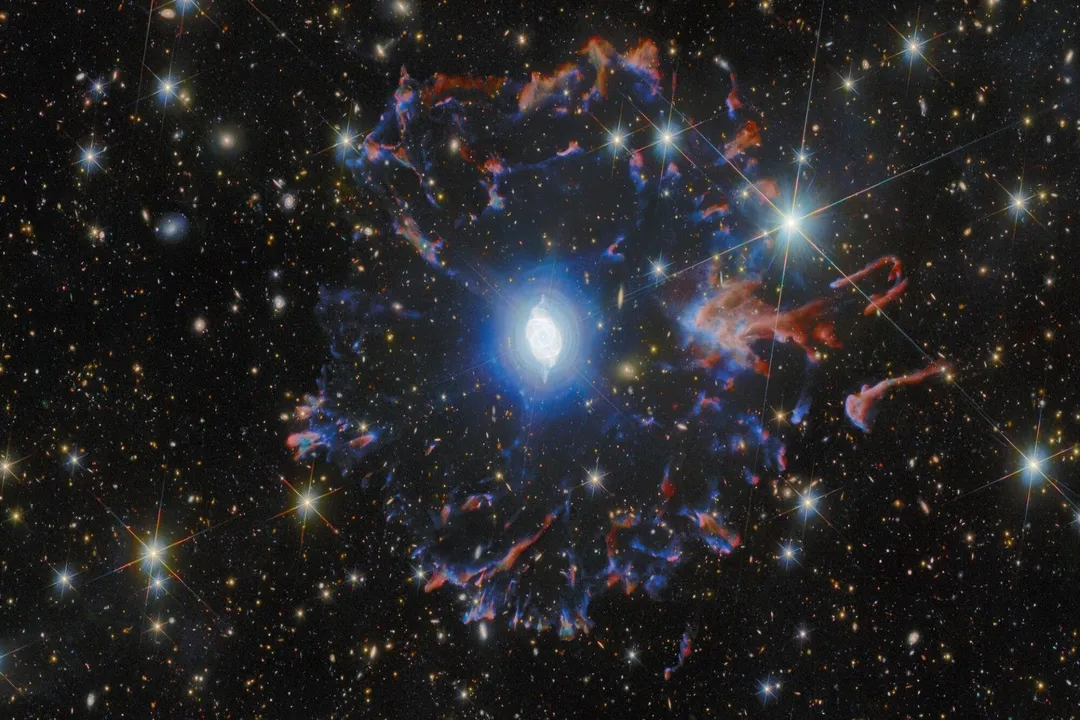
The future of the Cat's Eye Nebula is one of inevitable fading. Over the next several thousand years, the gas shells currently defining the "cat's eye" shape will continue to expand outward into the surrounding interstellar medium. [8] As this gas moves further from the central white dwarf, its density will decrease, and the intensity of the ionizing radiation from the cooling star will weaken. [8]
Eventually, the gas will become too thin and too distant from the central source to glow with the same brightness seen today. The nebula will effectively dissolve into the background of the galaxy, contributing its enriched chemical elements—such as carbon, nitrogen, and oxygen—to the interstellar medium. [8] This material, seeded with heavier elements created during the star's nuclear life, will eventually mix with local gas clouds, potentially becoming the raw material for future generations of stars and planetary systems.
The white dwarf itself will persist for an immense period. Without a source of fuel, it will slowly radiate away its residual thermal energy. [8] While the nebula will vanish from our view, the white dwarf will remain, gradually cooling over billions of years until it becomes a cold, dark cinder, effectively ending its visibility. [8]
| Phase | Activity | Estimated Impact |
|---|---|---|
| Current | Ionization | Nebula glows brightly due to UV radiation |
| Medium-term | Expansion | Gas clouds thin out and drift into space |
| Long-term | Dissipation | Nebula disappears; white dwarf cools |
# Observational Constraints
The way we perceive the future of the Cat's Eye Nebula is heavily dependent on our observational technology. Because the nebula is located approximately 3,000 light-years away, we are viewing it as it appeared 3,000 years ago. [8] While this distance is relatively close in galactic terms, it means we cannot witness real-time changes in its structure. We must rely on astrophysical models to predict its evolution. [8]
A critical aspect of our understanding involves the resolution of our instruments. Older telescopes showed a relatively simple, circular cloud. Modern instruments, such as the Hubble Space Telescope and the James Webb Space Telescope, have revealed that the "eye" is actually part of a much more complex, multi-layered system involving bipolar jets and turbulent knots. [1][5]
One interesting analytical perspective involves the "age" of the different components. By analyzing the expansion rates of the different shells and knots, astronomers can create a timeline of the star’s final death throes. Some of the outer, slower-moving shells appear to have been ejected roughly 1,000 years ago, while the inner, more chaotic features are much younger. [5] This means that the "face" of the nebula has been constantly changing on a human timescale, even if we are only seeing a static image at any one moment. [5]
# Comparative Dynamics
The Cat's Eye Nebula is often compared to other planetary nebulae, yet it stands out due to its extreme complexity. Many planetary nebulae exhibit simple, spherical, or bipolar symmetry. The Cat's Eye, however, contains multiple concentric rings and twisted knots of material that do not follow a simple expansion model. [1][5]
This complexity suggests that the central star likely has a binary companion, or perhaps even a more complex multi-star system. [8] A binary star system can create more complex patterns through gravitational interactions and the accretion of material, which might explain the high-speed jets and the skewed distribution of the ejected gas. [8] If a companion star is involved, it will not dissipate in the same way as the primary star. It will remain in the system, potentially influencing the final cooling rate of the white dwarf or even delaying the dissipation of the remaining gas by continuing to provide energy or material. [8]
# Scientific Value
The study of this nebula provides a preview of our own Sun's distant future. In about 5 billion years, the Sun will exhaust its nuclear fuel and undergo a similar transition, expanding into a red giant and eventually shedding its outer layers to form a planetary nebula. [8] While the Sun is unlikely to produce a nebula with the exact complexity of NGC 6543—which is influenced by the specific mass and rotation of the star—the physical processes are fundamentally the same. [8]
Understanding the Cat's Eye Nebula is not just about cataloging a distant, beautiful object; it is about calibrating our models of stellar end-of-life cycles. Every jet of gas and every ionization front we measure helps refine our calculations of how much mass stars lose in their final stages and how that mass is redistributed into the galaxy. [1][3]
The transition from a vibrant, glowing cloud to a fading, invisible remnant is a slow, methodical process on a cosmic scale. While we cannot watch the nebula dissipate in a human lifetime, the data gathered from modern observatories allows us to construct a reliable narrative of its fate. The nebula will continue its expansion until it is nothing more than a faint whisper of gas in the vastness of the interstellar medium, leaving behind only a dense, cooling white dwarf as a record of the star that once was. [8]
Related Questions
#Citations
Telescopes Team Up for New View of Cat's Eye Nebula - NASA
Take a journey through space to the remnants of a dying star The ...
New "Realities" of The Cat's Eye Nebula | Chandra Blog
Cat's Eye Nebula - Astronomers Without Borders
Hubble & Euclid zoom into cosmic eye - European Space Agency
A star dies in the Cat's Eye | Space photo of the day for March 10, 2026
Cat's Eye Nebula - Wikipedia
Two telescopes have teamed up for sharpest ever photos of Cat's ...