How quickly might recent simulations suggest the Moon accreted from the orbiting debris ring?
Answer
In a matter of hours or days
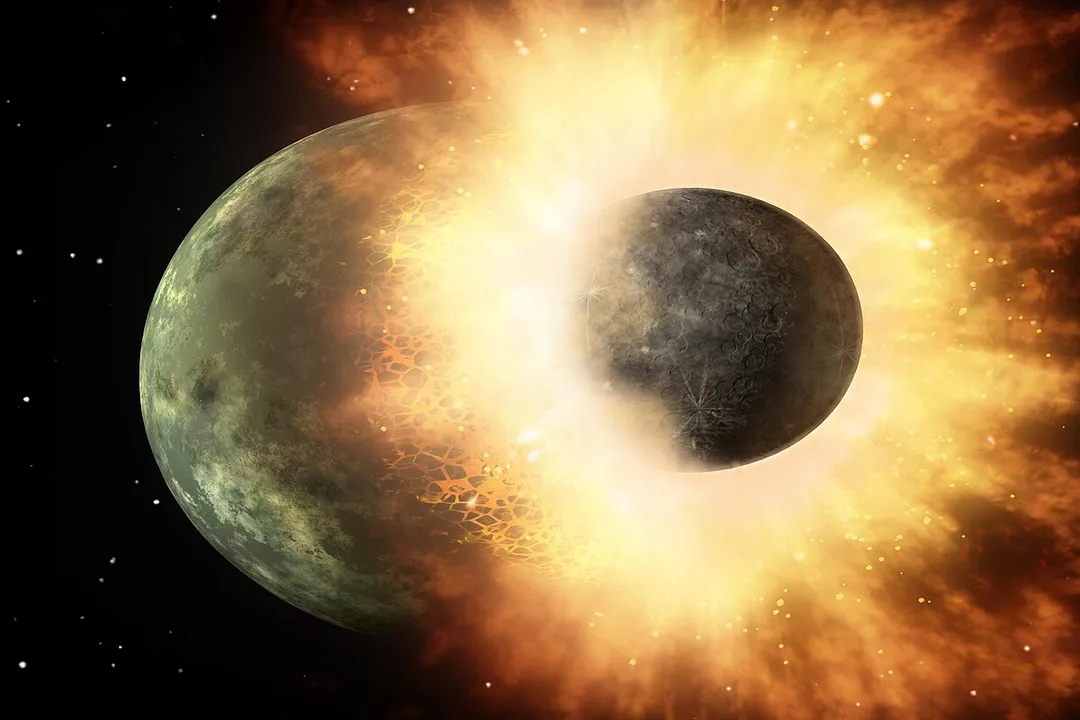
The timeline for the Moon's formation following the catastrophic impact has been dramatically revised based on newer computer simulations. While earlier scientific proposals estimated that the debris ring—composed of vaporized rock and molten material ejected into orbit around Earth—would take centuries or millennia to accrete into a stable satellite, recent modeling suggests a much more rapid genesis. These newer analyses indicate that the accretion process, where particles clumped together, could have occurred exceptionally fast, potentially forming the Moon in a timeframe measured in mere hours or days.
#Videos
What was Theia like? - YouTube
Related Questions
What size entity is the hypothetical protoplanet Theia estimated to be based on scientific models?What impact angle does the Giant-Impact Hypothesis suggest Theia used against the young Earth?What deep Earth structures are suggested to be the undigested remnants of Theia?Where are the two massive Large Low-Shear-Velocity Provinces (LLSVPs) primarily situated deep within the Earth?How quickly might recent simulations suggest the Moon accreted from the orbiting debris ring?What specific chemical similarity in lunar rocks strongly supports the Giant-Impact model?From which mythological figure is the hypothetical name Theia derived?What major outcome might have resulted if Theia had struck Earth in a perfectly head-on smash?What is the established relative size relationship between the Earth and the resulting Moon?How did the dense and light components of Theia contribute to the deep Earth structures after impact?