Which planet has collided with Earth?
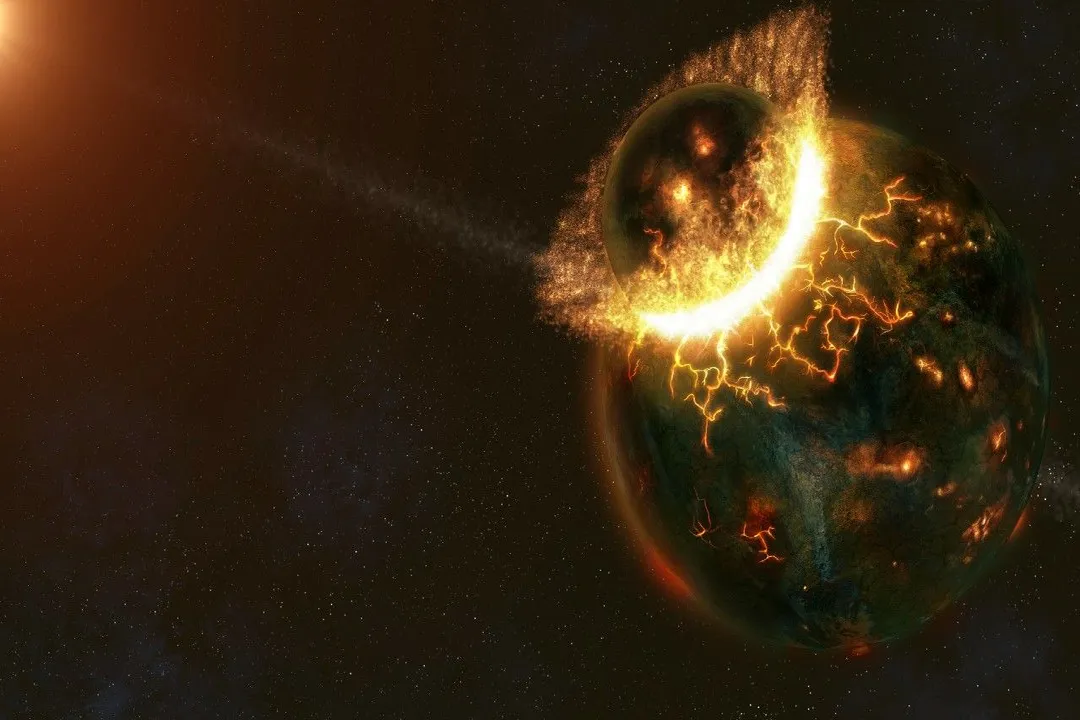
Earth hasn't always been the stable, life-sustaining rock we inhabit today. Roughly 4.5 billion years ago, during the chaotic infancy of the solar system, our planet endured a catastrophic collision that forever shaped its destiny. A massive, Mars-sized body slammed into the young Earth, scattering debris into orbit that eventually coalesced to form our Moon. [1][2] This hypothetical planet is known as Theia.
The collision theory, often referred to as the Giant Impact Hypothesis, provides the most widely accepted explanation for the origin of the Moon. [1][5] Without this violent event, Earth would likely lack its large natural satellite, which stabilizes the planet’s axial tilt and influences the tides, both of which have been vital for the development of complex life. [6]
# Meet Theia
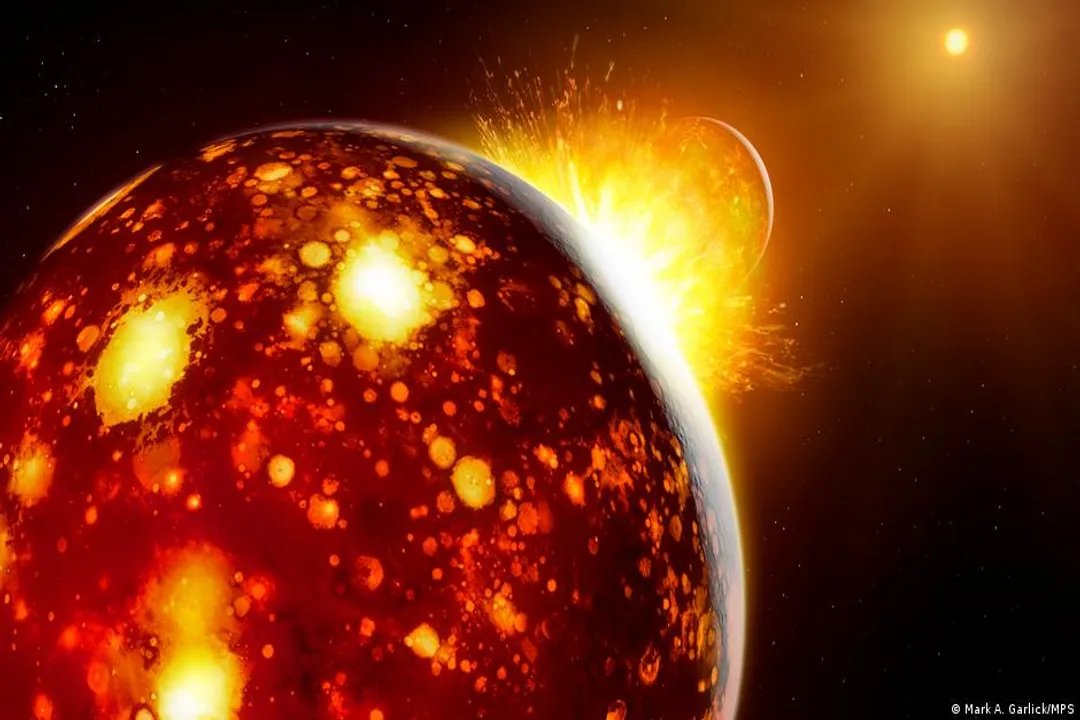
The name "Theia" is derived from Greek mythology. In the myths, Theia was a Titan and the mother of Selene, the goddess of the Moon. [1] Scientists adopted this name for the rogue planet because of the direct connection between the impact event and the Moon's creation. [5]
While Theia no longer exists as a distinct planet, its legacy is effectively fused into both Earth and the Moon. Researchers estimate that Theia was roughly the size of Mars, possessing a similar silicate-rich composition. [1][2] It likely formed in the same general region of the solar system as Earth, which explains why the isotopic signatures of Moon rocks returned by Apollo missions are so remarkably similar to those found on Earth. [4][10]
To better understand the scale and nature of this object, we can compare its estimated properties against the Earth of that era:
| Feature | Early Earth | Theia (Estimated) |
|---|---|---|
| Diameter | ~8,000 miles | ~4,200 miles |
| Mass | ~1 Earth Mass | ~0.1 to 0.5 Earth Mass |
| Composition | Silicate/Iron | Silicate/Iron |
| Fate | Survived (with massive scars) | Destroyed/Merged |
This comparison highlights that Theia was not a minor asteroid or comet, but a planetary-scale object. Its collision was not a glancing blow, but a massive transfer of energy and material. [9]
# The Impact
For years, scientists debated whether the debris that formed the Moon came primarily from Theia or from Earth itself. Newer simulations and isotopic analyses have shifted our understanding. We now know that the collision was likely incredibly fast, occurring in a matter of hours rather than taking months or years for the debris to settle. [9]
When Theia struck Earth, the energy released was immense. The impact vaporized significant portions of both the outer layers of the Earth and the entirety of Theia. [3][8] This vaporized rock and magma were blasted into orbit. Because Theia and Earth shared similar oxygen isotopes—a chemical "fingerprint"—the resulting debris disk was a homogenous mixture of material from both worlds. [4][10]
This explains a long-standing puzzle in planetary science: why the Moon is almost identical to Earth in its isotopic composition, despite coming from an external object. If Theia had formed in a distant part of the solar system, the isotopic mismatch would be stark. However, the evidence points to Theia being a "neighbor" that formed in the same local orbital environment. [7][10]
# Lunar Birth
Once the debris disk was established in orbit around Earth, gravity began the work of aggregation. Unlike the slow process of planetary formation that takes millions of years, the Moon likely formed rapidly from this disk. [9] As the hot, vaporized debris cooled, it began to clump together. The proximity of this disk to Earth meant that the Moon likely formed in a very short time frame, potentially as quickly as a few hours to a few days. [9]
This rapid formation is a stark contrast to older theories which suggested the Moon accreted slowly over centuries. The speed of this process helps explain why the Moon has its current orbital characteristics and why its composition appears so intricately linked to the mantle of the early Earth. [5]
# Analyzing Odds
It is worth considering the element of chance in this scenario. Had the angle of impact been slightly different, or had Theia been significantly smaller or larger, the consequences for Earth would have been entirely different. If the impact had been too energetic, Earth might have been completely obliterated, preventing the formation of a stable orbit for the debris. [6]
If the impact had been too shallow, the debris might not have been ejected into orbit in sufficient quantities to form the Moon. [9] This creates an interesting perspective on planetary habitability: the existence of the Moon—and by extension, the stabilizing of Earth's climate through tides and axial tilt—may rely on a "Goldilocks" impact scenario. We essentially live on a world that survived a near-death experience, and that very catastrophe provided the stabilizing partner our planet needed to foster life over the next four billion years.
# Scientific Consensus
The Giant Impact Hypothesis, while widely accepted, continues to be refined by new data. Advances in high-resolution computer simulations allow researchers to test different impact scenarios, adjusting for speed, angle, and density. [9] Every new study seems to reinforce the core idea: Theia was real, it was an Earth-neighbor, and it died to build the Moon. [2][4]
Some critics previously pointed to the similarity in isotopes as a reason to doubt the Theia impact, arguing it would be too coincidental for a rogue planet to be so similar in composition to Earth. [6] However, the current consensus is that the similarity is not a coincidence, but a clue. It confirms that the collision happened locally, within the same feed of planetary material. [7][10]
This discovery changes how we view planetary formation. It suggests that solar systems are not merely orderly arrangements of planets, but violent, dynamic environments where the current residents are often the survivors of a much more crowded and dangerous past. [2][7] Theia is not just a footnote in history; it is a fundamental component of the Earth we know today.
#Videos
What was Theia like? - YouTube
Theia: When the Earth Destroyed its Sibling Planet | Netflix - YouTube
Related Questions
#Citations
Theia (hypothetical planet) - Wikipedia
A Planet Slammed Into Earth 4.5 Billion Years Ago, Forming the ...
What was Theia like? - YouTube
Planet that collided with Earth likely from our solar system; study finds
Theia (planet) | Astronomy and Astrophysics | Research Starters
I was just reading up on the ancient Theia planet that supposedly ...
Earth and Theia smashed to birth the moon, but did they first ... - Space
Collision May Have Formed the Moon in Mere Hours, Simulations ...
An ancient planet smashed into Earth. We now know its origin