Did any planet collide with Earth?
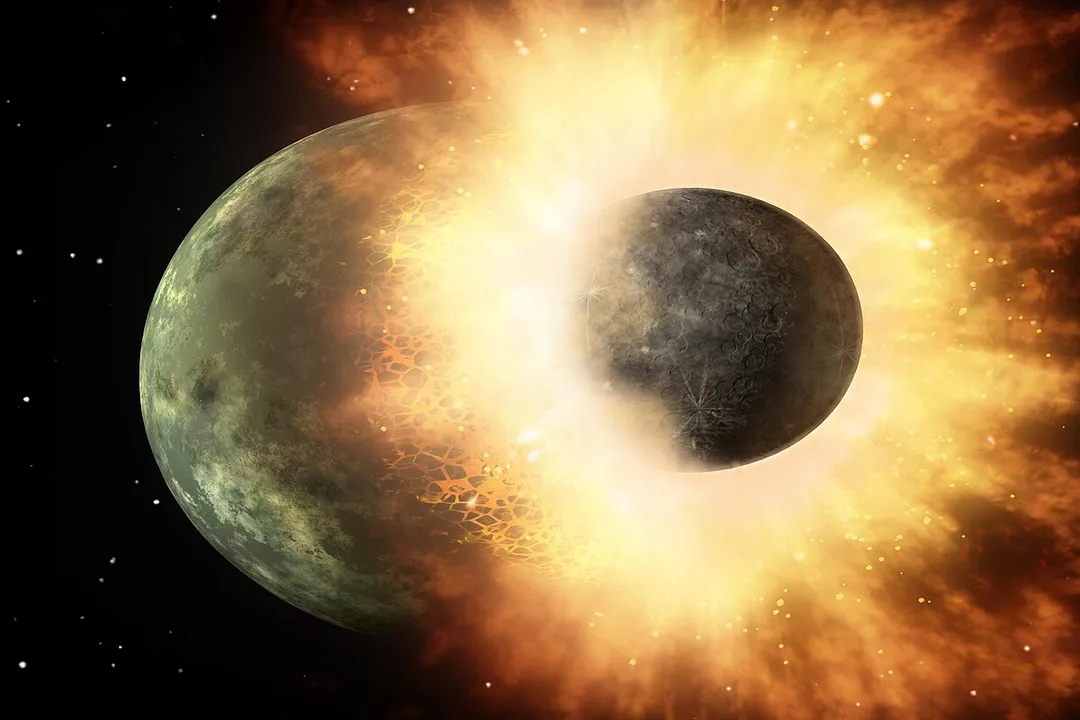
The idea that Earth once endured a catastrophic, world-altering impact from another planetary body is not just science fiction; it is the leading scientific explanation for how our Moon came into being. This immense collision involved a Mars-sized protoplanet, often referred to by the hypothetical name Theia, smashing into the nascent Earth roughly 4.5 billion years ago. [1] While it might sound like an apocalyptic event that ended the planet's story, this violent encounter was actually the crucial, fiery birth moment for Earth’s closest celestial neighbor and fundamentally shaped the planet we inhabit today. [3][5]
# Ancient Visitor
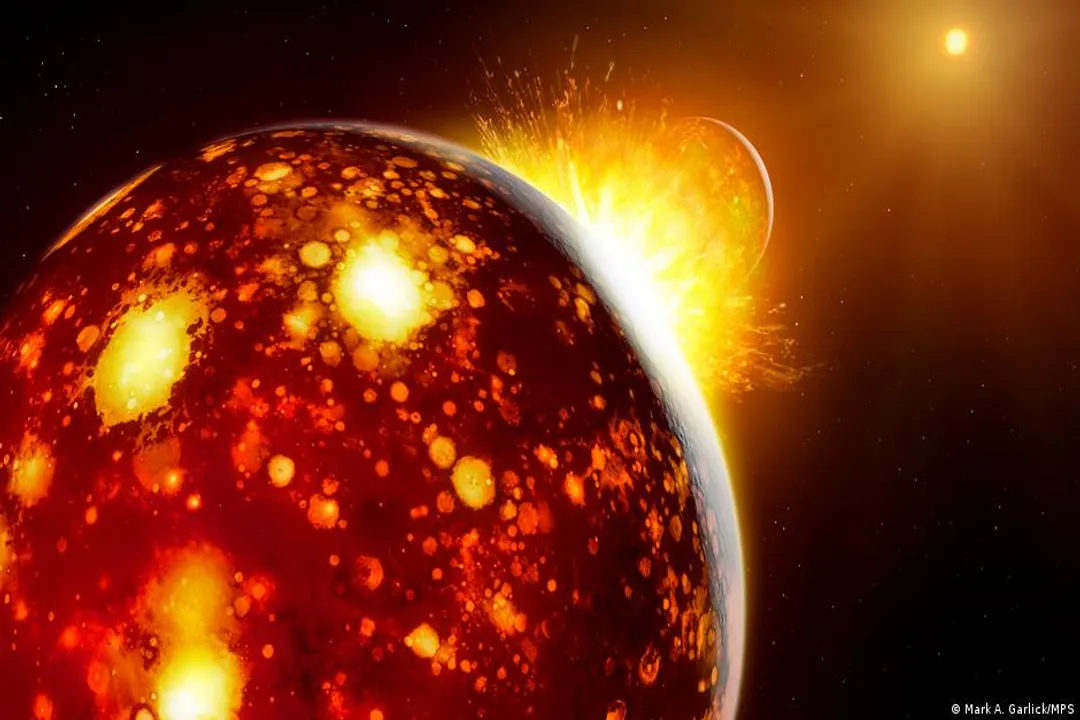
The entity believed responsible for this dramatic event is named Theia, a term derived from the Greek Titaness who was the mother of the Moon in mythology. [1] This object was likely a protoplanet, a building block of the Solar System still coalescing in the early, chaotic aftermath of the Sun’s formation. [7] Scientists estimate Theia was comparable in size to Mars, making it a substantial player in the early planetary lineup. [1] The collision itself is thought to have occurred shortly after the formation of the terrestrial planets, placing the event around 4.5 billion years ago. [1] Some analyses, however, suggest a slightly later timing, perhaps closer to 4 billion years ago, though the general consensus points toward the very early history of the Solar System. [5]
Geoscientists and astrophysicists have spent decades modeling this interaction, trying to reconcile the composition of the Moon with that of Earth. The prevailing theory, known as the Giant-Impact Hypothesis, suggests Theia struck the young Earth at a glancing angle rather than a direct head-on smash. [1] This specific angle and velocity were necessary to eject the right amount of material—a massive cloud of vaporized rock and debris—into orbit around Earth without completely disrupting our planet’s internal structure or sending all the material hurtling away into space. [2] If the impact had been perfectly head-on, much of Theia's material might have simply merged with Earth, or the energy might have been so immense that it vaporized both bodies entirely. [1] The Earth's neighbor hypothesis suggests Theia may have been orbiting near Earth in a co-orbital configuration before instability forced the collision. [5]
# Moon Genesis
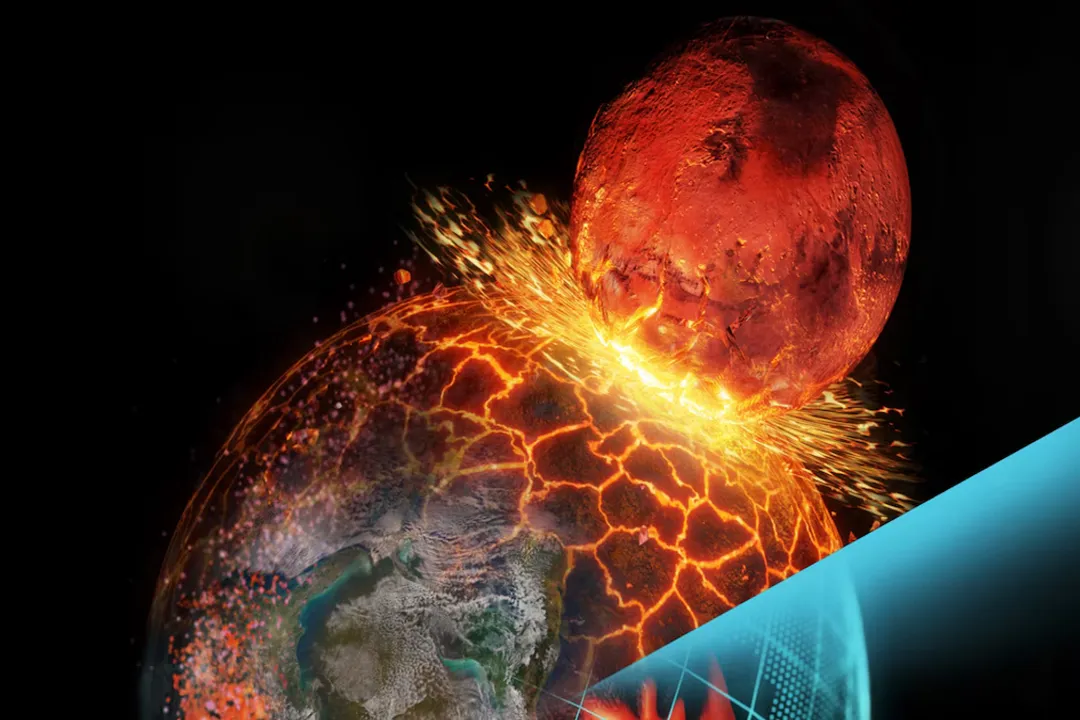
The immediate aftermath of the impact was a superheated, violent process that fundamentally altered both bodies. [5] The kinetic energy from the collision was tremendous, vaporizing significant portions of both Theia and Earth’s outer layers, creating a massive, orbiting ring of molten and vaporized rock. [1][9] This debris ring then began to rapidly accrete, or clump together, forming the Moon. [1] Intriguingly, simulations based on recent models suggest that this accretion process might have been far quicker than previously imagined, potentially forming the Moon in a matter of hours or days, rather than the centuries or millennia once proposed. [9]
The composition of the Moon is a major clue supporting this impact scenario. Lunar rocks brought back by the Apollo missions show striking similarities in oxygen isotope ratios to Earth’s mantle rocks, suggesting the Moon is made largely from terrestrial and impactor material mixed together in the ejected plume. [1] The impact wasn't just an external event; it was a mixing event on a planetary scale. It provided the necessary energy to completely melt and differentiate the early Earth, setting the stage for the internal layers we observe today. [3]
If we consider the scale of planetary formation, it is worth noting that the Moon is exceptionally large relative to its host planet—it is about one-quarter the diameter of Earth. [1] Such a massive satellite is rare in our Solar System, lending credence to the idea that its formation required an equally rare, massive, and singular event like the Theia impact, rather than gradual accretion from a smaller dust cloud.
# Deep Earth Imprints
The evidence for Theia’s existence is not just theoretical; scientists are finding what they believe are its lasting geological fingerprints buried deep within Earth’s own structure. [3][4] Deep beneath the surface, roughly spanning the core-mantle boundary, exist two massive, oddly shaped structures known as Large Low-Shear-Velocity Provinces (LLSVPs). [4] One lies beneath the Pacific Ocean, and the other is situated beneath Africa. [4] These provinces are chemically distinct from the surrounding mantle material and are significantly hotter than the material around them. [3][4]
New research suggests that these massive anomalies might be the undigested remnants of Theia itself, or at least the bulk of the impactor that failed to fully mix with Earth's mantle. [3][4] When Theia struck, some of its dense core may have sunk directly to the core-mantle boundary, while the lighter, silicate mantle material of Theia remained suspended in Earth’s mantle, eventually collecting into these two LLSVPs. [3] These structures represent a colossal amount of material—enough to fill the Pacific Ocean many times over—that has remained chemically isolated for billions of years. [4] The fact that these zones persist today, resisting total homogenization over eons of convection, speaks volumes about the sheer scale and violence of the initial collision. [3] Finding these large, distinct reservoirs deep inside our planet provides one of the most compelling lines of evidence supporting the giant-impact theory over alternative formation scenarios, such as the Moon forming elsewhere and being captured later. [4]
# Varying Impact Models
While the core concept of a Theia impact remains solid, the specifics of how it happened continue to be refined through complex computer simulations. Early models often favored a scenario where Theia was roughly the size of Mars, striking Earth at a high velocity. [1] However, newer simulations have shown that to achieve the observed similarity in isotopic composition between the Earth and Moon, the impactor might have needed to be smaller, or the impact itself might have needed to be slower and more of a "grazing blow". [2]
One interesting variation suggested by some models is that Theia might have been Earth’s neighbor in the Sun-Earth L4 or L5 Lagrange points—areas where gravitational forces stabilize objects—before being perturbed and sent into a collision course. [5] Another possibility explored involves an impactor smaller than Mars, perhaps only the size of a single ocean, but striking with extreme speed, which would also eject enough material for lunar formation. [1] The key takeaway from this ongoing refinement is that the Solar System was a much messier, more violent place four and a half billion years ago than the orderly system we observe now, full of bodies on chaotic orbits. [7] The success of a model is often judged by its ability to explain three things: the Moon's angular momentum, its orbital parameters, and its bulk composition compared to Earth's mantle. [1]
It is a fascinating exercise to consider the long-term thermal implications of such an event. A collision of this magnitude would have instantly raised the temperature of the entire Earth’s surface and possibly the bulk mantle to near-liquid states. [3] This massive influx of heat, coupled with the material from Theia, would have essentially reset the planet’s internal thermal budget. For a new planet forming under these conditions, the initial thermal state dictates everything from the early differentiation of core and mantle to the onset of plate tectonics much later. While we cannot directly measure the heat from 4.5 billion years ago, the current temperature gradients observed in the LLSVPs suggest that the material there has cooled at a different rate than the rest of the mantle, acting as a massive, deep-seated thermal "insulator" or anomaly for an immense duration. [4] This implies that the deep Earth today retains a structural memory of the very first, most energetic geological event in our planet's history.
Another way to frame the significance of this impact is to look at the timeline relative to other milestones. If we approximate Earth’s total history to a single calendar year, the Theia impact happens very early, perhaps in late January or early February. [5] The oldest rocks we find on Earth date back to about 4 billion years ago, and life appears shortly after that. [5] This means the entirety of Earth's long, stable history—the evolution of oceans, the rise of continents, the development of complex life—has unfolded after this initial, violent collision ripped a satellite from our planet's grasp. The Moon, therefore, is not just a bystander; it’s the preserved scar tissue of Earth’s infancy.
# Solar System Chaos
The collision between Earth and Theia was not an isolated incident in the early Solar System; rather, it was part of a period of intense bombardment and planetary formation characterized by bodies constantly being knocked off course. [7] Scientists theorize that multiple impacts, perhaps even a series of close calls or smaller collisions, may have been necessary to build the terrestrial planets up to their current sizes. [7] The impact that formed the Moon was simply the largest, most definitive smash that left an indelible mark on Earth itself, as opposed to just adding mass to the growing planet. [1]
While Theia is the star of this specific narrative, the principles governing its demise—gravitational instability, high-velocity impacts, and the rapid merging of planetary building blocks—were the engine driving the entire inner Solar System’s evolution. [7] The evidence of this violent era is written across the face of the Moon, which lacks the active geological resurfacing that has erased much of the early impact record from Earth's surface. Understanding the Theia event, therefore, gives us a crucial key to unlocking the entire story of terrestrial planet accretion, including Mercury, Venus, and Mars.
The current consensus, supported by the isotopic matching and the discovery of deep mantle anomalies, firmly points to a planetary collision as the genesis of the Moon. [3][4] It was an event so violent it birthed a new celestial body from the fragments of two worlds, an event whose deep, chemical shadows we can still map today within our own planet’s interior. [3] It underscores a vital, if terrifying, fact: our planet was forged in fire and chaos, and the presence of our stable, familiar satellite is the direct result of that primordial catastrophe. [1][9]
#Videos
What was Theia like? - YouTube
Related Questions
#Citations
Theia (hypothetical planet) - Wikipedia
I was just reading up on the ancient Theia planet that supposedly ...
4.5 billion years ago, another planet crashed into Earth. We may ...
The Remains of an Ancient Planet Lie Deep Within Earth - Caltech
What was Theia like? - YouTube
A Planet Slammed Into Earth 4.5 Billion Years Ago, Forming the ...
Solar System on a Collision Course | Science | AAAS
An ancient planet smashed into Earth. We now know its origin - DW
Collision May Have Formed the Moon in Mere Hours, Simulations ...