Why is resolving fine structural details within a galaxy billions of light-years away exceptionally difficult?
Answer
The galaxy subtends an extremely tiny angle in the sky due to cosmological distances.
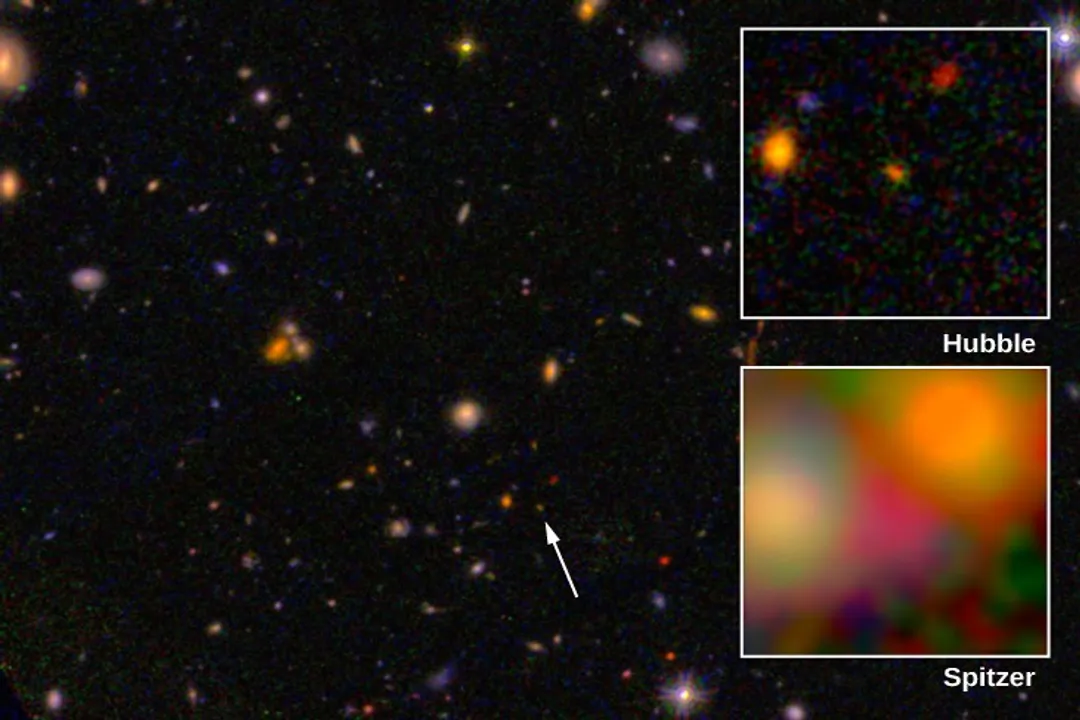
Angular resolution, the ability to distinguish between two closely spaced points, is severely limited when viewing objects at cosmological distances. Even massive galaxies, like the Milky Way, subtend an angle so small in the sky that their internal structures—such as spiral arms or star-forming clumps—appear smeared together. While techniques like adaptive optics or space telescopes mitigate atmospheric blurring, the fundamental geometric limitation imposed by the extreme angular size makes resolving fine internal morphology nearly impossible.
Related Questions
How does light intensity from a distant galaxy diminish according to the inverse square law?What spectral shift occurs when light from distant galaxies is stretched by the expansion of space?Why are instruments like the Herschel Space Telescope designed specifically for infrared capture?What is the primary characteristic of the cosmic environment observed when looking at a galaxy 13 billion light-years away?Why is resolving fine structural details within a galaxy billions of light-years away exceptionally difficult?How does uncertainty in the distance estimate affect judging a distant galaxy's true power output?What process is usually required to confirm that a faint, fuzzy object is indeed a distant galaxy rather than foreground contamination?What observation regarding very distant galaxies repeatedly challenges existing paradigms of galaxy evolution?How does the light travel time for a nearby nebula in the Milky Way contrast with light from a high-redshift galaxy?What outcome might an astronomer face when pointing a standard optical telescope at an extremely distant object?