What outcome might an astronomer face when pointing a standard optical telescope at an extremely distant object?
Answer
Seeing nothing, or only the faintest, reddest components within the visible range.
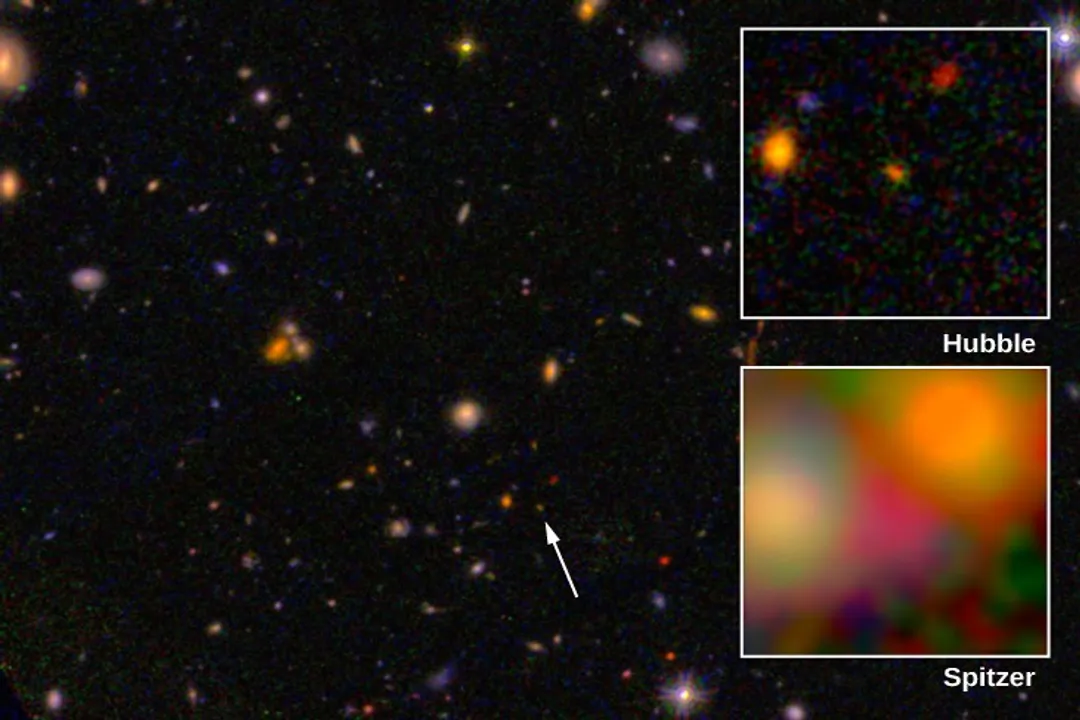
If an astronomer uses only an optical telescope on an extremely distant object, they face two major problems exacerbated by this choice of instrument. First, the light has been redshifted heavily by cosmic expansion, pushing much of the emitted energy out of the visible spectrum and into the infrared where the optical telescope is insensitive. Second, the object is incredibly faint. Consequently, the optical telescope might detect nothing at all, or perhaps only the residual light that managed to stay in the visible range, leading to an incomplete and skewed understanding of the galaxy's total light output and activity.
Related Questions
How does light intensity from a distant galaxy diminish according to the inverse square law?What spectral shift occurs when light from distant galaxies is stretched by the expansion of space?Why are instruments like the Herschel Space Telescope designed specifically for infrared capture?What is the primary characteristic of the cosmic environment observed when looking at a galaxy 13 billion light-years away?Why is resolving fine structural details within a galaxy billions of light-years away exceptionally difficult?How does uncertainty in the distance estimate affect judging a distant galaxy's true power output?What process is usually required to confirm that a faint, fuzzy object is indeed a distant galaxy rather than foreground contamination?What observation regarding very distant galaxies repeatedly challenges existing paradigms of galaxy evolution?How does the light travel time for a nearby nebula in the Milky Way contrast with light from a high-redshift galaxy?What outcome might an astronomer face when pointing a standard optical telescope at an extremely distant object?