What observation regarding very distant galaxies repeatedly challenges existing paradigms of galaxy evolution?
Answer
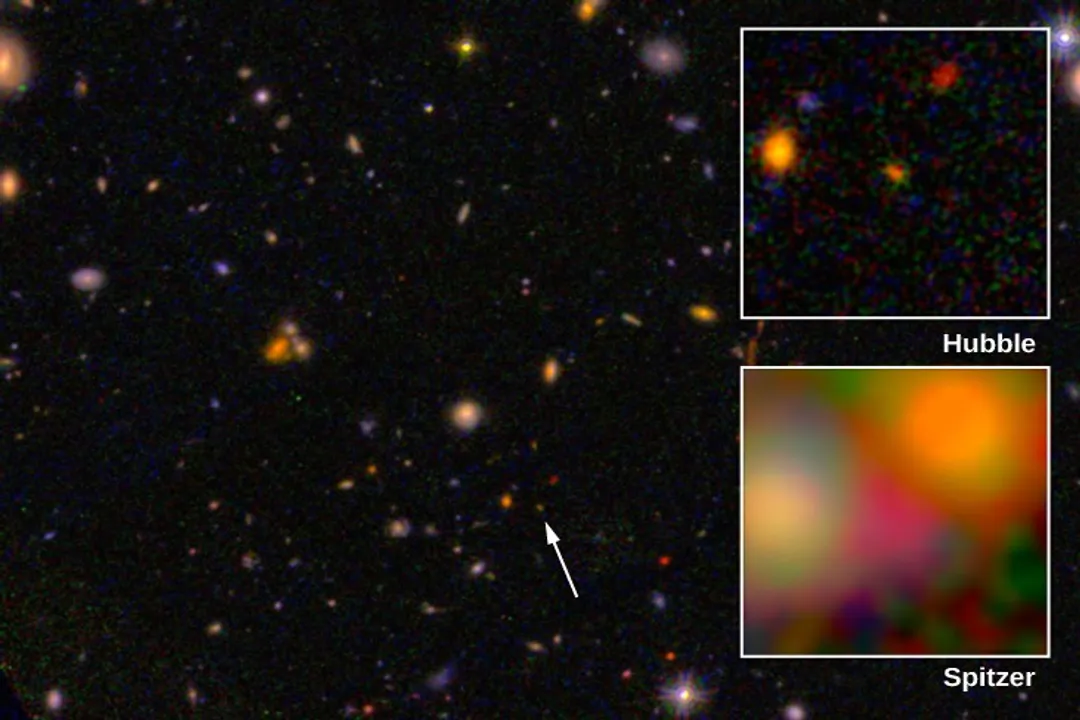
Finding massive, mature galaxies very early in cosmic history.
The finding that some galaxies observed at very early stages of cosmic history already appear massive and structurally mature contradicts established theoretical models that predicted a slower, more gradual build-up of stellar mass and structure over time. When observational data, despite potential errors from faintness or resolution, robustly confirms such a finding, it forces theoretical astronomers to revise their underlying assumptions about how rapidly and efficiently star formation and galaxy assembly must have proceeded in the primordial universe.
Related Questions
How does light intensity from a distant galaxy diminish according to the inverse square law?What spectral shift occurs when light from distant galaxies is stretched by the expansion of space?Why are instruments like the Herschel Space Telescope designed specifically for infrared capture?What is the primary characteristic of the cosmic environment observed when looking at a galaxy 13 billion light-years away?Why is resolving fine structural details within a galaxy billions of light-years away exceptionally difficult?How does uncertainty in the distance estimate affect judging a distant galaxy's true power output?What process is usually required to confirm that a faint, fuzzy object is indeed a distant galaxy rather than foreground contamination?What observation regarding very distant galaxies repeatedly challenges existing paradigms of galaxy evolution?How does the light travel time for a nearby nebula in the Milky Way contrast with light from a high-redshift galaxy?What outcome might an astronomer face when pointing a standard optical telescope at an extremely distant object?