Which Galilean moon is differentiated into a rock/ice blend and is notable for retaining the oldest, most heavily cratered surface?
Answer
Callisto
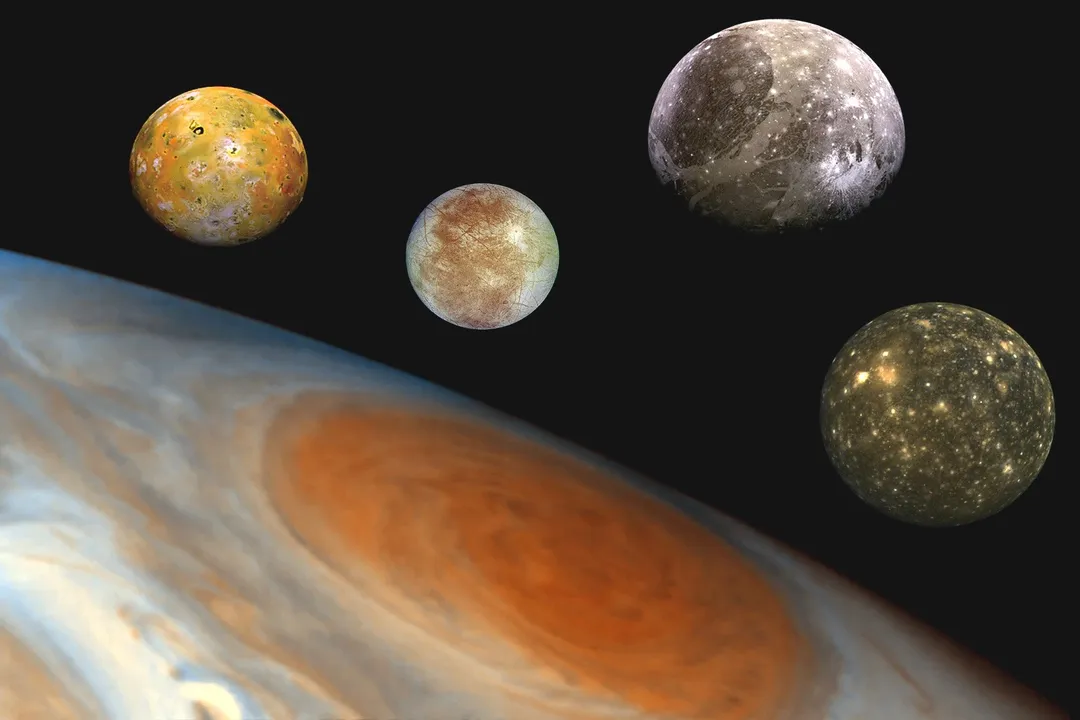
Callisto is the outermost moon, minimally differentiated, appears homogeneously mixed, and lacks current tidal heating, allowing it to retain the most ancient, heavily cratered surface.
Related Questions
Who first observed Jupiter's four largest satellites in early 1610?What is the term for the disc of gas and dust orbiting the young Jupiter from which the Galilean moons formed?What is the orbital resonance ratio shared by the three inner Galilean moons: Io, Europa, and Ganymede?What process, according to the University of Zurich simulations, explains Jupiter's enrichment in heavy chemical elements?In the Sequential Accretion Theory, what mechanism caused a newly formed moon to migrate inward toward Jupiter?Which Galilean moon is differentiated into a rock/ice blend and is notable for retaining the oldest, most heavily cratered surface?What structural pattern is evident when comparing the densities of the Galilean moons based on their distance from Jupiter?What primarily causes the structural differentiation observed in Io and Europa, leading to rock/iron cores?Which leading model is specifically credited with successfully reproducing the current 4:2:1 orbital resonance of the inner three moons?Why did Callisto's formation timeline significantly diverge from the inner moons, resulting in a much longer accumulation time?