How were the Galilean moons formed?
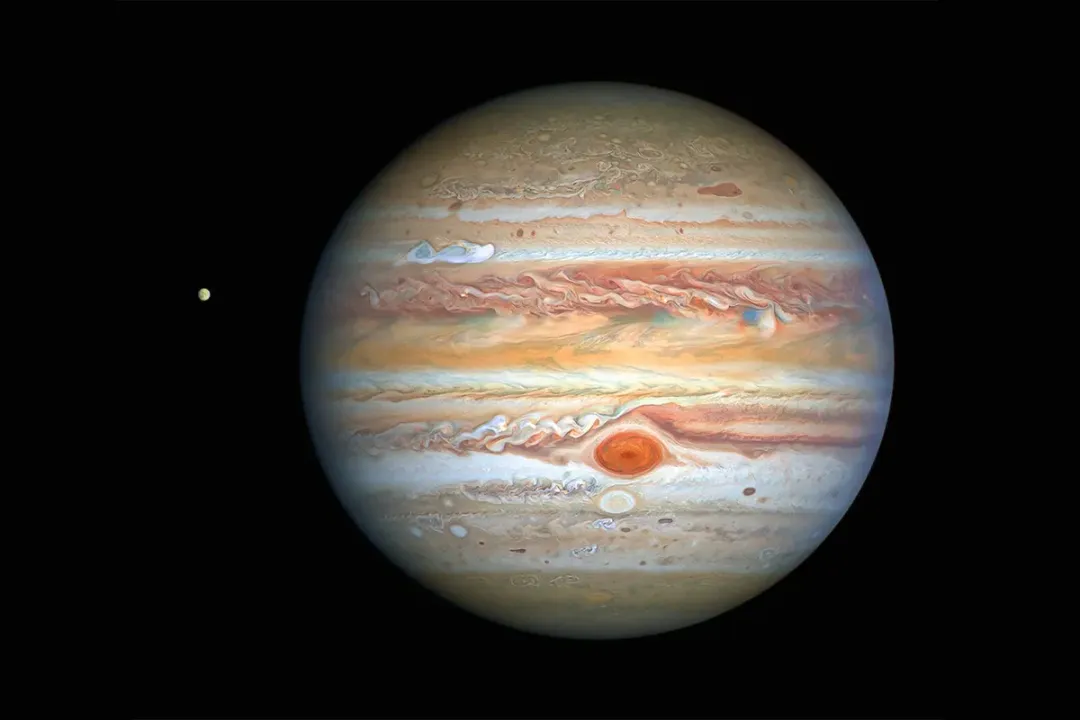
The story of Jupiter's four largest satellites—Io, Europa, Ganymede, and Callisto—is a dynamic drama etched into the history of our solar system, centered around the violent, dusty disc that once orbited the giant planet. These worlds, first glimpsed by Galileo Galilei in the early 17th century, are not just large moons; they represent a miniature solar system nested within our own, each retaining unique secrets about how planetary bodies accrete from a dense cloud of gas and dust. [1][8] Understanding their genesis requires moving past simple accretion models and grappling with timescales that challenge our standard views of circumplanetary evolution. [3]
# Discovery Context
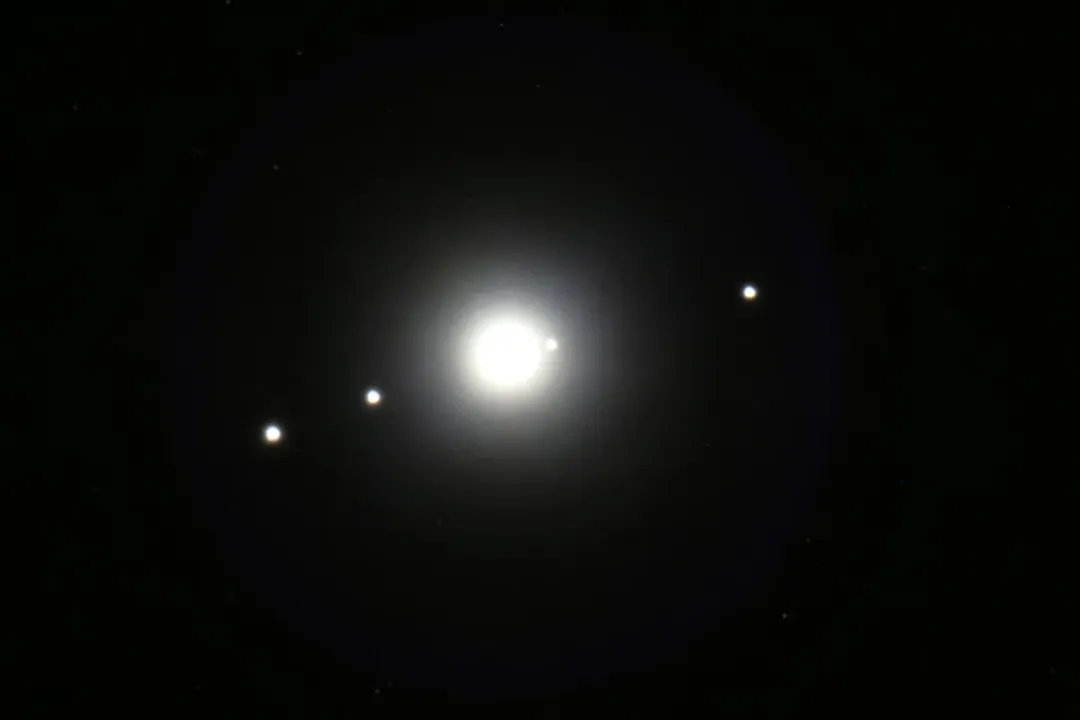
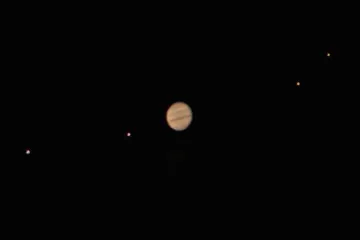
When Galileo first turned his rudimentary telescope toward Jupiter in January 1610, he observed three tiny, bright points of light flanking the planet, which he soon realized were orbiting Jupiter, not the Sun. [2] A few nights later, a fourth object appeared, completing the set now known as the Galilean moons. [1] This observation was revolutionary because it provided immediate, irrefutable proof that not everything in the heavens orbited the Earth, strongly supporting the Copernican model of the solar system. [2][8] Observing them today, even through modest backyard equipment, still offers a direct visual link to that foundational moment in astronomy. [2]
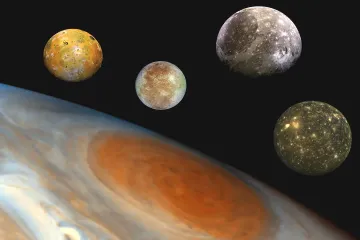
The four moons themselves present a striking diversity, which is a primary clue to their formation history. From the inside out, the order is Io, Europa, Ganymede, and Callisto. [1] Io is the most volcanically active world in the solar system, locked in a gravitational tug-of-war with Jupiter and the other moons that flexes its interior. [1] Europa hides a vast, salty ocean beneath a shell of ice, making it a prime target in the search for extraterrestrial life. [1][4] Ganymede is unique as the largest moon in the entire solar system—it is actually larger than the planet Mercury and possesses its own intrinsic magnetic field. [1] Finally, Callisto is a heavily cratered, ancient world, believed to have retained much of its original icy composition from the early Jovian nebula. [1] This gradient—from highly differentiated and active (Io) to largely undifferentiated (Callisto)—is what models of formation must successfully explain. [4]
# Disk Accretion Models
The prevailing, though now debated, theory posits that the Galilean moons formed in situ from a circumplanetary disk of gas and dust surrounding Jupiter shortly after the planet itself coalesced. [3][4][8] Jupiter, being the most massive planet, captured a significant fraction of the remaining material from the solar nebula that didn't form the Sun, creating a localized, rotating cloud—the Jovian nebula. [4][5] This disk was substantially smaller than the solar nebula but still contained enough mass to build these four large satellites. [3]
Under the classic model, the formation mirrors that of the solar system itself: material clumps together, dust aggregates into pebbles, pebbles grow into planetesimals, and these planetesimals collide and merge to form the final moons. [4][6] This process is known as core accretion. [4] Because Jupiter's gravity was so intense, the material density in this disc was very high, meaning the process should have been relatively rapid. [5] The traditional view often suggests that the inner moons, Io and Europa, formed closer to Jupiter where the temperature was higher, leading to more rock and less ice, while the outer moons, Ganymede and Callisto, accreted further out in the colder regions, locking up vast quantities of water ice. [1][4]
However, simulating this rapid, in situ formation presents significant hurdles, particularly concerning the final orbital distribution and internal structure of the moons. [3][6] If the moons formed quickly from a dense, gas-rich disk, the process should have involved significant gas drag and rapid orbital migration, potentially leading to the moons spiraling inward and being consumed by Jupiter. [7] Furthermore, the sheer mass that had to accrete in a relatively short time is enormous. To give a sense of scale, the material needed to form Ganymede and Callisto alone, plus Jupiter's other smaller moons, represents a significant fraction of the mass that Jupiter captured initially. [1] Thinking about the initial mass distribution required for this, it implies that the gas component of that circumplanetary disk must have been several percent of Jupiter's current mass, a substantial reservoir that then had to rapidly dissipate or be incorporated into the moons themselves. [5] This rapid, massive accumulation in a turbulent environment introduces complexities that recent research has sought to address by slowing down the timeline. [3]
# Slow Formation Hypothesis
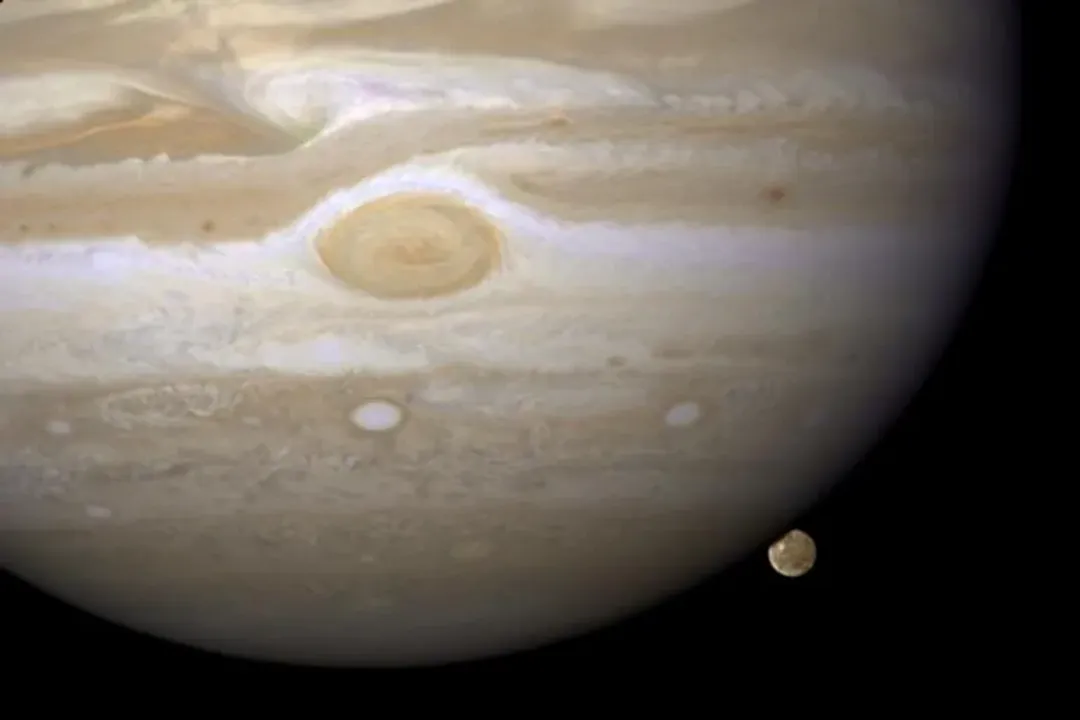
Newer computational models, informed by observations and improved simulation techniques, suggest that the Galilean moons did not form rapidly side-by-side but assembled over a much longer timescale, perhaps spanning millions of years, through a sequence of accretion and migration events. [3][6] This slow formation scenario aims to resolve the issues of gas dissipation and orbital instability inherent in the fast model. [3][7]
One key proposition, supported by researchers who have successfully modeled the system, is that the moons did not all form in the exact location we see them today. [6] Instead, a smaller initial set of moonlets formed near Jupiter, and as they grew, they interacted gravitationally with the surrounding gas in the disk. [3][7] This gas drag would cause them to spiral inward towards Jupiter. [7] The crucial difference is when this spiral-in happens relative to the disappearance of the gas disk. If the disk is long-lived, the moons migrate inward and are lost. The slow model suggests that the accretion process for the final moons was delayed until the gas had largely dissipated, allowing the growing moons to interact primarily with a thinner disk of solids or simply through mutual gravitational interactions, minimizing destructive inward migration. [3][6]
Another compelling idea within the slow formation context is that the moons formed sequentially, perhaps starting with the outermost moon, Callisto, and then the inner moons formed later as material was either supplied from the outer system or as the inner region re-accreted after early losses. [4] This sequential assembly helps explain the observed mass differences and orbital architecture. [7] The models recreating this process often show that the final assembly occurs through chaotic mergers of several large protoplanets, rather than smooth, steady accretion from a perfectly ordered disk. [6] This chaotic phase, happening after the gas has vanished, allows for the maintenance of the current, relatively stable orbital resonances. [6]
# Compositional Clues and Evidence
The chemical makeup of the four worlds offers strong evidence supporting the idea that the environment changed dramatically during their formation, aligning well with a slower, more complex accretion history. [4]
The key piece of evidence lies in the relative ice-to-rock ratios. [1] Callisto is the least differentiated; its bulk composition suggests it is about 50% rock and 50% water ice by mass, representing a composition very similar to the region of the solar nebula from which it formed. [1][4] Ganymede is also ice-rich, though more differentiated than Callisto. [1] Europa has less ice relative to its rocky core than Callisto. [1] In sharp contrast, Io is almost entirely rock and molten iron, having virtually no water ice left. [1]
This chemical gradient is difficult to explain if all four moons formed simultaneously from a static thermal gradient in a dense, gas-rich disk. A fast formation would likely have resulted in all moons being much more dominated by rock, as the high temperatures near Jupiter would have boiled off volatiles even at the distances where Ganymede and Callisto reside today, unless they formed much further out and migrated inward. [4][5]
The slow model provides a neat explanation. Imagine an initial debris disk that primarily builds the outer, icy moons like Callisto relatively quickly in the colder zone. [3] As time passes, the remaining material migrates inward, or perhaps the intense tidal heating from Jupiter drives out volatiles from the inner region, effectively "baking out" the ice from the precursors of Io and Europa over a very long period. [5] The fact that Io is so refractory (rocky) might imply that its material passed through a region of intense heating for a long time before settling into its final orbit, or that its precursor bodies were themselves differentiated prior to final accretion. [4] It is interesting to consider that if Callisto formed first, retaining its original composition, while Io’s building blocks were subjected to prolonged, low-level heating or migration through warmer zones over millions of years, the resulting compositional contrast would naturally emerge, distinguishing the system from a snapshot accretion event. This scenario suggests that the volatile content we observe is not just a function of radial distance from Jupiter, but a record of the time its precursor material spent exposed to the evolving thermal environment. [3]
# Orbital Architecture Implications
The current orbital spacing of the Galilean moons is also telling. They are locked in a near-perfect Laplace resonance: for every one orbit Callisto completes, Europa completes almost exactly two, and Io completes almost exactly four. [1] This resonance is incredibly stable and is a hallmark of a system that settled down gently after its major growth phase. [6]
If the moons had formed in situ rapidly, the gravitational interactions during the chaotic growth phase would likely have disrupted this fine tuning, forcing the moons into chaotic, non-resonant orbits that would have quickly resulted in mergers or ejections. [7] The very existence of this stable resonance strongly favors models where the moons migrated inward together in resonance (coupled migration) before settling into their current stable configuration once the gas or thick planetesimal disk was gone. [6] The slow, tidal-driven migration is the mechanism that allows this resonant structure to be established and preserved. [3]
To put the formation timescale into perspective against other bodies, the Earth took tens of millions of years to fully accrete from the solar nebula, and the giant planets themselves are thought to have formed within the first few million years of the solar system's history. [5] If the slow Galilean formation took several million years, it means the Jovian system was still actively building its major components long after the Sun had mostly cleared out its immediate vicinity, suggesting a prolonged, localized period of construction around Jupiter. [3][6] This implies that Jupiter wasn't just a passive recipient of leftover solar nebula material; it maintained a quasi-stable environment capable of supporting moon-building processes for a significant fraction of the Sun's early life, a feat rivaled only by the continued accretion disks seen around young stars in other systems.
# The Outer Moon Difference
The case of Callisto often serves as a litmus test for any formation theory. [4] Because it is so far out, it experienced the least tidal heating and was coldest, leading to its icy, heavily cratered appearance. [1] If the slow model is correct, Callisto's initial accretion might have been the fastest, as the precursor material was already abundant and cold. [3] The fact that it lacks significant differentiation (i.e., a large iron core) implies that its internal heating, even from radioactive decay, was insufficient to cause a complete separation of rock and ice, or that the formation process was too swift to allow significant differentiation before the system stabilized. [1][4]
In contrast, the inner moons show significant differentiation. [1] Io is completely differentiated due to intense tidal heating, but Europa and Ganymede must have differentiated internally from intrinsic heat sources or residual heat from formation, even before Jupiter's tides became dominant. [4] The ability of the slow model to produce the required internal heat budget over the extended timescale is a key area of ongoing research. [7]
In summary, the evidence points away from a simple, rapid buildup. The chemical diversity, the stable orbital resonance, and the massive scale of the initial material all suggest a protracted, multi-stage formation history for the Galilean moons. [3][6] They appear to be the product of an evolving circumplanetary environment, one that transitioned from a dense, gas-rich nebula to a debris field of large icy and rocky bodies, all orchestrated by the immense gravitational influence of Jupiter itself. [4][8]
#Videos
Ch. 13: Jupiter (24 of 37) Formation of the Jupiter's Galilean Moons
Related Questions
#Citations
Galilean moons - Wikipedia
Jupiter's Galilean moons complete guide - BBC Sky at Night Magazine
Jupiter's Galilean Moons May Have Formed Slowly - Eos.org
Formation of the Galilean Moons | astrobites
How do planetary scientists account for how the Galilean moons of ...
Astronomers re-create the formation of Jupiter's Galilean moons ...
The formation of the Galilean moons and Titan in the Grand Tack ...
How Did Jupiter's Galilean Moons Form? - Universe Today
Ch. 13: Jupiter (24 of 37) Formation of the Jupiter's Galilean Moons
Formation of Jupiter's four largest moons explained - Facebook