What remnant is theorized to be formed directly from the collapse powering a Hypernova?
Answer
Black Hole
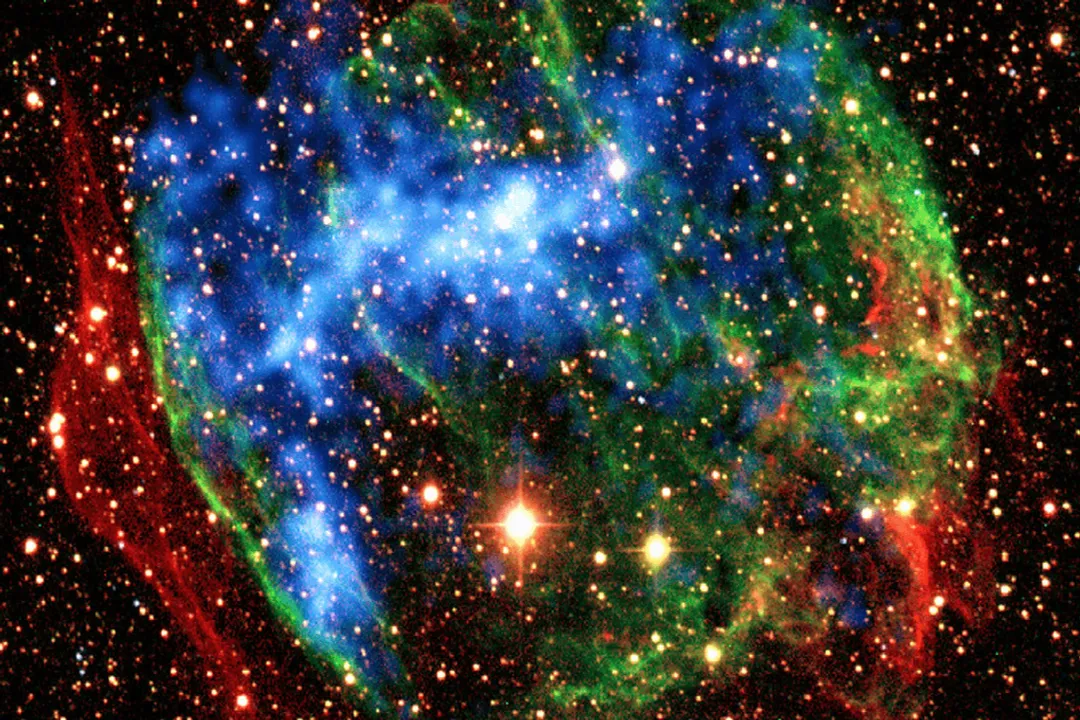
The core collapse mechanism leading to a hypernova involves an initial star so massive that its gravitational implosion overpowers even the extreme density offered by neutron degeneracy pressure. Unlike a standard Type II core-collapse supernova, which often leaves behind a highly dense neutron star, the sheer scale of the hypernova progenitor's mass causes the collapse to bypass this intermediate stage entirely. The result of this unrestricted gravitational infall is the direct formation of a black hole, which is the ultimate endpoint of gravitational collapse in this context.
Related Questions
What mass threshold triggers runaway fusion in a Type Ia supernova?What is the minimum progenitor mass believed to result in a Hypernova?Which elements are primarily formed during the rapid neutron capture in a Kilonova?What remnant is theorized to be formed directly from the collapse powering a Hypernova?How much brighter is a Hypernova compared to a typical Supernova?How much greater is the energy released by a Supernova compared to a Classical Nova?Why does saturation of a massive star's core with iron guarantee gravitational collapse?What highly focused danger accompanies the Black Hole formation in a Hypernova event?Given its mass of 14 solar masses, what is Betelgeuse expected to produce?What is the estimated distance threshold within which a supernova poses a significant ozone depletion risk to Earth?