What is the estimated distance threshold within which a supernova poses a significant ozone depletion risk to Earth?
Answer
50 to 100 light-years
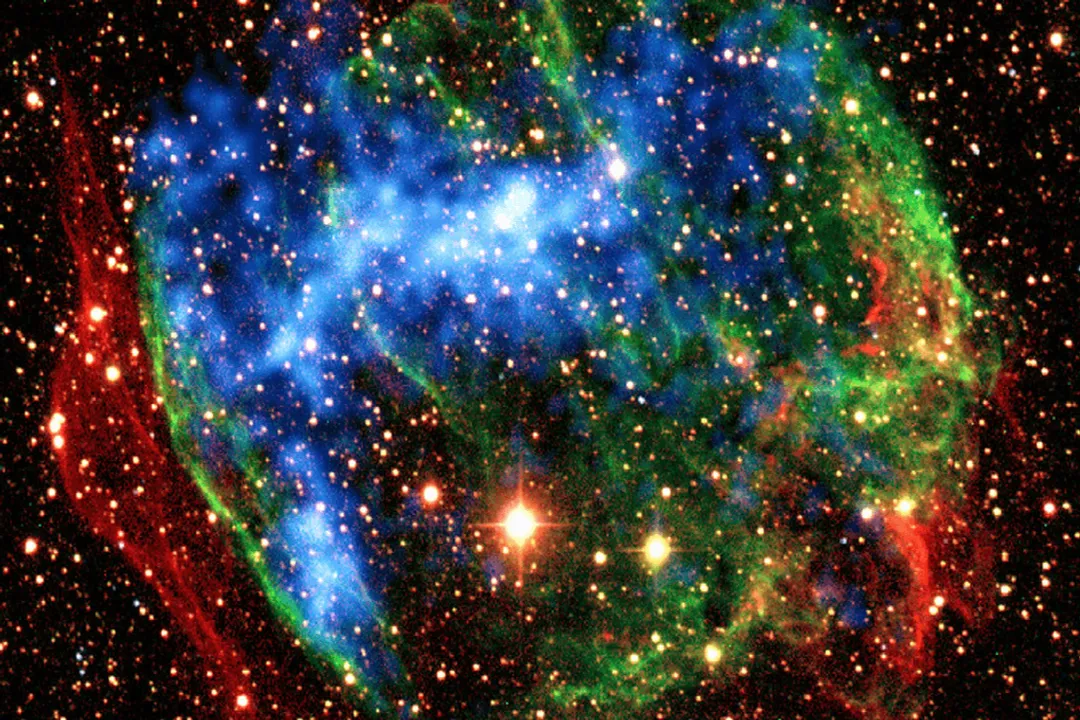
When assessing the immediate danger posed by nearby stellar explosions, the critical factor for atmospheric damage, such as ozone layer stripping, relates to the proximity of the blast. While the supernova of Betelgeuse at about 642.5 light-years away is considered merely a spectacular visual event for Earth, the theoretical danger zone where X-rays and high-energy particles could significantly erode the ozone layer is estimated to be much closer. This critical safety perimeter is thought to lie within the range of 50 to 100 light-years. A hypernova occurring within this limited range would pose the apex threat by combining general radiation damage with a focused, beam-like GRB.
Related Questions
What mass threshold triggers runaway fusion in a Type Ia supernova?What is the minimum progenitor mass believed to result in a Hypernova?Which elements are primarily formed during the rapid neutron capture in a Kilonova?What remnant is theorized to be formed directly from the collapse powering a Hypernova?How much brighter is a Hypernova compared to a typical Supernova?How much greater is the energy released by a Supernova compared to a Classical Nova?Why does saturation of a massive star's core with iron guarantee gravitational collapse?What highly focused danger accompanies the Black Hole formation in a Hypernova event?Given its mass of 14 solar masses, what is Betelgeuse expected to produce?What is the estimated distance threshold within which a supernova poses a significant ozone depletion risk to Earth?