What is worse than a supernova?
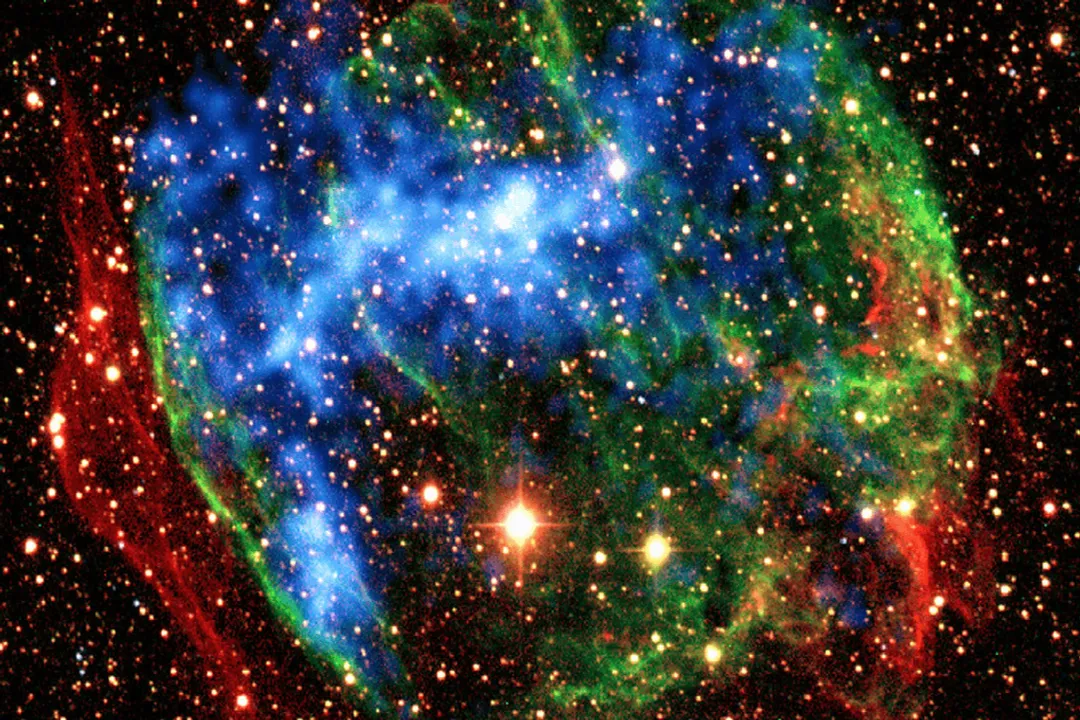
The simple act of a star dying, culminating in a supernova, is already one of the most catastrophic, light-blinding events the universe has to offer. These stellar explosions can momentarily outshine entire galaxies, seeding the cosmos with the heavy elements necessary for planets and life itself. Yet, in the face of cosmic extremes, even a standard supernova can seem merely a respectable light show. The true question then becomes: what stellar demise pushes past that already incredible benchmark? What possesses an even greater output of energy or creates a more profound, long-lasting astrophysical scar? The answer often lies in the very largest stars and the most extreme collapse scenarios imaginable.
# Stellar Tiers
To gauge what exceeds a supernova, one must first appreciate the baseline. The term nova itself, Latin for "new star," originally applied to any sudden brightening, but astronomers have since separated these events from the true stellar detonations. A classical nova arises in a binary system involving a white dwarf that siphons material from a companion star. The surface layer of hydrogen fusion ignites, causing a rapid flare that ejects material, but critically, the white dwarf remains intact, allowing the process to potentially repeat. This event releases energy perhaps 10,000 to 100,000 times the energy the Sun emits in a year.
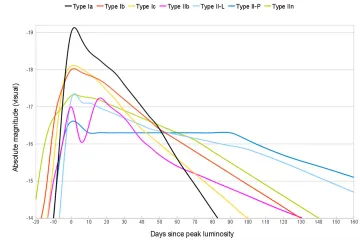
Supernovae, however, involve complete stellar destruction or core collapse, making them intrinsically brighter by a factor of at least $10,000$ compared to a nova. There are two main pathways to this much greater violence. A Type Ia supernova occurs when a white dwarf in a binary system accretes so much mass that it surpasses the Chandrasekhar limit—about $1.44$ solar masses—triggering runaway fusion throughout its core and leading to total annihilation. The other route, the core-collapse supernova (Types Ib, Ic, and II), marks the end of a massive star’s life. When such a star exhausts its fuel, it can no longer generate the outward pressure to counter gravity, especially once its core is saturated with iron. Iron fusion consumes energy rather than releasing it, which guarantees the gravitational collapse of the core, triggering the rebound explosion.
# Extreme Eruption
If a supernova is the death cry of a massive star, the hypernova is its scream. Astronomers often view the hypernova as a special, over-luminous subtype of the core-collapse event. These catastrophic explosions are believed to result from the demise of stars born with masses exceeding 30 solar masses. While a standard core-collapse supernova is already a phenomenal release of energy, a hypernova elevates this several notches; they are estimated to be 10 to 100 times brighter than a typical supernova.
The difference in scale is dramatic, transforming a spectacular cosmic death into something truly apocalyptic on a relative scale.
| Event Type | Progenitor/Cause | Typical Remnant | Relative Brightness to Nova |
|---|---|---|---|
| Classical Nova | White dwarf surface fusion | White Dwarf Intact | Baseline |
| Supernova (Type II) | Massive star core collapse | Neutron Star or Black Hole | Nova |
| Hypernova | Ultra-massive star core collapse () | Black Hole likely | Supernova |
| Kilonova | Neutron Star Merger | Expanding Ejecta Cloud | Nova (Less than SN) |
This comparison table highlights that while a kilonova represents immense power, it falls short of a supernova's total light output, making the hypernova the clear winner in terms of sheer, blinding luminosity when asking what is "worse" than a supernova. A star only 14 solar masses, like Betelgeuse, is unlikely to reach hypernova status; it is expected to produce a standard core-collapse supernova. The hypernova pathway seems reserved for the true giants of the stellar population.
# Collapse Endpoints
What truly separates the hypernova from a standard supernova explosion, aside from the magnitude of the light, is often what remains behind. While a Type II supernova can leave behind a neutron star—an object so dense a teaspoon would weigh billions of tons—the collapse powering a hypernova is theorized to bypass that intermediate step entirely, plunging directly into the formation of a black hole.
The formation of a black hole via a hypernova is not just a matter of an extremely dense remnant; it is often accompanied by another, more focused, form of cosmic danger: long gamma-ray bursts (GRBs). These are the most energetic electromagnetic events known in the universe. In the hypernova model, the collapsing core forms a rapidly spinning black hole that generates powerful, highly focused jets of plasma moving at near the speed of light. If one of these jets happens to be pointed directly at a distant civilization, the energy deposited across the narrow beam can be exponentially more intense than the spherical light emission of the overall explosion. From an observer's perspective in the path of that beam, the GRB associated with a hypernova is certainly a far worse, more immediate threat than the general radiant energy of a non-beamed supernova explosion.
It is an interesting divergence in stellar death: both the Type Ia supernova and the core-collapse supernova/hypernova are final acts, but only the latter, in its most extreme form, is intrinsically linked to these focused, beam-like weapons of cosmic destruction. This suggests that the mechanism—the direct formation of a spinning, jet-producing black hole—is what truly defines the "worse" outcome, not just the total integrated light curve of the initial blast.
# Element Forges
There is another explosive event that warrants discussion, though it is typically less luminous than a supernova: the kilonova. While less powerful in raw light than a supernova, the kilonova represents an event that is perhaps the most important for the chemical makeup of the universe. These events occur when two compact objects—typically two neutron stars—spiral inward and collide, a process detectable through both gravitational waves and electromagnetic radiation.
The collision environment in a kilonova is so extreme that it facilitates the creation of elements heavier than iron, such as gold, platinum, and uranium, through rapid neutron capture processes. One such merger was found to produce the equivalent of a thousand Earth-masses in heavy metals alone. Without these events, the elements that form the basis of our technology and even fundamental biology would be scarce. Therefore, while a kilonova is not worse than a supernova in terms of instantaneous destructive power, it is arguably more cosmically significant in building the material universe we inhabit.
# Proximity Dangers
When considering what is "worse" than a supernova, the discussion naturally turns to the possibility of one happening nearby. The sources highlight that even the potential supernova of Betelgeuse, which is only about 642.5 light-years away, would not cause a mass extinction event on Earth. It would be a magnificent, long-lasting night-sky spectacle, but not a species-ending threat.
This leads to an analysis of the safety distance. While the sources confirm that nearby supernovae are unlikely to cause extinction, the actual danger zone—the distance within which atmospheric stripping or ozone depletion becomes a significant concern—is thought to be much closer, perhaps within 50 to 100 light-years. If a star like Eta Carinae—a much more massive candidate, perhaps over 100 solar masses initially—were to explode within that critical distance, the threat profile changes entirely. In this localized scenario, the blast of X-rays and high-energy particles could strip away our ozone layer over the course of months or years, exposing all surface life to lethal solar radiation. A hypernova event at that range would compound this danger with the addition of an intense, focused GRB. The sheer focused energy of a GRB directed our way would be orders of magnitude worse than the general fireball of a standard supernova, even at the same range, because the energy density is concentrated along a narrow line of sight.
Therefore, a nearby hypernova that results in a GRB aimed at us represents the apex of stellar death events in terms of localized danger. It combines the extreme energy of the most powerful stellar explosion with a focused beam capable of inflicting lethal damage across vast interstellar distances, far exceeding the threat posed by a non-beamed supernova exploding at a comparable range. The sheer speed of the collapse, proceeding from silicon burning to core implosion in mere seconds, ensures a catastrophic energy release before any warning could fully propagate across our solar system.
Related Questions
#Citations
Ask Astro: What are the differences between supernovae, kilonovae ...
Which is more likely to go supernova in our lifetime, Betelgeuse or ...
Nova, Supernova, Hypernova, Kilonova – What's The Difference?