In the MK system, what luminosity class designation is used for main-sequence stars fusing hydrogen, like the Sun (G2V)?
Answer
Class V (Dwarfs)
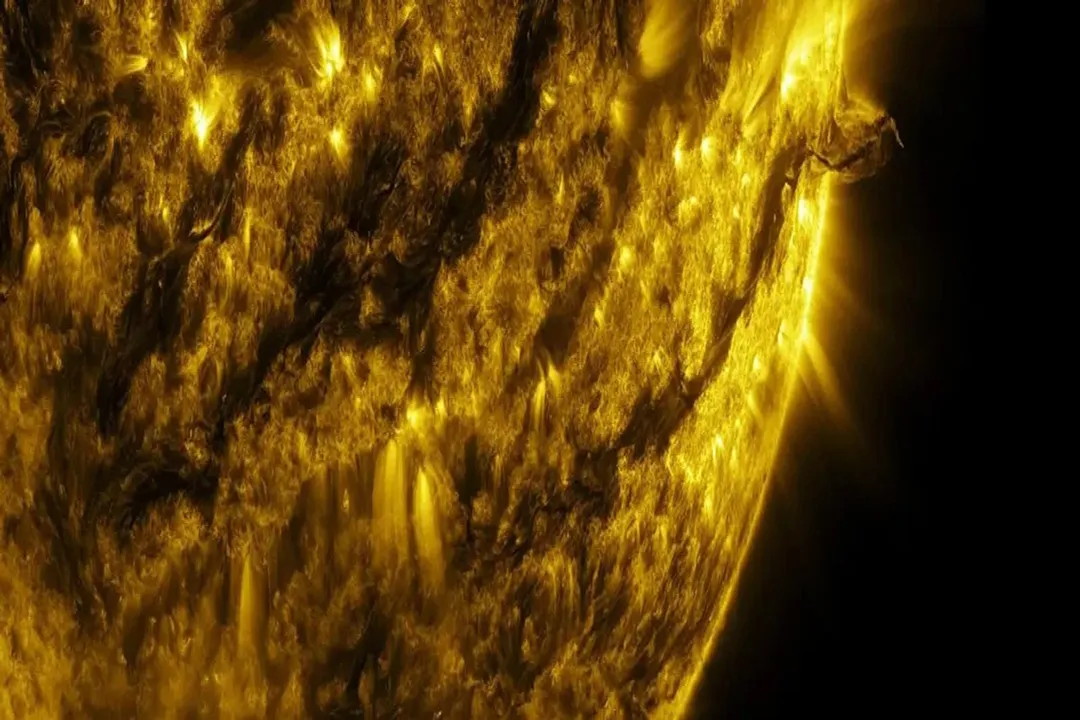
The Morgan-Keenan (MK) system utilizes luminosity classes to differentiate stars that might otherwise share the same spectral (temperature) classification. The designation for stars that are actively fusing hydrogen in their core and currently residing on the main sequence is Luminosity Class V, commonly referred to as Dwarfs. Our Sun is classified as G2V, indicating it is a main-sequence yellow dwarf. This class stands in direct contrast to evolved stars like Giants (Class III) or Supergiants (Classes I, II, IV), which have exhausted core hydrogen and are dramatically larger and more luminous despite sometimes sharing similar surface temperatures with a dwarf star.
Related Questions
What approximate percentage of main-sequence stars are M-type Red Dwarfs in the solar neighborhood?What internal mechanism allows Red Dwarfs to sustain core hydrogen fusion for up to 14 trillion years?What stellar remnant is formed after a star similar in mass to our Sun exhausts its core hydrogen fuel?How do K-type Orange Dwarfs offer a theoretical advantage over G-type stars regarding habitability?What percentage of local main-sequence stars are accounted for when combining M and K dwarfs?What is the mass constraint that separates the largest Brown Dwarfs from the smallest true main-sequence stars?Which spectral class primarily characterizes the K-type Orange Dwarfs in the Morgan–Keenan (MK) classification system?How does the fuel consumption rate of massive O-type stars compare to that of low-luminosity M-dwarfs?What critical orbital complication can arise for planets orbiting closely within the habitable zone of K-dwarf stars?In the MK system, what luminosity class designation is used for main-sequence stars fusing hydrogen, like the Sun (G2V)?What surface temperature range characterizes the T spectral class among Brown Dwarfs?