Which part of the Moon cannot be seen on Earth?
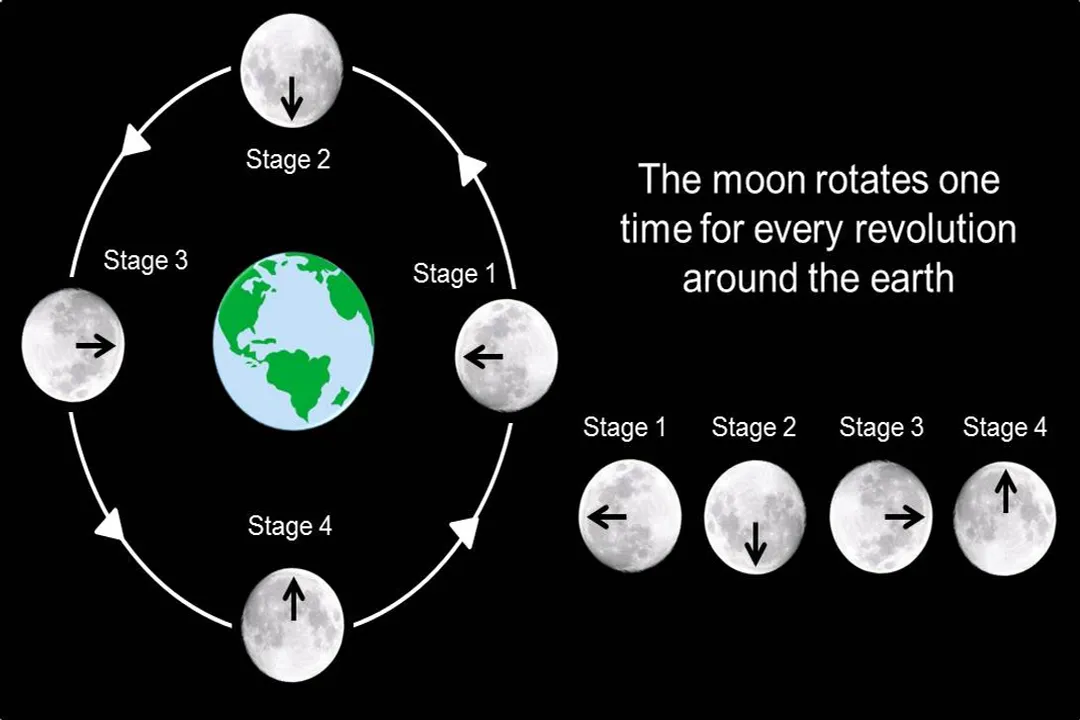
The part of the Moon that remains perpetually hidden from our direct view on Earth is known by astronomers as the Far Side of the Moon. This is a critical distinction because, for decades, the public imagination often associated this unseen region with the "Dark Side of the Moon". This latter term is misleading, as the far side receives just as much sunlight as the near side facing us; the darkness is purely a matter of perspective from Earth. When the Moon is full in our sky, the near side is fully illuminated, meaning the far side is experiencing its own local midnight. Conversely, during a New Moon, the far side is bathed in sunlight, though we cannot see it.
# Tidal Lock
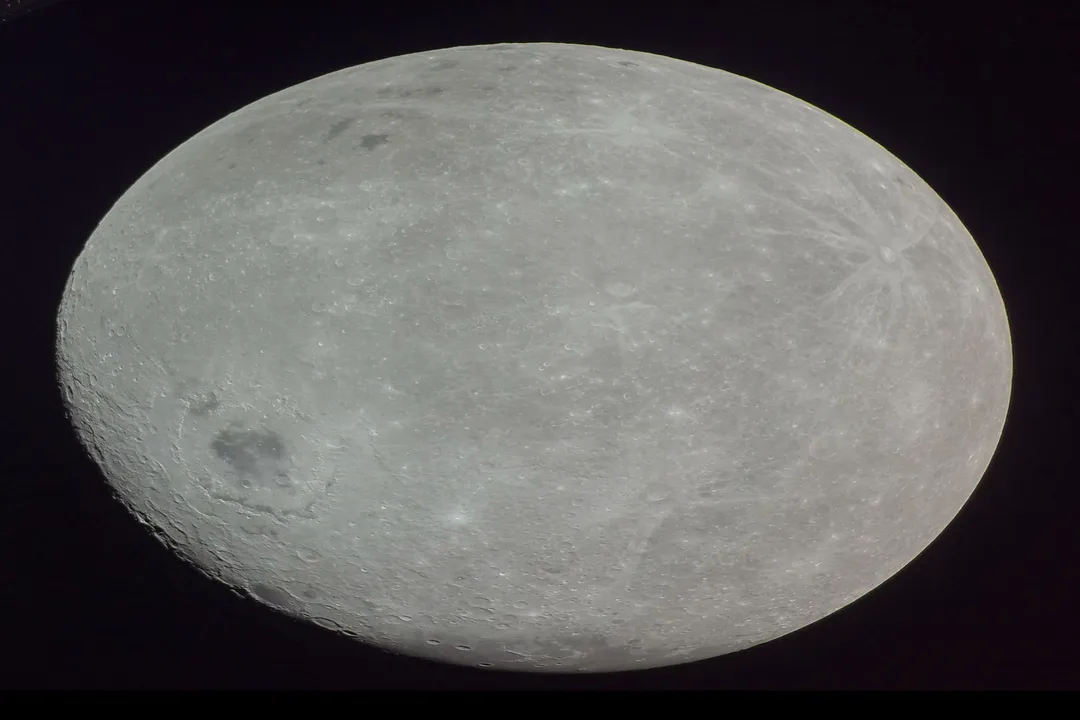
The reason this portion of the Moon is always hidden is due to a phenomenon called tidal locking, or synchronous rotation. Over astronomical time scales, the gravitational interaction between the Earth and the Moon has slowed the Moon's rotation rate until its rotational period exactly matches its orbital period around our planet. Picture a dancer spinning in place while walking around a partner; if they spin exactly once for every circle they complete, they always present the same side to their partner. The Moon does this with Earth.
This synchronization means that the Moon takes roughly $27.3$ Earth days to complete one rotation on its axis, which is the same amount of time it takes to complete one orbit around the Earth. Because this alignment has been stable for billions of years, we are gravitationally tethered to observe only the same hemisphere, leading to the permanently obscured far side.
# Surface Contrast
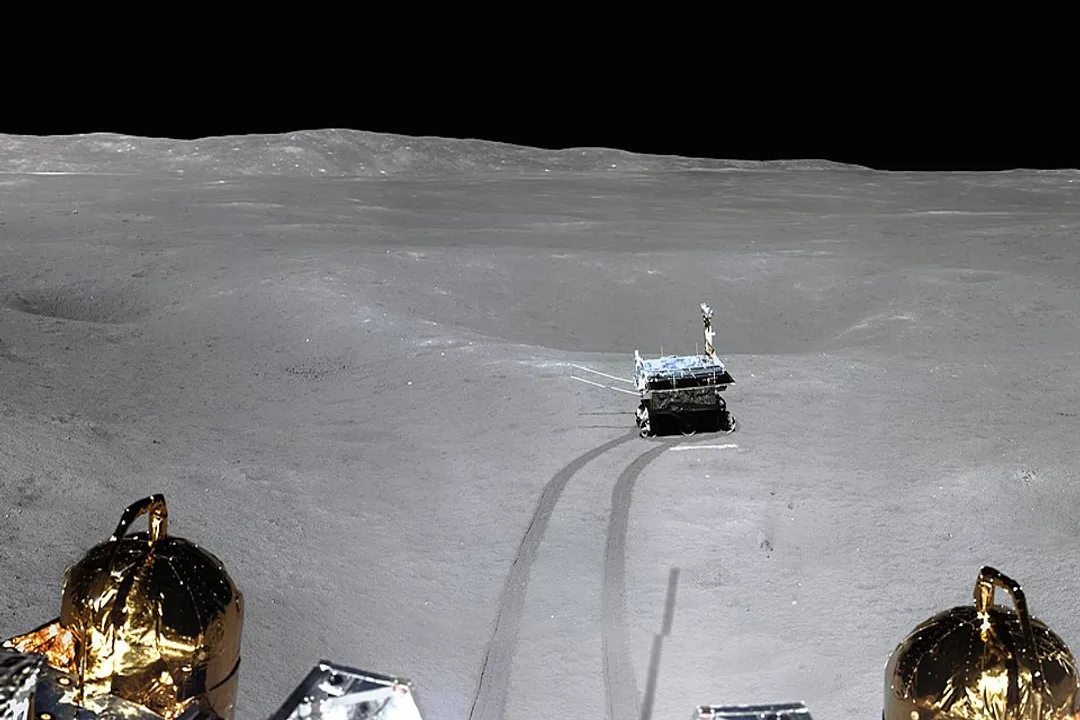
When humanity finally glimpsed the far side, the view was immediately startling because the lunar geography visible from Earth is not representative of the Moon as a whole. The near side, the one we see, is characterized by vast, dark, smooth plains known as maria (Latin for "seas"). These maria are solidified ancient basaltic lava flows that filled massive impact basins long ago.
The far side, however, tells a very different story. It is overwhelmingly dominated by impact craters and highlands, featuring only about $1%$ of the surface covered by maria, compared to roughly $31%$ coverage on the near side. This vast disparity in surface features is one of the most striking differences between the two hemispheres. Early theories suggested the far side might have a thicker crust overall, preventing the magma from easily breaching the surface to form the large lava seas we see on the near side. This difference in crustal density—less heavy surface material filling in impacts on the far side—is a significant geological puzzle that informs our understanding of early solar system impacts and internal lunar heat distribution.
To appreciate this stark contrast, consider the most prominent features visible from our perspective: the Mare Imbrium, Oceanus Procellarum, and Mare Tranquillitatis (the landing site of Apollo 11). None of these massive dark plains have a direct counterpart on the far side; instead, features like the enormous South Pole–Aitken basin, one of the largest impact structures in the entire Solar System, dominate the hidden terrain.
| Feature Aspect | Near Side (Visible from Earth) | Far Side (Never Visible from Earth) |
|---|---|---|
| Surface Coverage by Maria | Approximately $31%$ | Approximately $1%$ |
| Dominant Terrain | Large, smooth, dark basaltic plains (maria) | Heavily cratered highlands |
| Prominent Structures | Mare Tranquillitatis | South Pole–Aitken basin |
| Albedo (General Brightness) | Generally darker due to iron-rich maria | Generally brighter (higher albedo) |
# Wobbling View
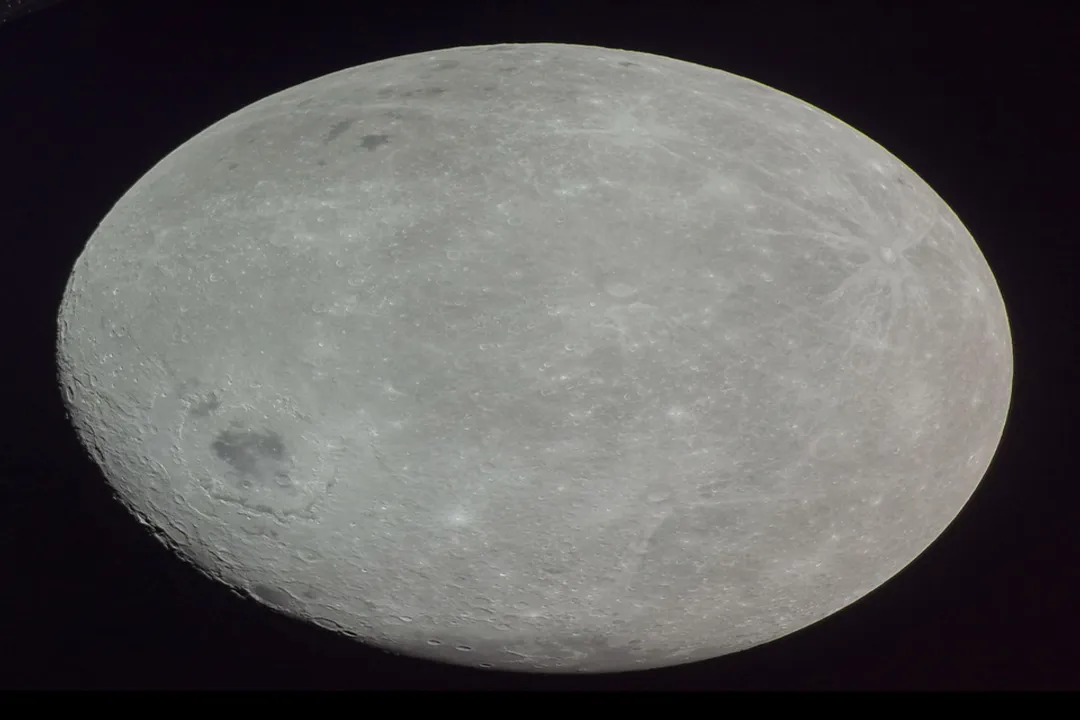
While tidal locking dictates that the Moon always presents the same face, the idea that exactly $50%$ of the surface is always hidden is a slight oversimplification. The Moon’s orbit is not perfectly circular, nor is its axis perfectly aligned with its orbit plane relative to Earth. This slight irregularity in its motion causes a barely perceptible rocking or nodding effect known as libration.
Libration allows observers on Earth, over the course of a month, to peek around the eastern and western edges, as well as the northern and southern poles of the Moon. This slight shift means that an observer positioned perfectly can actually view approximately $59%$ of the lunar surface over time, rather than the expected $50%$. If you combine the views taken over several orbital cycles, the cumulative visible area expands beyond the theoretical half-sphere. This means the area that cannot be seen—the truly permanently hidden zone—is actually only about $41%$ of the surface.
This continuous, slight shift in perspective presents an interesting observational challenge. For amateur astronomers, mastering the timing of when libration maximally exposes a specific limb feature is a rewarding pursuit, often requiring patience over several months to catch the edge views that shift visibility by mere degrees. Furthermore, during early lunar mapping, mission planners had to account for these librations precisely to ensure complete coverage by orbital probes, even for regions deemed "permanently hidden" from direct telescopic viewing on Earth.
# First Views
For millennia, the far side remained the ultimate mystery, known only through inference and the occasional glimpse provided by high-altitude observations that could slightly overcome atmospheric distortion. The veil was finally lifted in October 1959 when the Soviet Union's Luna 3 probe successfully flew past the Moon and transmitted the first photographs of the hidden hemisphere back to Earth. These grainy, black-and-white images instantly revealed the stark, crater-pocked landscape previously only theorized about, confirming the massive geological disparity between the two sides.
Subsequent robotic missions, particularly those from the US and the USSR, mapped this region in greater detail, but it remained physically inaccessible to humans until the Apollo program. The far side has a distinct, almost untouched appearance compared to the near side, which has been viewed constantly by human eyes for our entire existence. The first human beings to see the far side directly, without the mediation of instruments or television screens, were the Apollo 8 astronauts in 1968. When they rounded the Moon, they became the first people to witness the hidden face, seeing the vast expanses of cratered highlands across the horizon.
The first landing on the far side, by China's Chang'e 4 lander in January 2019, marked another monumental achievement. Landing there is significantly more complex than landing on the near side because direct, real-time radio communication with Earth is impossible due to the Moon blocking the signal. This necessitates the use of a relay satellite, like the Queqiao satellite, positioned at a specific point in space (a Lagrange point) to maintain the line of sight necessary for command and control signals. This technical requirement underscores the inherent difficulty in studying this remote hemisphere compared to the side that has essentially been monitored since the dawn of space exploration.
#Videos
WHY CAN'T WE SEE THE FAR SIDE OF THE MOON? - YouTube
Why Is The Far Side Of The Moon So Different? - YouTube
Related Questions
#Citations
Far side of the Moon - Wikipedia
Is there a spot on the surface of earth that the moon can't be seen ...
Why don't we ever see the far side of the moon? | PBS News
What is the other side of the moon that you cannot see called? - Quora
WHY CAN'T WE SEE THE FAR SIDE OF THE MOON? - YouTube
Is there any point on earth where the moon stays below the horizon ...
Why is space black? - StarChild - NASA
What part of the moon is not visible from Earth?