What two intrinsic properties combine to determine a star's total luminosity?
Answer
Temperature and its surface area (radius)
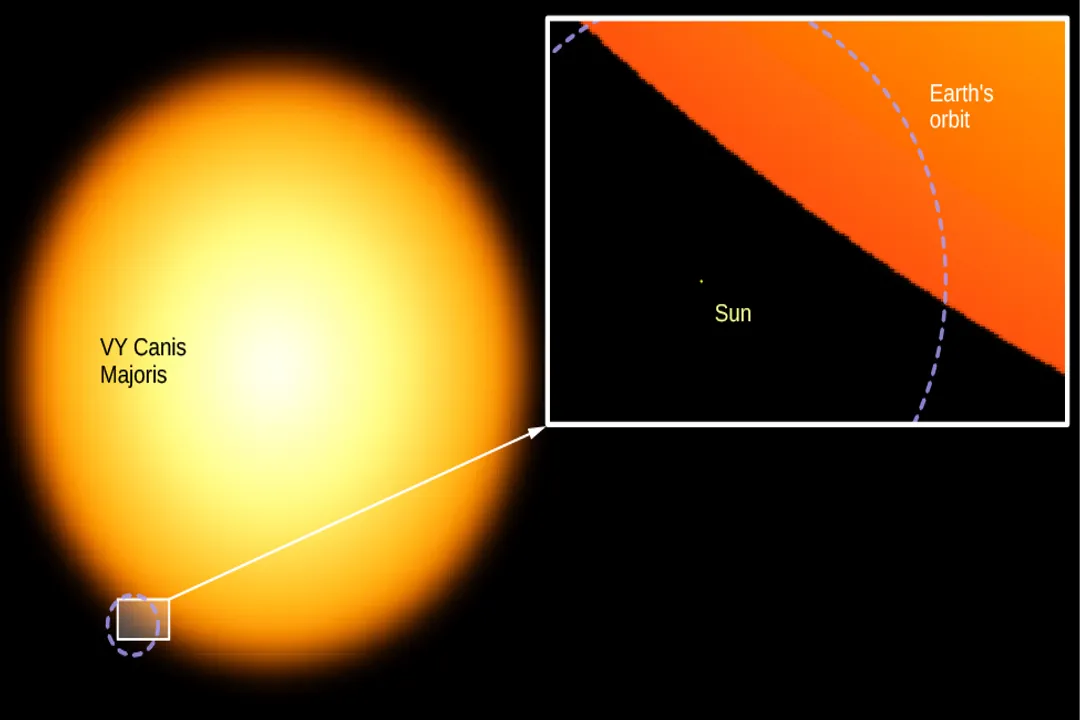
Total luminosity, which is the star's actual intrinsic brightness, is fundamentally dependent on both how hot its surface is and the total physical area radiating that energy. This relationship is essential for understanding stars that have evolved off the main sequence. For example, a star that has become a giant or supergiant can be cool (red) but still immensely luminous because its surface area, or radius, has expanded tremendously, compensating for the lower energy output per square meter.
Related Questions
What category describes objects less massive than $0.08 M_{\odot}$?What is the mnemonic for the Harvard spectral classification sequence O, B, A, F, G, K, M?What does the Roman numeral 'V' in the Sun's $ ext{G2V}$ classification signify?Where do more massive main-sequence stars map on the Hertzsprung-Russell (H-R) diagram?What two intrinsic properties combine to determine a star's total luminosity?Which H-R diagram region hosts cool, red stars like Betelgeuse that exhibit high total luminosity?Which stellar remnant occupies the lower-left corner of the H-R diagram, such as Sirius B?What does the $ ext{I}$ luminosity class signify within the Morgan-Keenan ($ ext{MK}$) system?How extreme is the density of a white dwarf packing solar mass into an Earth-sized volume?How does the lifespan of a star 40 times the Sun’s mass compare to our Sun's lifespan?What fundamental physical property dictates nearly everything about a star's entire existence?What is the relationship between a main-sequence star’s mass and its position on the H-R diagram?