What are the five basic characteristics of a star?
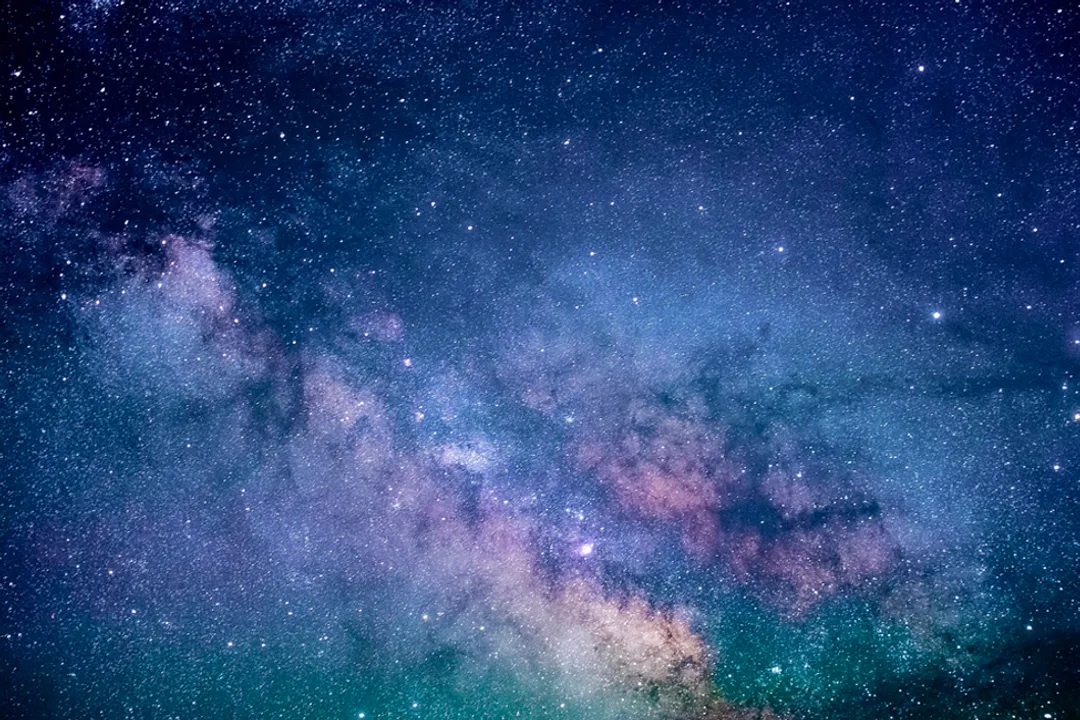
The universe is populated by an almost unimaginable number of stars—estimates suggest there could be up to a septillion in the observable universe, with our Milky Way alone hosting over a hundred billion. Despite this sheer volume and variety, every star, from the most colossal blue giant to the tiniest red dwarf, can be fundamentally described by the same set of five basic characteristics: mass, size, surface temperature, color, and brightness. These physical traits are deeply interconnected; understanding one often provides immediate insight into the others, painting a complete picture of a star's nature and its place in the grand cosmic lifecycle.
# Mass

Stellar mass holds the undisputed top spot among a star's properties, often regarded by astronomers as the most important characteristic. This initial quantity of material dictates virtually every other aspect of the star’s existence, from how long it lives to how it will ultimately perish. A star’s existence is a constant battle between the crushing inward force of its own gravity and the outward pressure generated by nuclear fusion in its core. Mass sets the stakes for this contest: the more massive the star, the greater the core pressure and temperature required to maintain equilibrium, forcing it to consume its hydrogen fuel at a tremendously accelerated rate.
Measuring the mass of a solitary star is challenging, but a significant portion of stars exist in companion systems, making measurement feasible. Astronomers often employ an adaptation of Kepler’s Third Law, originally conceived with input from Isaac Newton, which requires observing the orbital period () and the average separation () of two orbiting bodies. The resulting calculation allows for the determination of the combined mass of the binary pair. Stellar mass is conventionally quantified relative to our own Sun, expressed in units of solar mass, denoted as . For instance, Sirius, a very bright neighbor, tips the scales at just over two solar masses. At the other extreme, some of the most massive stars known, such as Eta Carinae, clock in between 100 and 150 .
The consequence of this mass difference on lifespan is staggering. Lower-mass stars burn their fuel slowly, possessing lifetimes that can stretch into the trillions of years, far exceeding the current age of the universe itself. Conversely, a star packing 100 solar masses might only endure for a mere few million years before exhausting its reserves and meeting a dramatic end. Considering that the universe is currently estimated to be about $13.8$ billion years old, the most meager red dwarfs, capable of shining for perhaps $12$ trillion years, are effectively immortal on the cosmic timescale, while their most massive counterparts expire before the universe has even seen its first billionth birthday. This disparity shows that a star’s mass is not just a measurement; it is a precise countdown timer etched into its very being.
# Size
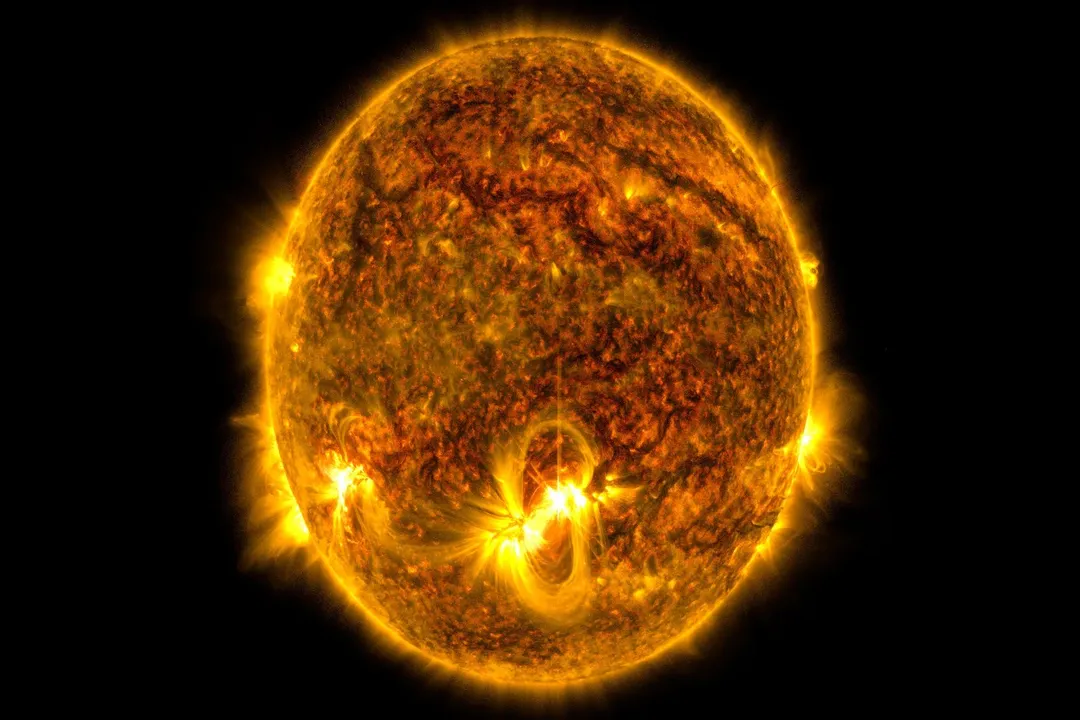
The physical size of a star, usually expressed as its diameter or radius, shows an enormous range across the stellar population. Astronomers typically measure stellar size in terms of the Sun’s radius (). On the smaller end of the scale, the compact remnants of dead stars, known as white dwarfs, are often only about the size of Earth. Even more compressed are neutron stars, which can have diameters as small as $20$ to $40$ kilometers.
Yet, this small end is dwarfed by the giants. Stars classified as supergiants can boast diameters reaching approximately $900,000,000$ kilometers, sometimes amounting to $650$ times the diameter of our Sun. The star Rigel, for example, is measured in the tens of solar radii. If the famed red supergiant Betelgeuse were placed where the Sun sits, its outer layers would likely extend past the orbit of Jupiter.
While size is an independent measure, it is inseparable from temperature when determining how much energy a star actually broadcasts. A star's luminosity is directly dependent on both its radius and its surface temperature. A very large star that is relatively cool on the surface can still radiate a massive amount of total energy because it has such a vast surface area emitting light, a concept formalized by Stefan’s Law (though not explicitly named in all sources, the relationship is noted).
# Temperature
The surface temperature of a star is a critical, quantifiable characteristic, usually determined by observing the star’s light and expressed on the Kelvin (K) scale. This scale sets absolute zero at $0$ K, which is equivalent to $-273.15$ degrees Celsius. Stellar temperatures vary widely: the coolest stars, which appear distinctly reddish, are found around $2,500$ K. Conversely, the hottest stars can push toward $50,000$ K. Our familiar Sun occupies a middle ground, possessing a surface temperature of roughly $5,500$ K.
It is important to note that this surface temperature is just the skin deep reading; the core of a main-sequence star must maintain temperatures in the millions of Kelvins to sustain the nuclear fusion process that keeps the star from collapsing under gravity. The surface temperature is influenced by both the rate of energy production deep within the core and the star's overall size. Annie Jump Cannon’s groundbreaking work in sorting spectral data directly ties this measured temperature to a star's spectral class, providing a systematic method for cataloging these variables.
# Color
A star's color serves as the most immediate visual proxy for its surface temperature. This relationship is intuitive, much like observing a piece of iron heating up: the cooler it gets, the redder it appears, and as it heats further, it progresses through orange to a bright white or even a blue-white color.
For stars, this color spectrum translates directly into temperature ranges. Stars at the cooler end of the scale appear decidedly red, while the hotter stars exhibit a bluer appearance. Yellow stars, like the Sun, sit squarely in the middle range of surface temperatures. This simple visual cue is so reliable that astronomers use spectral type classifications—initially designated by letters like O, B, A, F, G, K, and M—to sort stars in order of decreasing surface temperature. The hottest stars fall into the O class and appear blue, while the coolest M-class stars appear red.
The interplay here is direct: the hotter the surface temperature, the bluer the light it emits, and the cooler the surface temperature, the redder the light. This connection allows astronomers to estimate temperature by simply observing the star’s hue, making color an indispensable characteristic for preliminary stellar analysis.
| Star Color | Relative Temperature | Example Classification (Conceptual) |
|---|---|---|
| Blue/Blue-White | Hottest | O or B Class |
| White | Mid-High | A Class |
| Yellow | Medium | G Class (The Sun) |
| Red-Orange | Mid-Low | K Class |
| Red | Coolest | M Class |
This relationship is so fundamental that astronomers often utilize the star's color index as a quick estimation of its surface temperature.

# Brightness
When we observe the heavens, the most obvious trait distinguishing one star from another is its brightness. However, astronomers separate this observable trait into two distinct, measurable concepts: luminosity and magnitude.
Luminosity is the intrinsic property—the total amount of light and radiant energy a star radiates per unit of time, measured as power. It depends mathematically on the star's surface temperature and its physical diameter. A large, cool star (like a red giant) can have a higher luminosity than a small, hot star (like a white dwarf) simply because the giant has vastly more surface area from which to radiate energy.
Magnitude, on the other hand, relates to perception. There are two key types of magnitude:
- Apparent Magnitude: This is how bright the star looks from Earth, factoring in both its true luminosity and its specific distance from us. A star that is intrinsically dim but very close (like the Sun) can have a dazzling apparent magnitude.
- Absolute Magnitude: This is a standardized measure of a star’s true brightness, defined as the apparent magnitude the star would have if it were placed at a standard, fixed distance of $10$ parsecs ($32.6$ light-years) from Earth. This allows for a fair, distance-independent comparison of stellar power output.
The scales themselves are somewhat counterintuitive: a smaller (more negative) magnitude number indicates a brighter object. Furthermore, the magnitude system is logarithmic; a difference of five in magnitude corresponds to a brightness factor of exactly $100$ times. Therefore, to truly characterize a star, knowing its absolute magnitude (luminosity) is essential, as it strips away the ambiguity of distance.
The connections between these five characteristics become most clear when plotted on the Hertzsprung-Russell diagram (H-R diagram). This graph plots surface temperature against absolute brightness, and as discovered by Hertzsprung and Russell independently, most stars cluster along a diagonal band known as the main sequence. On this sequence, hotter stars are intrinsically brighter. Stars that have left this main sequence—like the large, bright giants and supergiants, or the small, dim white dwarfs—occupy other distinct regions, clearly illustrating how mass and evolutionary stage affect the simultaneous readings of temperature and luminosity. Astronomers even use the subtle details in a star's spectrum, specifically the width of spectral lines, which is affected by atmospheric density, to assign a luminosity class (like V for main sequence or Ia for luminous supergiant), further refining the size estimation for a given temperature. The combination of spectral class (related to temperature/color) and luminosity class (related to size) provides an incredibly precise snapshot of a star's current evolutionary state.
Related Questions
#Citations
Characteristics Of A Star - Sciencing
Star Basics - NASA Science
The Properties of Stars
[PDF] Characteristics of Stars
Star - Wikipedia
Star and Celestial Object Characteristics – Introduction to Astronomy
Star Classification | Characteristics & Type - Lesson - Study.com
[PDF] Characteristics of Stars p.752-759