What are the five features of the star?

A star is, fundamentally, a luminous spheroid of plasma held together by its own gravity, with our own Sun serving as the nearest and most well-studied example. Though billions upon billions reside in our Milky Way galaxy alone, and an estimated to stars exist in the observable universe, most appear only as fixed points of light due to the immense distances involved. Astronomers discern the nature of these distant objects by breaking them down into several key physical characteristics, which, when measured, reveal everything from their current state to their eventual demise. While a comprehensive study involves many parameters—including age, rotation, and magnetic field strength—we can focus on five primary features that define a star’s identity: its mass, its size, its surface temperature, its resulting color, and its brightness.
# Mass
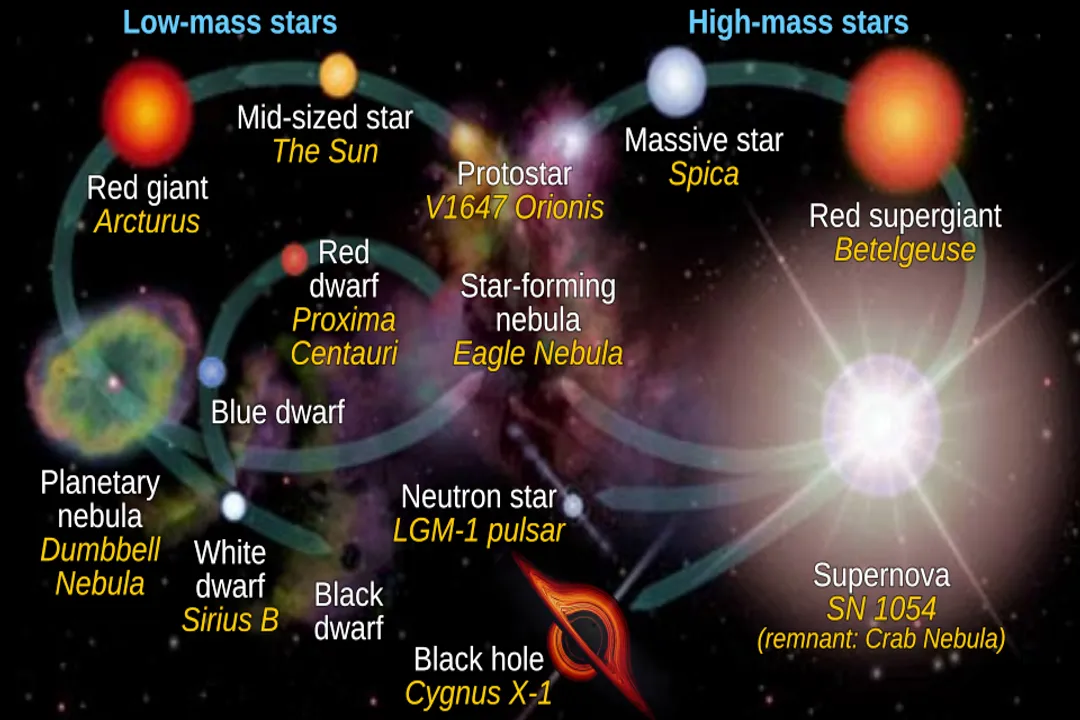
The mass of a star is perhaps the most consequential characteristic, as it determines the star's entire life story, from its formation to its final remnant. Stars are formed from the gravitational collapse of dense regions within vast molecular clouds, which are predominantly composed of hydrogen, with helium making up about 23 to 28 percent, and traces of heavier elements.
The sheer quantity of this initial material dictates the eventual fate of the stellar object. Stars capable of sustaining nuclear fusion in their cores—the process that makes them shine—must possess a certain minimum mass. For stars similar in composition to our Sun, the theoretical minimum mass required to ignite core hydrogen fusion is roughly 75 times the mass of Jupiter (). Objects below this threshold are often classified as brown dwarfs, occupying a murky transition zone between true stars and gas giants.
Mass is typically measured relative to the Sun, where equals the Sun's mass. Stars exhibit a wide range, from the smallest, like 2MASS J0523-1403 at only about (or about for very low metallicity stars), up to over for some of the most massive known examples. Massive stars, such as those exceeding , live dramatically different lives than their low-mass counterparts. They experience far greater pressure in their cores, forcing them to burn through their hydrogen fuel at an accelerated rate. While a star like the Sun is expected to reside on the main sequence for about 10 billion years, the most massive stars might only last a few million years. A star over can lose more than half of its total mass while still on the main sequence, significantly altering its evolutionary track.
The mass also governs the star's end product: less massive stars (like our Sun, to ) swell into red giants, shed their outer layers as a planetary nebula, and leave behind a white dwarf core. Conversely, the most massive stars collapse their iron cores violently, resulting in a supernova explosion, leaving behind either a neutron star or, if the remaining core exceeds roughly , a black hole.
# Size
The physical extent of a star, its size or radius, is another core characteristic, often quantified in terms of solar radii (). This dimension is crucial because it works alongside surface temperature to set the star's total energy output, or luminosity.
Stars display astonishing variation in physical diameter. On the compact end, stellar remnants like white dwarfs are incredibly small, only about 20 to 40 kilometers in diameter, roughly the size of the Earth. At the opposite extreme are the giants and supergiants. The Sun, our point of reference, has a standard radius, but stars like the red supergiant Betelgeuse can measure about 640 times the Sun’s diameter, yet possess a far lower overall density than a main-sequence star.
When a star exhausts its core hydrogen fuel, it typically expands dramatically as it transitions into a red giant phase. For instance, the Sun, in about 5 billion years, is projected to expand to a radius approaching 1 astronomical unit (about 250 times its current size).
When comparing the scale of different stars, the difference between a main-sequence star and an evolved giant can be stark, even if their masses are somewhat similar. A dense white dwarf core, which is the end-state of a Sun-like star, might have the mass of but the physical size of Earth, whereas a main-sequence star of similar mass is vastly larger. This highlights how stellar evolution dramatically reconfigures the physical dimensions of an object even when the total mass budget remains nearly constant.

# Temperature
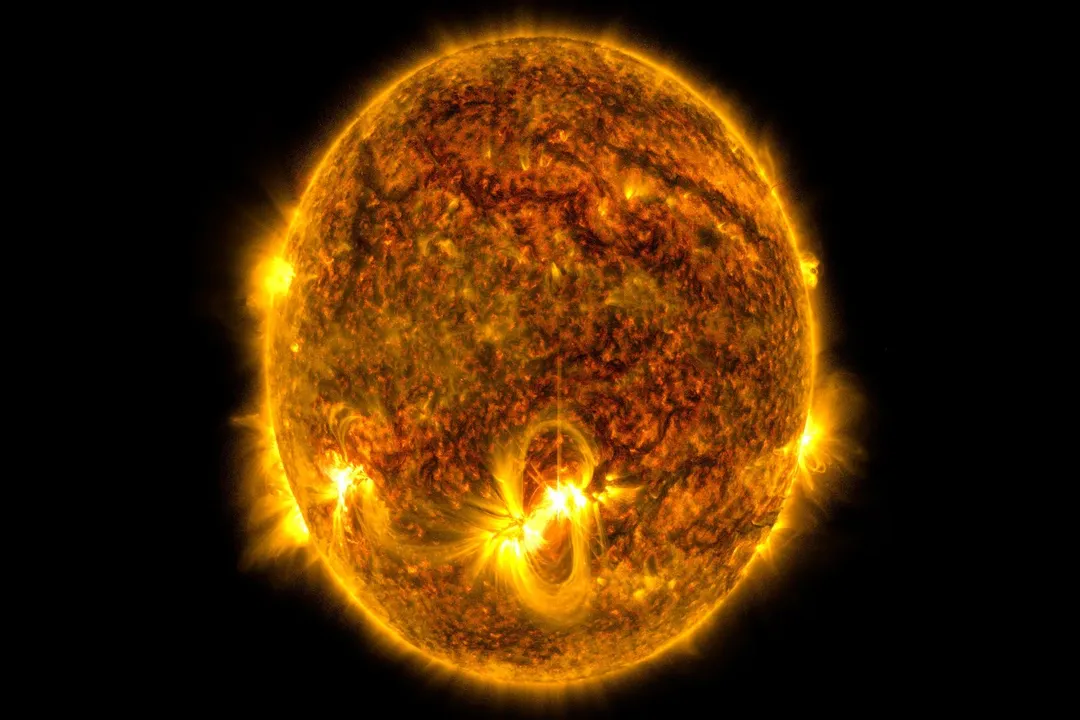
The surface temperature of a star is a fundamental metric, usually expressed on the Kelvin (K) scale, where is absolute zero. This temperature dictates the star's internal physics and its resulting spectral characteristics. While the core temperature of a main-sequence star is generally around several million kelvins, allowing fusion to proceed, it is the outer surface temperature that astronomers directly measure.
Temperature governs the rate of ionization within a star’s atmosphere, which in turn produces the specific dark absorption lines seen in its spectrum. Astronomers can estimate this temperature by examining the star's color index, comparing its visual magnitude against its photographic magnitude.
The observable range is significant. The hottest main-sequence stars, those of type O, can reach surface temperatures of or more. In contrast, the coolest, reddest stars can register temperatures around $2,600$ to . Our Sun sits comfortably in the middle, with a surface temperature of approximately . Red giants, despite being highly luminous due to their immense surface area, actually possess relatively cool surfaces, often around .
# Color
A star's color is an immediate, visible representation of its surface temperature. This link is so direct that color serves as a primary classification tool. The fundamental relationship is straightforward: cooler stars emit most of their visible light at longer wavelengths, making them appear red, whereas hotter stars emit light peaking at shorter, bluer wavelengths, appearing blue. Stars with intermediate temperatures fall into the yellow (like the Sun) or white categories. Stars can also present blended appearances, such as blue-white or red-orange.
The modern spectral classification system—O, B, A, F, G, K, M, in order of decreasing surface temperature—is entirely dependent on this surface reading. An O-type star is scorching hot and blue, while an M-type star is relatively cool and red.
For example, a G-class star like our Sun has a temperature between and and appears yellow. To the naked eye, the faintest stars visible under dark skies are typically red or orange because their lower temperatures push their peak emission toward the red end of the spectrum, which is often more perceptible than the slightly hotter, but fainter, blue stars. Observing the color of a star, therefore, offers an accessible first insight into the extreme physical conditions simmering on its surface.
# Brightness
The final critical feature is brightness, which is a composite characteristic involving both the star's intrinsic energy generation (Luminosity) and how we perceive that light from our vantage point (Magnitude).
# Intrinsic Luminosity
Luminosity is the total amount of radiant energy, across all wavelengths, that a star releases per unit of time, measured in units of power (like Watts). This is an intrinsic property, determined by the star's physical size and its surface temperature. A star can be very large but cool (like a red giant), or small but very hot (like a white dwarf); both scenarios result in unique luminosities. The most luminous known stars are enormous supergiants, radiating up to 6 million times the Sun's luminosity.
# Apparent Magnitude
Magnitude describes the apparent brightness—how bright the star looks to an observer on Earth. This perceived brightness is a combination of the true luminosity, the star's distance, and any dimming caused by intervening interstellar dust and gas. Because distance plays such a major role, a star that is intrinsically far more powerful may appear dimmer than a closer, less energetic one.
Astronomers use a logarithmic magnitude scale, where smaller numbers indicate greater brightness, and negative numbers signify the brightest objects. A difference of one magnitude corresponds to a brightness factor of about $2.5$ times.
Consider the difference between Sirius and Canopus: Sirius appears the brightest star in our night sky with an apparent magnitude of $-1.44$. However, Canopus, with an absolute magnitude of $-5.53$, is vastly more luminous—approximately $14,000$ times the Sun’s luminosity, compared to Sirius at only 23 times the Sun’s luminosity. Yet, Sirius wins the apparent brightness contest because it is much closer to us, located only $8.6$ light-years away, whereas Canopus is about $310$ light-years distant. This distinction between intrinsic luminosity and apparent magnitude is essential for accurately gauging a star's true output and its scale within the cosmos.
# Composition and Life Cycle
While the preceding five features relate to the star's physical measurements, the underlying composition and its ongoing life cycle provide the context for why those features exist.
Stars are built predominantly from hydrogen and helium. Astronomers often use the abundance of elements heavier than helium, termed "metals," to categorize stellar populations; younger stars, like the Sun, have higher metallicity because they formed from recycled material shed by previous stellar generations. The concentration of these metals can subtly influence the time a star spends burning fuel and the strength of its magnetic field.
The star’s internal engine is nuclear fusion. For the majority of its existence, a star operates on the main sequence, stably converting hydrogen into helium in its core. This fusion generates the outward pressure that perfectly counteracts the inward crush of gravity, maintaining a state called hydrostatic equilibrium.
An interesting consideration for stellar lifespans is how efficiently they consume their fuel relative to their total supply. A red dwarf, being less massive than , is fully convective, meaning it can circulate almost all its mass to the core to fuse, allowing it to persist for about one trillion years, significantly exceeding the current age of the universe ($13.8$ billion years). By contrast, a star like the Sun, which can only fuse about 10% of its total mass via core fusion, has a main sequence life of about 10 billion years. This difference in longevity due to mass and convective mixing is a testament to how powerful mass is as a determining factor. If you could observe a star 10 billion years from now, and it was a red dwarf, it would still likely be fusing hydrogen, while our Sun would long since have transitioned into a giant.
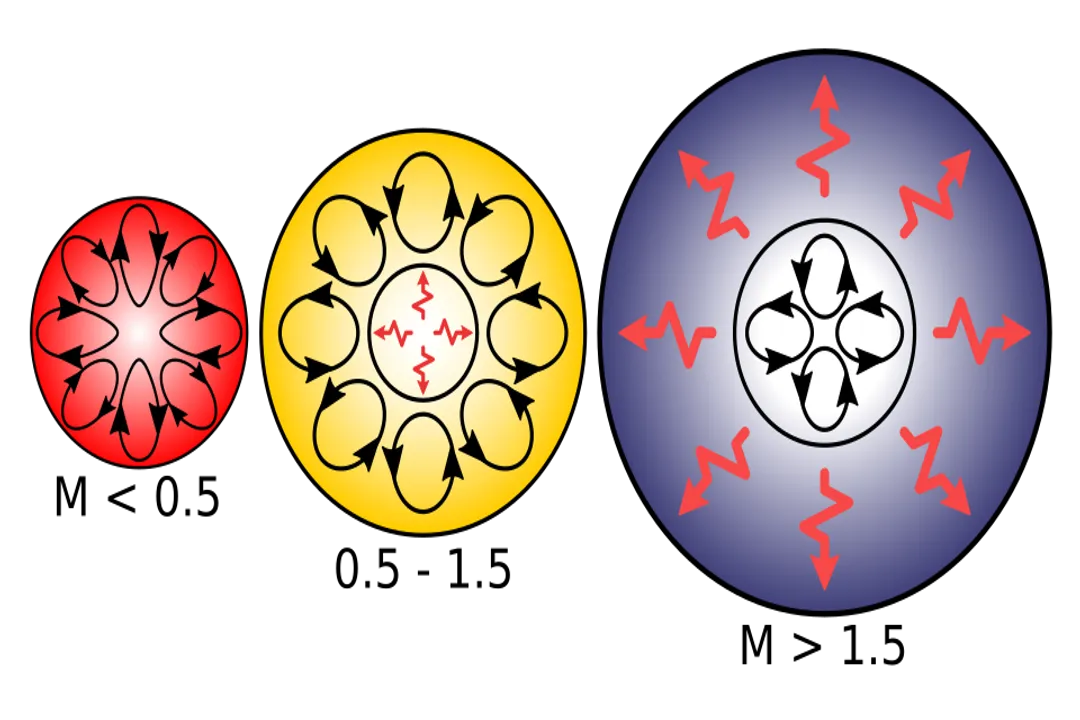
The structure that results from this sustained fusion—the balance between the radiation zone (where energy moves via photons) and the convection zone (where hot plasma physically rises and falls)—also varies by mass. For example, high-mass stars have a convection zone deep inside with a radiative zone closer to the surface, while smaller stars, like the Sun, possess the opposite arrangement, with the convective zone nearer the surface layer we observe, the photosphere.
In summary, the five observable features—mass, size, temperature, color, and brightness—are deeply interconnected, all stemming from the fundamental physics of gravitational collapse and nuclear fusion that define a star's existence from birth in a molecular cloud to its final, dense remnant.
Related Questions
#Citations
Star Basics - NASA Science
The Properties of Stars
Star - Wikipedia
Characteristics Of A Star - Sciencing