What theoretical risk does a passing rogue star pose to the inner solar system?
Answer
Gravitational perturbation of the Oort cloud
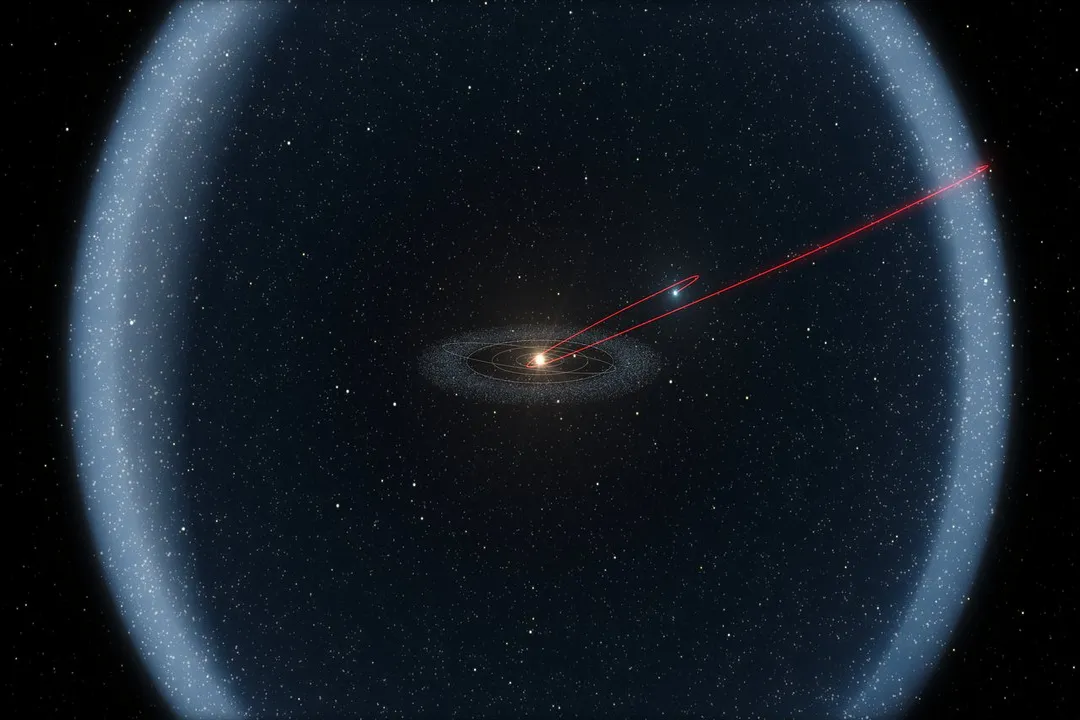
While the probability of a direct collision between a rogue star and the Sun is virtually zero due to the immense scale of interstellar space, a passing star could still exert a disruptive influence. If a rogue star were to pass through the Oort cloud, which is the distant region containing icy bodies surrounding our solar system, its gravity could disturb the orbits of these objects. Such a perturbation could potentially redirect a shower of comets toward the inner solar system, creating a long-term risk for planetary environments.
#Videos
Neil deGrasse Tyson Explains Rogue Stars - YouTube
The Wildest Stars: How Rogue Suns Race Across the Galaxy
Related Questions
How does a supermassive black hole contribute to the creation of a rogue star?What specific process allows a supernova event to eject a star from a binary system?Why is precise measurement of proper motion essential for detecting rogue stars?What theoretical risk does a passing rogue star pose to the inner solar system?How do scientists utilize rogue stars to map the distribution of dark matter?What is the primary difference between a hypervelocity star and a runaway star?Why is the distinction between a rogue star and a brown dwarf important?How does the study of rogue stars improve our understanding of galactic evolution?What information can astronomers infer by calculating the total mass of a galaxy using a rogue star?Why are rogue stars considered valuable data points for early universe history?