What is the meaning of rogue star?
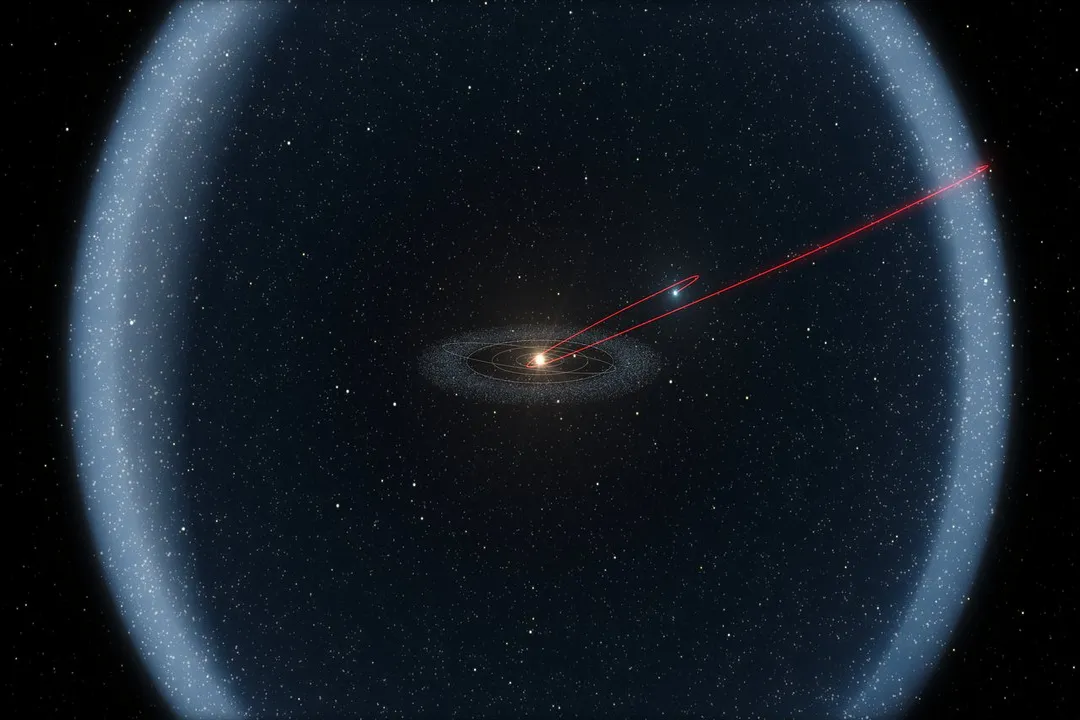
Imagine a star wandering through the absolute darkness of intergalactic space, millions of light-years away from the comforting glow of a galaxy. While we typically associate stars with their home galaxies, where they dance in organized spirals or elliptical swarms, some stars exist as solitary nomads. These objects, known as rogue stars, have been stripped from their parent clusters and cast into the void. [2][4] They represent some of the most dynamic events in the universe, serving as kinetic evidence of the violent interactions that can occur within dense stellar neighborhoods. [9]
# Ejection Mechanics
The primary way a star becomes a rogue is through a gravitational slingshot. The most efficient "launcher" in a galaxy is a supermassive black hole. [4] When a multiple-star system, such as a binary, wanders too close to the black hole at the center of a galaxy, the immense tidal forces tear the system apart. The black hole may capture one of the stars, pulling it into an orbit, while the other star is flung outward at extreme velocity. [2][4] This process can accelerate the star to speeds high enough to escape the galaxy's gravitational pull entirely. [2][9]
Another common method involves supernovae. In a binary system, if one star explodes as a supernova, the sudden loss of mass can disrupt the gravitational equilibrium of the pair. If the orbital velocity is high enough, the companion star is no longer bound to the exploded star's remnant and is effectively released into space. [4] These ejected stars, sometimes called hypervelocity stars, move much faster than the average star in our local neighborhood, carrying the kinetic energy of their violent birth. [2]
# Detection Challenges
Finding these stars is difficult because they lack a background host. Astronomers usually identify stars by looking for groups or by observing their motion relative to the galactic disk. [8] Since rogue stars travel through the vast, empty spaces between galaxies, they are essentially invisible to standard deep-sky surveys. Scientists often rely on precise measurements of "proper motion"—how a star changes its position in the sky over several years—to identify them. [8]
Projects like the Gaia space observatory have significantly improved our ability to track these objects. By mapping the positions and velocities of millions of stars, researchers can backtrack a star’s path to see if it originated from a galactic center or a known cluster. [8] If a star is moving at a speed that exceeds the escape velocity of its home galaxy and its trajectory points back to a dense center, it is a prime candidate for a rogue status. [9]
# Statistical Estimates
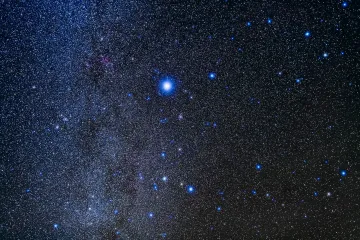
While individual rogue stars are hard to see, calculations suggest they are not rare. Some estimates indicate that there could be billions of such stars drifting in the space between galaxies. [2][4] Because they are not obscured by the dust or light of a galaxy, they are theoretically easy to study if we can point a telescope at the right spot, but the volume of space to cover is effectively infinite, making the search akin to finding a needle in a haystack. [8]
| Mechanism | Energy Source | Typical Velocity | Commonality |
|---|---|---|---|
| Black Hole Slingshot | Tidal Forces | Very High | Rare |
| Supernova Ejection | Binary Mass Loss | Moderate | Frequent |
| Galactic Collision | Tidal Disruptions | Variable | Occasional |
The table above illustrates the three primary ways stars are ejected from their homes. Note that while supernova ejections are more frequent, the black hole slingshot method produces the stars with the highest velocities, often earning them the classification of hypervelocity stars. [2][9]
# Solar Risks
There is occasional public concern regarding whether a rogue star could enter our solar system and cause damage. While the math shows that such an event is possible, the probability is astronomically low. [7] Our solar system is tiny compared to the interstellar voids. Even if a star were on a collision course, the sheer distance between stars means that a direct hit is virtually impossible. [7]
However, a close pass—even if it does not hit the Sun—could be disruptive. If a rogue star were to pass through the Oort cloud, the region of icy bodies surrounding our solar system, its gravity could perturb the orbits of these objects. This might send a shower of comets toward the inner solar system, creating a long-term risk for Earth. [7] This scenario remains a theoretical possibility rather than a near-term concern. Astronomers monitor the motions of nearby stars, and no rogue star is currently identified as being on a trajectory that threatens the stability of our neighborhood. [7]
# Analytical Observation
The existence of rogue stars forces a re-evaluation of how we categorize stellar death and life. We often think of stars as permanent fixtures, fixed in their celestial positions. In reality, galaxies are fluid, dynamic systems. The presence of these rogues suggests that every galaxy is "leaking" stars constantly. This continuous shedding of mass and energy is a byproduct of the galaxy's internal engine.
If we consider the age of the universe, it becomes clear that many of these rogue stars have been traveling for billions of years. They are the ultimate time capsules, originating from early galaxies or star clusters that may no longer exist in their original form. A rogue star could potentially be millions of years older than the galaxy it currently drifts near, making these wanderers valuable data points for understanding the history of star formation in the early universe. [4]
# Defining Status
A common point of confusion exists regarding the definition of a rogue star versus a brown dwarf or a rogue planet. A rogue star is a full-fledged star that has undergone nuclear fusion and was ejected. [4] In contrast, objects like brown dwarfs are sometimes born in isolation, never forming into a star, and rogue planets are planetary-mass objects ejected from their solar systems. [3] The distinction lies in their origin: rogue stars had a "home" and lost it; many smaller isolated objects may have simply formed in the darkness. [3][9]
To better understand the scale of these objects, consider the following breakdown of how we classify these wanderers:
- Hypervelocity Stars: These are the rogues ejected by supermassive black holes. They travel at extreme speeds, sometimes thousands of kilometers per second. [2]
- Runaway Stars: These are usually ejected by supernovae. They travel at high speeds but typically remain within or near the galactic halo. [2]
- Intergalactic Stars: These are stars that are fully detached from any galaxy. They may be remnants from galactic collisions or ancient ejections that have traveled for eons. [4]

# Research Significance
The study of these stars is not just about cataloging misfits; it is about testing the laws of gravity. By observing how these stars move, scientists can map the distribution of dark matter in and around galaxies. If a star is ejected at a specific speed, its trajectory is influenced by the gravitational pull of the dark matter halo surrounding its parent galaxy. [8] If the star's path does not match the predicted trajectory, it suggests that our current models of galactic mass distribution might be incomplete. [8]
This provides a method to "weigh" a galaxy. By measuring the speed of a rogue star as it exits the galactic boundaries, researchers can calculate the total mass of the galaxy, including the invisible dark matter that holds it together. [8] Every rogue star is, in effect, a probe sent by the galaxy into the deep universe, providing information that telescopes could not otherwise gather.
# Future Outlook
As technology advances, specifically with improved infrared mapping and larger space-based telescopes, the number of identified rogue stars is expected to grow. Currently, we only see the ones relatively close to us or the ones moving at extremely high velocities. There is a vast population of "slower" rogues that simply appear as background stars, indistinguishable from the crowd without high-precision data. [8]
The ongoing work to catalog these objects helps fill the gaps in our understanding of how galaxies evolve. We are learning that the space between galaxies is not truly empty; it is populated by a thin, sparse drift of stellar material. This suggests a universe that is much more interconnected than it appears, where stars can move from one galactic environment to another, potentially carrying heavy elements and enriching the intergalactic medium with materials forged in their cores. [4]
Understanding the rogue star phenomenon changes the perspective of the universe from a collection of static, isolated galaxies to a interconnected system where stars can escape their origins and venture out into the unknown. It serves as a reminder that even in the most organized systems, there are always elements that break free, drifting into the darkness to become something entirely new.
#Videos
Neil deGrasse Tyson Explains Rogue Stars - YouTube
The Wildest Stars: How Rogue Suns Race Across the Galaxy
Related Questions
#Citations
Neil deGrasse Tyson Explains Rogue Stars - YouTube
Rogue Stars: The Miscreants of Our Galaxy | Space
Is there such a thing as a rogue star outside of a galaxy? - Reddit
Rogue star not heading for Solar System collision after all - ESO.org
A rogue star could cast Earth into darkness – and end humanity
New Study Lists The Ways a Rogue Star Could Spell Doom For Our ...
Our galaxy's marvelous rogues and misfits - Astronomy Magazine
What are these rogue stars, and how do they end up drifting ... - Quora