What key observation confirms that an observer will never see Venus high overhead near midnight?
Answer
Because its orbit is internal to Earth's, it is always bound to the dawn or dusk hours.
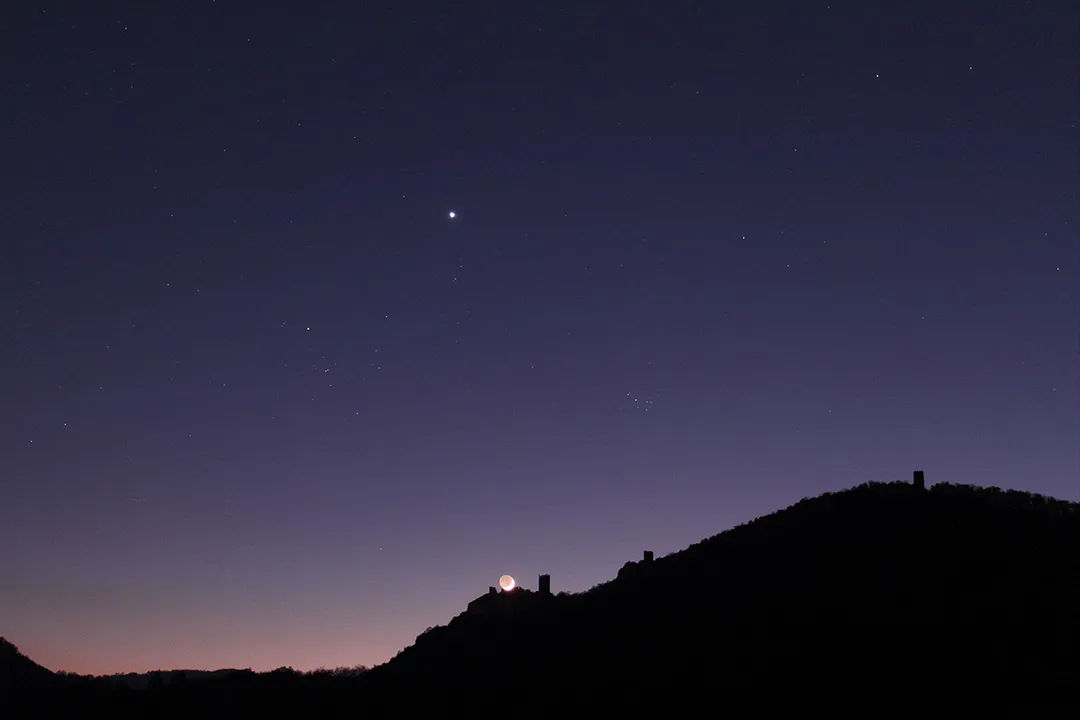
The fundamental reason Venus is never seen high overhead around midnight is rooted in its orbital position as an inner planet. Since Venus orbits entirely inside the orbit of Earth, its angular separation from the Sun, as measured from Earth, is limited. If a planet is far from the Sun in the sky (i.e., high overhead when the Sun is below the horizon at midnight), it must orbit outside the Earth's path. Venus's physical constraint means it must remain in close angular proximity to the Sun, restricting its visibility strictly to the twilight periods just before sunrise (Morning Star) or just after sunset (Evening Star).
Related Questions
Why is Venus constrained to the dawn or dusk hours unlike planets like Mars or Jupiter?What is the approximate orbital period of Venus compared to Earth's orbital period?What event occurs when Venus passes directly between the Earth and the Sun, causing it to vanish?What is the approximate length of the synodic period that governs Venus's full cycle of visibility?What geometrical event defines Venus setting at its latest time after the Sun in the evening sky?What is the observational status of Venus during superior conjunction?How does the maximum greatest elongation angle of Venus contrast with that of Mercury?What phase does Venus exhibit when positioned between Earth and the Sun, contrasting with its appearance at greatest elongation?What factor determines the *duration* of Venus's visibility window in the twilight, separate from orbital mechanics?What key observation confirms that an observer will never see Venus high overhead near midnight?