What energy source fundamentally drives terrestrial weather dynamics versus space weather electrodynamics?
Answer
Differential solar heating versus solar ejection and particle acceleration
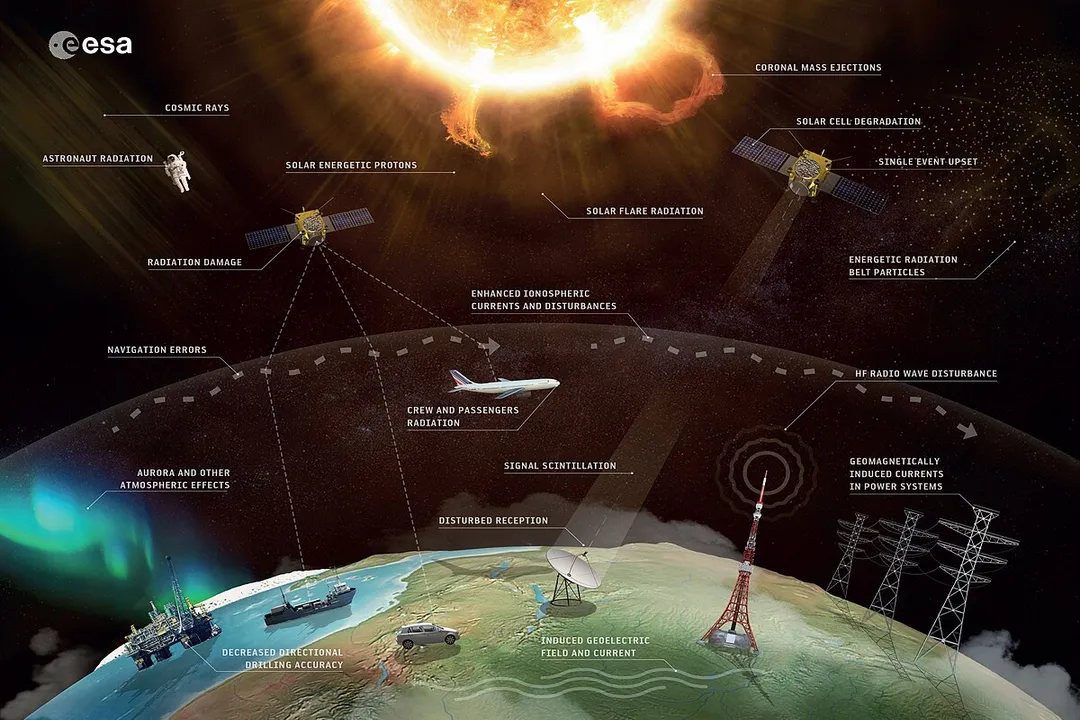
Terrestrial weather, such as temperature shifts and rainfall, is fundamentally driven by atmospheric thermodynamics and fluid dynamics. This process is initiated by the differential heating of the globe caused by the Sun's visible and infrared radiation—the heat input. Space weather, however, is driven by electrodynamics resulting from the Sun's constant outward spewing of charged particles (solar wind) and periodic, sudden energetic releases (ejections and acceleration events) occurring in the near-vacuum of space, which primarily affect charged systems like the magnetosphere and electronics.
Related Questions
What medium defines space weather versus atmospheric weather conditions?How quickly do intense radiation bursts from Solar Flares reach Earth, and what atmospheric layer do they primarily affect?What generates Earth's primary protection, the magnetosphere, against solar wind?What specific hazard results when a powerful CME triggers significant compression of the magnetosphere?How do Geomagnetically Induced Currents (GICs) specifically impact high-voltage power grids?Besides charging effects, what physical change to the upper atmosphere increases drag on low-Earth orbit satellites during space weather events?What specific major solar event in 1859 demonstrated the hazard of induced currents by causing widespread failure in which technology?After the magnetosphere deflects most solar wind, what is the critical protective function of Earth's atmosphere regarding remaining radiation and particulate matter?What is the key timing difference when comparing the arrival of radiation from a Solar Flare versus the physical particles from a Coronal Mass Ejection (CME)?What energy source fundamentally drives terrestrial weather dynamics versus space weather electrodynamics?