How quickly do intense radiation bursts from Solar Flares reach Earth, and what atmospheric layer do they primarily affect?
Answer
About eight minutes, primarily affecting the ionosphere
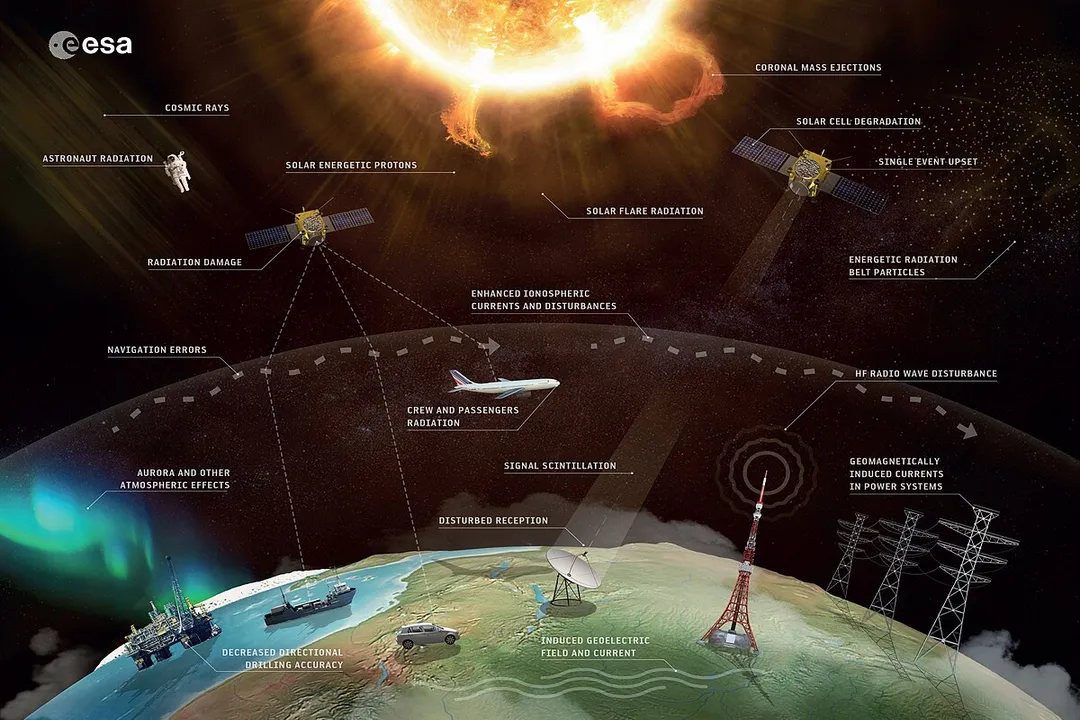
Solar flares are described as intense bursts of radiation, which travel at the speed of light. Because the distance is relatively short, this electromagnetic radiation reaches Earth in approximately eight minutes. Upon arrival, this intense energy primarily interacts with the ionosphere, which is the upper layer of Earth's atmosphere that has been charged by solar radiation. This interaction leads to immediate, though often temporary, disruptions in radio communications because the charged particles alter the propagation characteristics of that atmospheric layer.
Related Questions
What medium defines space weather versus atmospheric weather conditions?How quickly do intense radiation bursts from Solar Flares reach Earth, and what atmospheric layer do they primarily affect?What generates Earth's primary protection, the magnetosphere, against solar wind?What specific hazard results when a powerful CME triggers significant compression of the magnetosphere?How do Geomagnetically Induced Currents (GICs) specifically impact high-voltage power grids?Besides charging effects, what physical change to the upper atmosphere increases drag on low-Earth orbit satellites during space weather events?What specific major solar event in 1859 demonstrated the hazard of induced currents by causing widespread failure in which technology?After the magnetosphere deflects most solar wind, what is the critical protective function of Earth's atmosphere regarding remaining radiation and particulate matter?What is the key timing difference when comparing the arrival of radiation from a Solar Flare versus the physical particles from a Coronal Mass Ejection (CME)?What energy source fundamentally drives terrestrial weather dynamics versus space weather electrodynamics?