In high-resolution images, what often causes the visible red or pink hues within a star-forming nebula?
Answer
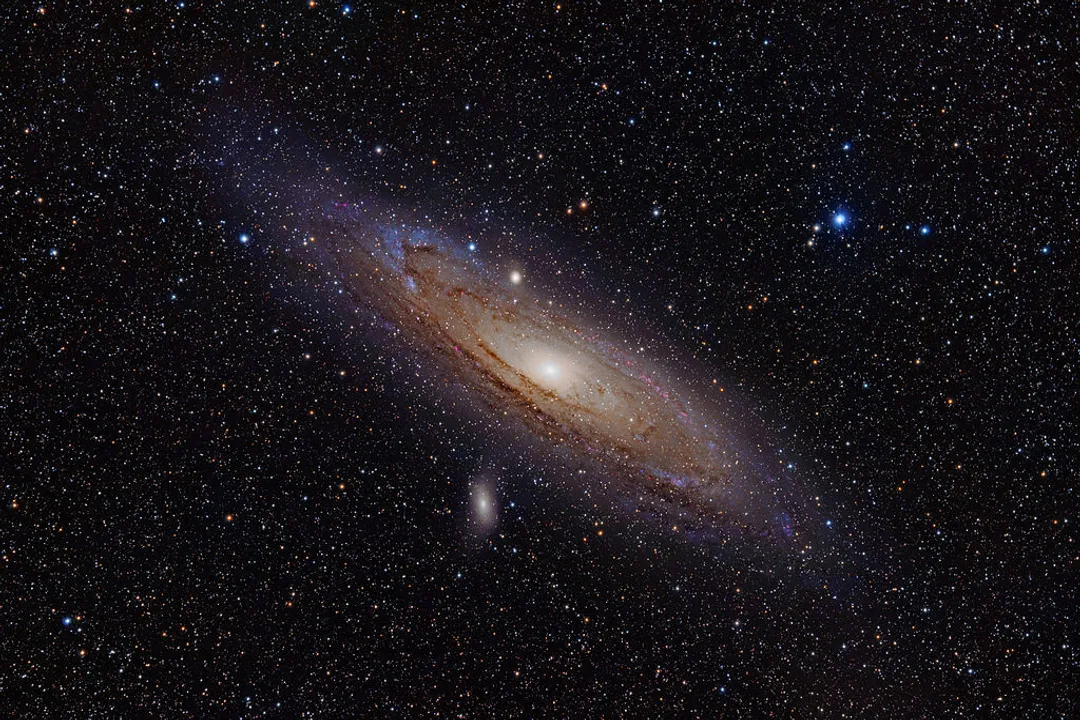
Ionized hydrogen gas energized by powerful ultraviolet light from massive young stars
The red or pink color seen in nebulae is typically ionized hydrogen gas that has been energized by the intense ultraviolet radiation emitted by massive, recently formed O and B type stars.
Related Questions
What are the primary components making up a spiral galaxy?Where is the majority of the gas and dust located within a spiral galaxy's morphology?What dynamic mechanism is responsible for compressing material in spiral arms to trigger star formation?How does the spatial distribution of dust compare to that of diffuse gas in the disk?What observational technique allows astronomers to map the distribution of neutral hydrogen gas extending beyond dust obscuration?What materials are the dark dust lanes in spiral arms typically composed of?Which component of the interstellar medium is described as being subject to destruction over cosmic timescales, requiring replenishment from supernovae?What is the significance of finding substantial amounts of gas and dust in a galaxy?In high-resolution images, what often causes the visible red or pink hues within a star-forming nebula?What is the summarized functional difference between the gas and the dust components in defining a galaxy's visible structure?