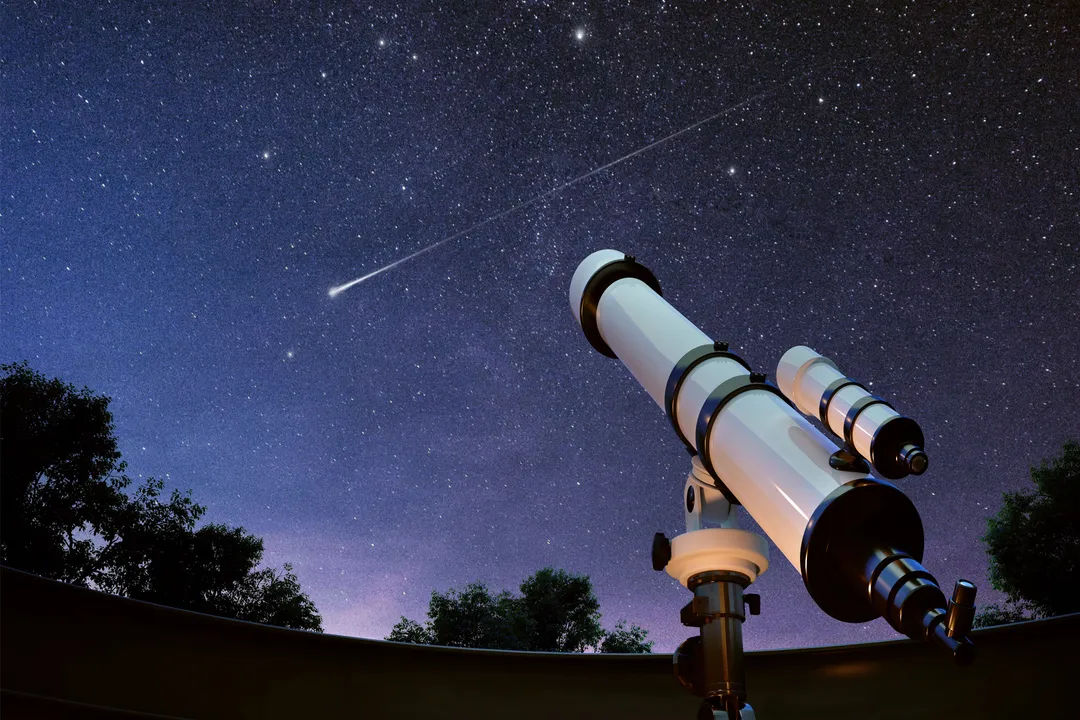
How does doubling the diameter of a telescope’s lens or mirror affect its light-gathering ability?
It quadruples the light it collects
The relationship between a telescope's aperture diameter and its light-gathering power is not linear, but rather determined by the area of the light-collecting surface, which follows the formula for the area of a circle ($A = \pi r^2$). Since the diameter is twice the radius ($D=2r$), if the diameter is doubled, the radius is also doubled. Consequently, the collected area increases by the square of the change in radius (or diameter). Therefore, doubling the diameter results in $2^2 = 4$ times the light being collected. This exponential increase in collected photons is crucial when observing faint objects, as it directly translates into the difference between perceiving a vague smudge and discerning actual structural details within nebulae or galaxies.