What is a telescope in short?
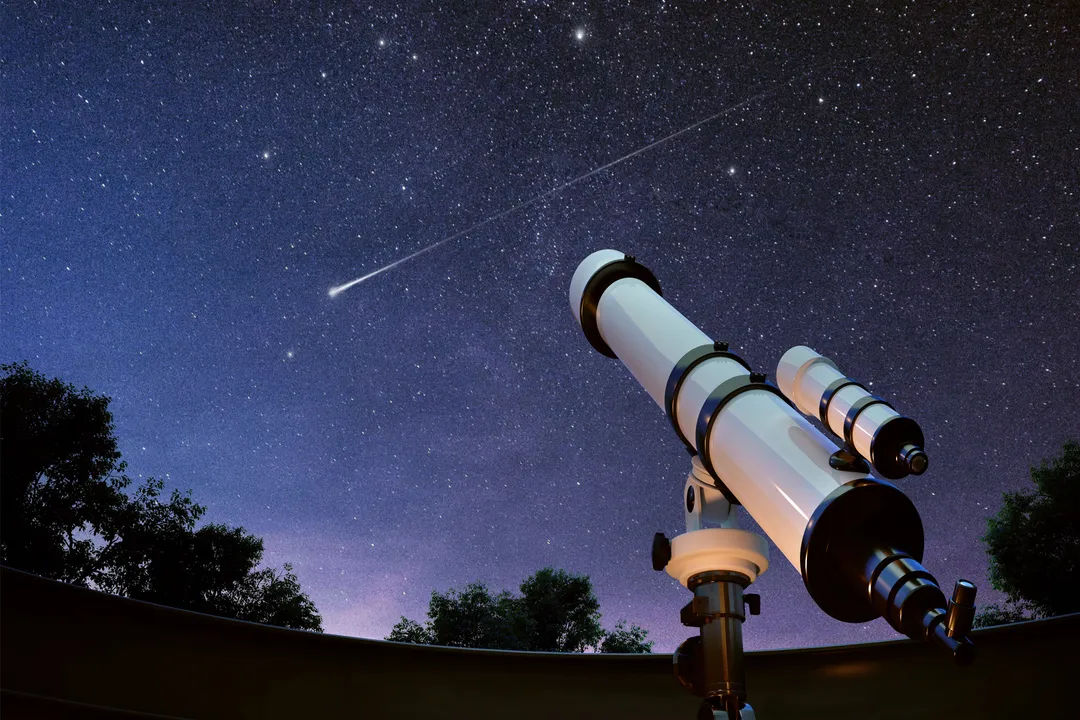
A telescope, at its most fundamental description, is simply an instrument built to defeat distance. [1][3][6] It allows our eyes to perceive things far away that we cannot resolve or see clearly with our unaided vision. [2][8] While the popular conception of a telescope often centers on making objects appear larger, the true power of any functioning scope—whether professional or amateur—lies in its capacity to collect light. [4][9] Essentially, a telescope acts as a giant, artificial pupil for viewing the distant cosmos, focusing faint light rays from celestial bodies onto a single point or sensor. [4][5][9]
# Light Gathering
The single most important characteristic of any telescope is its aperture, which is the diameter of its primary light-collecting element—be it a lens or a mirror. [1][4] This collecting power is what truly separates professional astronomical instruments from backyard models. [4] If you are looking at a distant galaxy, you are gathering photons that have traveled for millions of years. Your telescope’s job is to catch as many of those photons as possible in a short time frame. [9]
Consider the difference in light-gathering ability. Doubling the diameter of a telescope’s lens or mirror does not just double the light it collects; it quadruples it, because the area is proportional to the square of the radius (). [4] This means that an 8-inch telescope collects four times the light of a 4-inch telescope. When observing truly faint objects, like distant nebulae or dim galaxies, this exponential increase in light collection is transformative; it is the difference between seeing a faint smudge and discerning real structure. [4]
# Optical Types
Telescopes are primarily classified based on how they manipulate the incoming light stream. There are two main categories that have defined astronomical observation for centuries: refractors and reflectors. [1][4][9]
# Refractors
The refracting telescope relies exclusively on lenses. [1][9] Light enters the front end through a large lens called the objective lens, which bends (refracts) the light rays to converge at a focal point inside the tube. [1][9] A smaller lens, the eyepiece, then magnifies this focused image for the observer. [1] Historically, these were the first practical telescopes, famously used by Galileo. [1] They are often prized for producing sharp, high-contrast images, particularly for planetary observation, as the light path is sealed, protecting the optics from dust and air currents. [1][4]
# Reflectors
The reflecting telescope bypasses the use of large, perfectly shaped lenses by using mirrors instead. [1][9] The objective element is a large, concave primary mirror at the base of the tube, which collects and reflects the light back up the tube to a focal point. [1] Because mirrors can be supported from the back, they can be made much larger than lenses without sagging under their own weight, which is why the largest research telescopes in the world almost exclusively use mirrors. [1][4] In many common designs, like the Newtonian reflector, a small, flat secondary mirror intercepts the converging light beam and redirects it out the side of the tube to an eyepiece. [1][9]
It is interesting to note the trade-offs inherent in these designs. While refractors offer fantastic image clarity, manufacturing a large, flawless objective lens free from chromatic aberration (color fringing) is incredibly difficult and expensive. [1] Reflectors, on the other hand, can be built with significantly larger apertures for less cost, but they require periodic collimation—the precise alignment of the mirrors—to maintain sharp focus. [1][9]

# Performance Metrics
When discussing what a telescope does, people often jump immediately to magnification, but this is frequently misleading for the novice observer. [4][8] Magnification is merely the ratio of the telescope's focal length to the eyepiece's focal length. [9]
# Magnification Limits
While a telescope can magnify an object, excessive magnification yields a dim, blurry image, because there isn't enough collected light to properly illuminate the enlarged view. [4] Generally, an amateur telescope should not be pushed beyond about 50 times the diameter of its aperture in inches (or about twice its aperture in millimeters) before the image quality degrades significantly due to atmospheric turbulence or insufficient light. [4][9] For example, a 4-inch (100mm) telescope has a theoretical practical limit around magnification, though achieving sharp views that high is rare. [4]
# Resolution Power
A more meaningful metric for astronomical observation is resolution, or the ability to distinguish fine details between two closely spaced objects. [1] This is directly related to the aperture size and the clarity of the optics, not the eyepiece used. [1] A telescope with a wide aperture resolves fine detail better than a narrow one, even if both are set to the same magnification level. [1] This means a large, low-power view from a big telescope often shows more true detail than a small, highly magnified view from a smaller instrument. [4] If you are comparing two scopes, ignore the advertised "maximum magnification" and instead focus on the size of the main lens or mirror—that is the true indicator of potential performance. [1][4]
# Wavelengths Observed
While the term "telescope" usually implies visible light, the concept extends to any device that gathers electromagnetic radiation from space. [4] Astronomers utilize instruments specifically tuned to capture parts of the spectrum that visible light telescopes cannot see. [4][9]
These specialized instruments include:
- Radio Telescopes: These massive dish antennas collect extremely long radio waves, allowing scientists to study cold gas clouds, distant galaxies, and pulsars. [4][9]
- Infrared Telescopes: These observe heat signatures, helping to penetrate dusty regions of space where stars are forming, as infrared light passes through dust more easily than visible light. [4]
- X-ray and Gamma-ray Telescopes: These are usually placed in space because Earth’s atmosphere blocks these high-energy radiations. [4] They observe extremely energetic events like black holes, supernova remnants, and active galactic nuclei. [4]
The selection of the right tool depends entirely on the target. A large reflecting telescope on Earth is perfect for viewing the Moon or Jupiter's bands, but studying the temperature of a forming star requires a dedicated infrared instrument, perhaps even one positioned outside the blurring effects of our atmosphere. [4][9] The fundamental principle remains the same across all these types: gather weak signals across a large area to reveal details otherwise hidden. [4]

# Historical Context
The origins of the telescope point back to the early century in Europe, though an exact inventor is hard to pin down. [1] The earliest practical designs often featured simple objective lenses and eyepieces. [1] However, it was figures like Galileo Galilei, who refined early designs and turned them towards the heavens, who truly brought the instrument into scientific prominence around 1609. [1] He used his improved refracting telescopes to make groundbreaking observations of the Moon's surface, the phases of Venus, and the moons orbiting Jupiter, fundamentally shifting humanity's view of the solar system. [1]
The transition to using mirrors, spearheaded by thinkers like Isaac Newton, marked the next great leap, moving the technology past the inherent limitations of early lens-making toward greater light-gathering capacity for fainter and more distant targets. [1][9]
# The Observing Experience
Understanding what a telescope is also involves appreciating what it enables. For the casual observer, it transforms familiar objects. Seeing the craters on the Moon up close or the distinct color bands on Saturn suddenly makes these objects tactile and real rather than just distant points of light. [8] The instrument is a bridge across astronomical distances, turning abstract points in the sky into tangible, observable worlds. [2] When you look through the eyepiece, you are literally capturing light that began its journey sometimes centuries or millennia ago, making the telescope a time machine as much as a magnifying glass. [4]
Related Questions
#Citations
Telescope - Wikipedia
telescope - Kids | Britannica Kids | Homework Help
TELESCOPE Definition & Meaning - Merriam-Webster
Telescopes 101 - NASA Science
How a Telescope Works - Imaging.org
TELESCOPE Definition & Meaning - Dictionary.com
Glossary term: Telescope - IAU Office of Astronomy for Education
Telescopes Lesson for Kids: Definition & Facts - Video - Study.com
Telescopes | Physics - Lumen Learning
Telescope - Definition, Examples, Quiz, FAQ, Trivia - Workybooks