What is the impact of the telescope?
The telescope arrived not as a quiet refinement but as a thunderclap, immediately forcing humanity to reassess its place in a cosmos previously defined by philosophical tradition rather than physical evidence. It was one of the most important instruments of the Scientific Revolution, an invention credited generally to the Dutchman Hans Lippershey in the year 1608. This device, initially a simple combination of convex and concave lenses in a tube used by spectacle makers, quickly evolved from an Earth-bound novelty for surveying and military use into the ultimate tool for celestial investigation. Before its arrival, dedicated astronomers like Tycho Brahe had amassed meticulous naked-eye data, and thinkers like Copernicus had formulated bold, Sun-centered theories, yet these remained largely in the realm of intellectual debate, often colored by religious or Aristotelian prejudices. The telescope offered an entirely new, tangible means to test conflicting theories against the physical reality of the heavens.
# Initial Gaze
The earliest recognizable practical device, generally attributed to Lippershey though disputed by contemporaries like Zacharias Janssen and Jacob Metius, magnified distant objects only three or four times. The principles behind using lenses to bring distant things closer had roots tracing back to antiquity and Islamic scientists, but the 1608 configuration was the breakthrough.
Galileo’s Focus
News of this "perspective glass" reached Galileo Galilei in 1609, sparking an immediate dedication to improvement. Galileo, a skilled instrument maker, rapidly refined the design, moving from a three-diameter magnification to an eight-powered instrument, and eventually achieving a magnification of 33 diameters using a roughly 60 cm lead tube. It was Galileo who first turned this terrestrial tool toward the sky, publishing his astonishing results in Sidereus Nuncius (The Starry Messenger) in 1610.
His observations delivered immediate, devastating blows to the old, accepted cosmology:
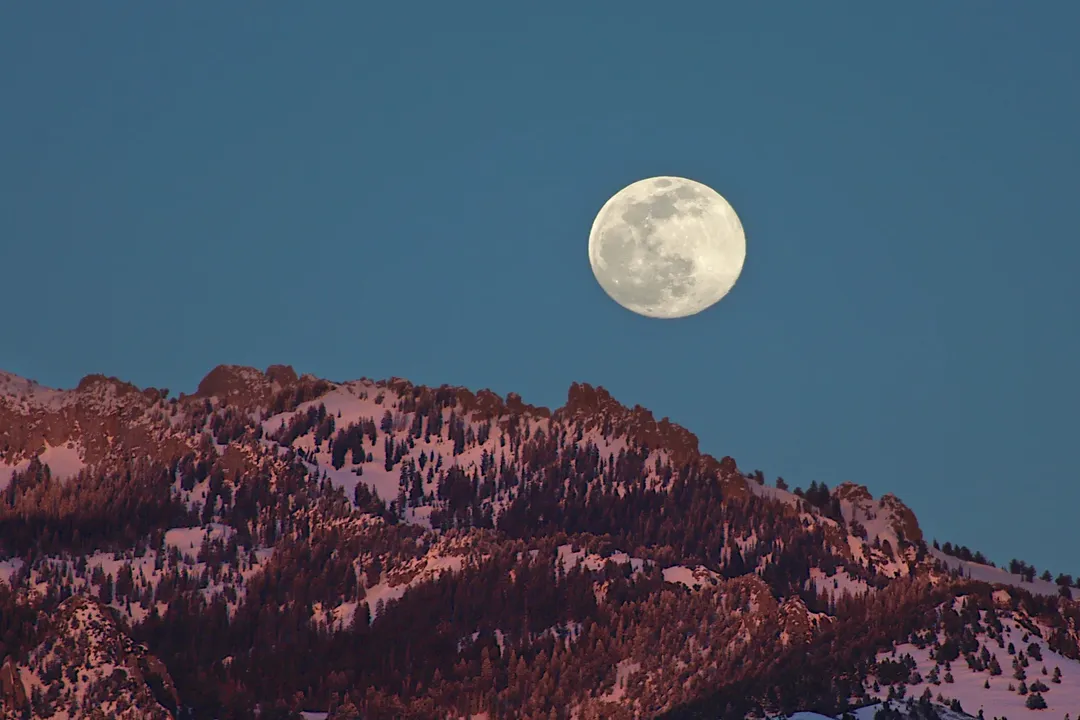
- The Moon: Galileo showed its surface was not a translucent, perfect celestial sphere, but a world of mountains and valleys, similar in substance to Earth.
- Jupiter’s Moons: He spotted four objects orbiting Jupiter, proving that not everything revolved around the Earth, which directly refuted a key critique leveled against the Copernican model.
- The Sun: By observing dark spots that moved across its face, Galileo demonstrated that the Sun itself rotated and possessed an imperfect, changing surface, shattering the notion of a static, divine perfection in the heavens.
- Venus: He observed the phases of Venus, another observation strongly supporting the Sun-centered system.
While Galileo rapidly publicized his findings, it is important to note that the English astronomer Thomas Harriot may have made the first recorded telescopic observation of the Moon a month before Galileo, and his later map of the Moon was more detailed. However, the sheer volume of Galileo’s distributed publications—over 500 copies of the Starry Messenger—cemented his observations in the learned world, despite his eventual condemnation by the Church. The telescope became synonymous with the man who knew how to publish what he saw.
# Societal Upheaval
The impact of the telescope extended far past astronomical charts; it was a technology that ignited a fundamental shift in the structure of human thought and society. The collapse of the geocentric view, long supported by religious dogma, directly challenged established authority. If the Moon was imperfect and the Earth was not the center of all motion, the comforting framework that placed humanity at the center of all things fractured.
The telescope, alongside the printing press that disseminated its findings, was central to the cultural transformation toward a worldview based on facts and tangible proof rather than tradition. This necessity for empirical validation directly influenced the hardening of the scientific method as the gold standard for acquiring knowledge. Furthermore, the ability to observe celestial bodies more accurately aided navigation and charting, which consequently facilitated global trade and supported the expansion of economic systems like capitalism. The technology acted as a powerful catalyst, expanding human perception, encouraging skepticism, and demanding a new, more critical way of thinking—the modern mind.
As this new vision of an infinite universe dawned, it raised unsettling questions: If the Sun was mutable, what else was changing? Could there be life on other worlds? The instrument revealed just how much was unknown about the heavenly bodies, setting the stage for centuries of further inquiry.
# Refining Sight
The technological challenge immediately following the initial shock was purely optical. The early refracting telescopes suffered from chromatic aberration, where colors failed to converge to a single point, blurring the image. Early astronomers often had to build their own instruments, sometimes constructing massive devices just to gain marginal improvements in clarity. For instance, a typical 17th-century astronomical telescope might be around 15 meters long, while Johannes Hevelius built one 46 meters long by 1647.
This need for clearer, more powerful views drove innovation in instrument design:
- Reflectors: In 1668, Isaac Newton invented the reflecting telescope, using a curved mirror instead of lenses to gather light. This design drastically reduced chromatic aberration and allowed for a 40x magnification in an instrument ten times shorter than a refractor of equivalent strength.
- Precision Tools: Micrometers were added to take precise angular measurements, and by the 18th century, different types of glass began to mitigate lens issues. Binoculars (double telescopes), which Galileo had briefly invented, became common for steady, three-dimensional viewing on land and sea.
The establishment of purpose-built observatories, often state-funded to solve practical navigational problems, institutionalized this new science. Nations founded observatories in Paris (1667) and Greenwich (1675), extending this scientific organization globally to places like Siam and Jaipur in the following decades.
It is fascinating to observe the initial hurdle clearance. Galileo, through sheer skill in lens grinding, achieved a magnification jump of nearly ten times (from 3x to 30x) in just a year or so, creating the most powerful existing instrument at the time. This initial, rapid burst of qualitative improvement, driven by individual craftsmanship, contrasts sharply with the subsequent centuries required for systemic improvements like Newton's reflector to solve fundamental optical flaws. The early telescope’s impact was so immediate because the initial technological gap it crossed—from no magnification to crude magnification—was so vast, allowing the philosophical shift to take hold before the technical limitations became utterly prohibitive.
# Space Ascends
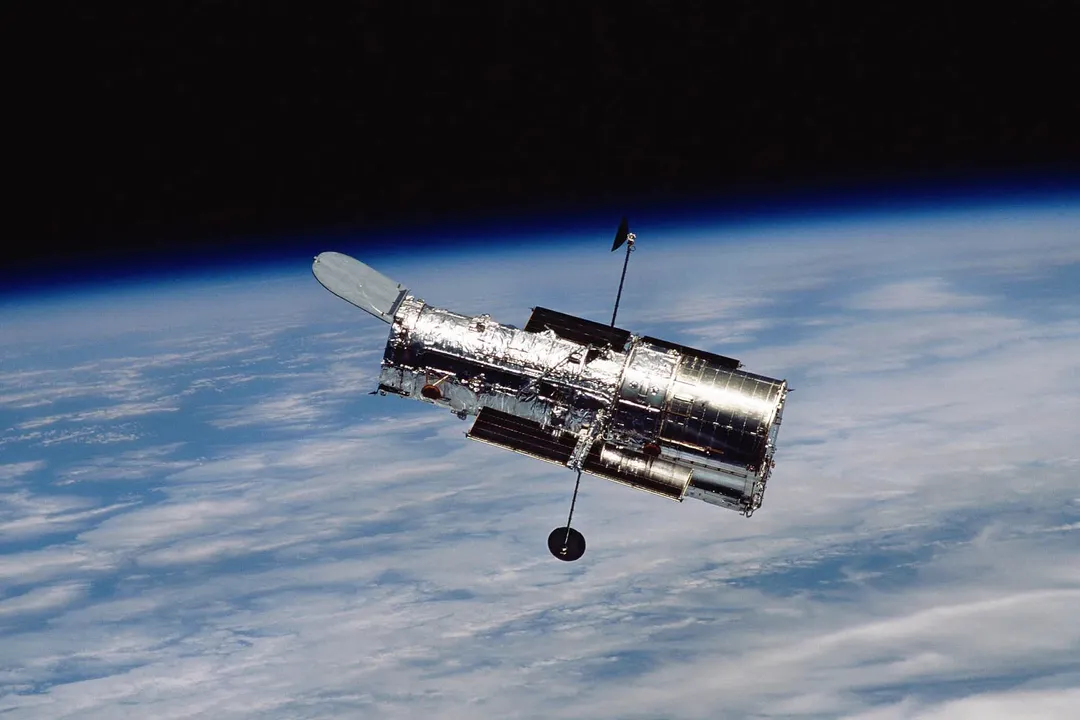
While ground-based telescopes pushed the limits of mirror and lens technology, the next great leap involved escaping the planet altogether. Earth’s atmosphere is a significant barrier to pristine observation. The shifting pockets of air cause the familiar twinkling effect, which blurs images captured from the ground, regardless of mirror size. Furthermore, the atmosphere blocks certain wavelengths of light entirely, blinding ground-based instruments to portions of the electromagnetic spectrum vital for understanding cosmic processes.
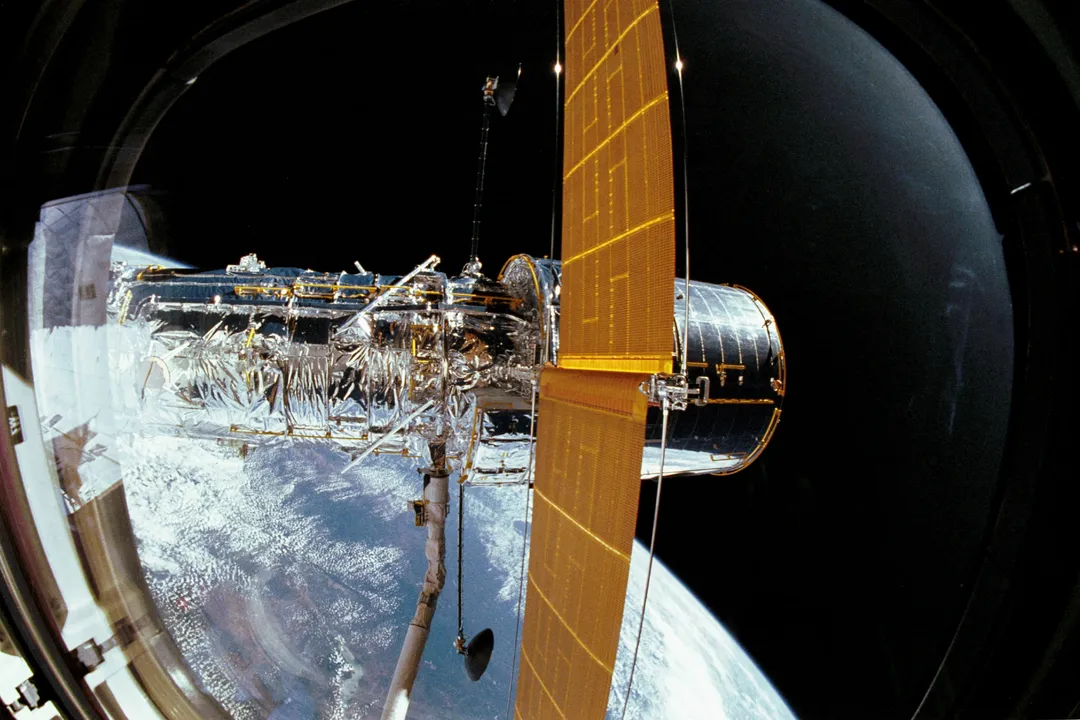
The Hubble Space Telescope, launched in 1990 and orbiting about 300 miles above the surface, was specifically designed to overcome these terrestrial limitations. Its primary advantages stem from its vantage point:
- Distortion-Free View: By operating above the atmosphere, Hubble captures steady, unwavering light, achieving significantly higher resolution than ground-based counterparts.
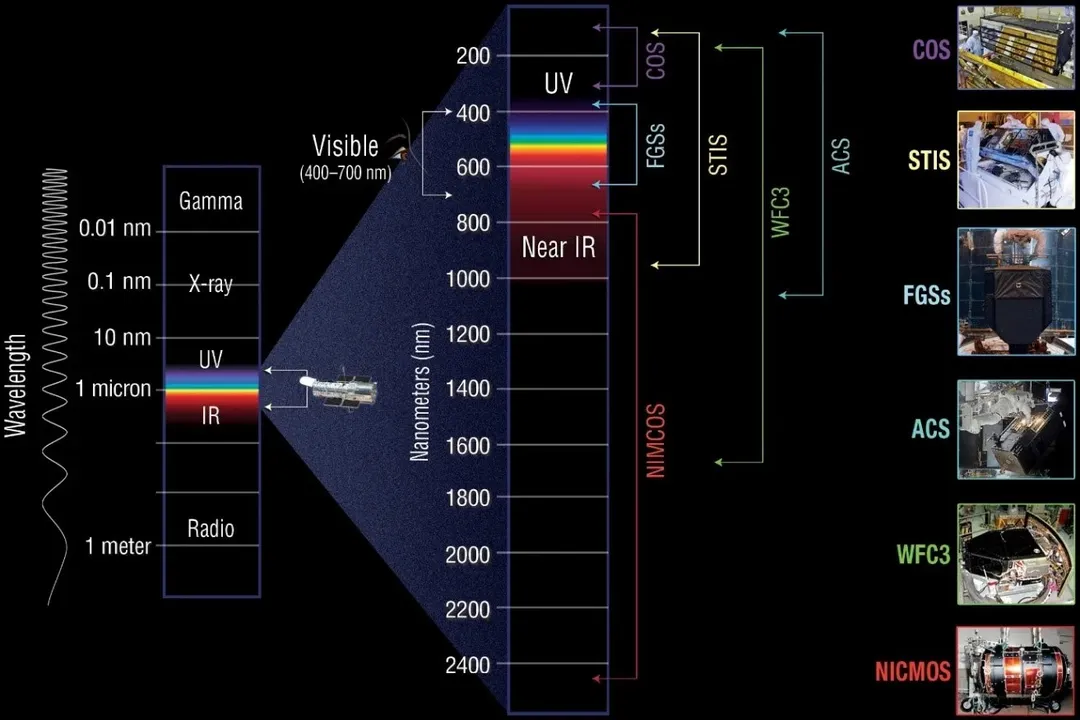
- Wavelength Coverage: It observes ultraviolet and infrared light, in addition to visible light, capturing details invisible from Earth.
- Dark Skies: It avoids light pollution and weather, allowing it to see objects 10 times fainter than what the largest ground telescopes can detect.
- Serviceability: Its low-Earth orbit allowed astronauts to visit and repair it through five servicing missions, keeping the technology continually updated over more than three decades.
Hubble's ability to stare at a single point in the sky for days allowed it to capture "deep fields," revealing the universe as it existed billions of years ago—a form of near time travel to the dawn of cosmic structure.

# Enduring Scientific Payoff
The telescope, from Galileo's 30-power instrument to the Hubble, has been instrumental in expanding our cosmological map, showing us where we really fit. Hubble’s work alone has led to over 21,000 peer-reviewed science papers. Key scientific results focus on answering profound questions: determining the age of the universe, exploring dark matter, and charting the formation of galaxies, such as seeing the light from galaxy GN-z11, which traveled 13.4 billion years to reach us. The sheer volume of discovery generated by this single platform demonstrates a shift in how high-level science is conducted; unlike Galileo, whose discoveries were centralized around his own observations, modern instruments facilitate a broad, global research community—scientists from 41 countries have won observing time on Hubble. This distributed, data-driven approach contrasts with the singular genius model of the 17th century.
Beyond pure science, the technological innovations required to keep a complex instrument like Hubble functional have provided concrete benefits back on Earth. The mirror-polishing techniques used for high-quality optics inspired tools that sharpened the skates of U.S. Olympic speed skaters. More significantly, this same high-tech mirror processing has been adapted for use in clinical settings, such as a new breast biopsy system. Furthermore, the methods developed for servicing Hubble in a zero-gravity, airless environment have influenced how humans work in space, leading to standardizing tools like the Pistol Grip Tool for astronaut use.
Looking forward, the telescope's impact continues to fuel grander pursuits. The very technologies initially focused on pure astronomy have often found terrestrial applications: radio telescopes, for example, trace origins to military projects, while the spirit of discovery inspires modern innovators. Philanthropists like Paul Allen and Elon Musk cite their childhood wonder inspired by space exploration as motivation for later technological ventures. Today's astronomers using newer, better instruments still face fundamental questions that remain unanswered: What is Dark Matter? What is Dark Energy? Are there other universes? And crucially, are planets like Earth common, and do they host life? The telescope began by showing us our place in the solar system, and it continues today by defining the limits of what we can even imagine asking about reality itself.
# Cultural Echoes
The impact of the telescope is also deeply etched into our collective culture. When Galileo shared his drawings of the Moon, he presented a visual language that contradicted millennia of accepted thought, aided by his Renaissance art training in using chiaroscuro (light and shadow) to depict topography. In the centuries that followed, the vastness revealed by the telescope birthed entirely new genres, such as science fiction, exemplified by Francis Godwin’s The Man in the Moon in 1638.
Today, modern telescopes like Hubble have become fixtures in popular culture, appearing on stamps, in films, and inspiring art exhibitions like "Mapping the Cosmos" at the Walters Art Museum. The visually stunning images, even challenging to experience for the visually impaired, are made accessible through specialized tactile books like "Touch the Universe". The instrument has moved from being a purely scientific apparatus to a cultural touchstone representing human curiosity and aspiration. The telescope's greatest overall contribution, then, is arguably the sustained public imagination it captures, driving interest in STEM fields and securing the funding necessary for the next generation of observational technology.
Related Questions
#Citations
Why Have a Telescope in Space? - NASA Science
Galileo and the Telescope | Modeling the Cosmos | Digital Collections
The Telescope – Science Technology and Society a Student Led ...
Q and A of the Day: How Have Telescopes Changed Things?
How the Telescope Revolutionized Our World and Ignited…
The Telescope – Science, Technology, & Society: A Student-Led ...
The Telescope & the Scientific Revolution